Guide
What foundation does a bollard need?
Root-fixed, base-plated, socketed and shallow-mount bollard foundations explained, with rated foundation classes, curing, buried services and CDM.
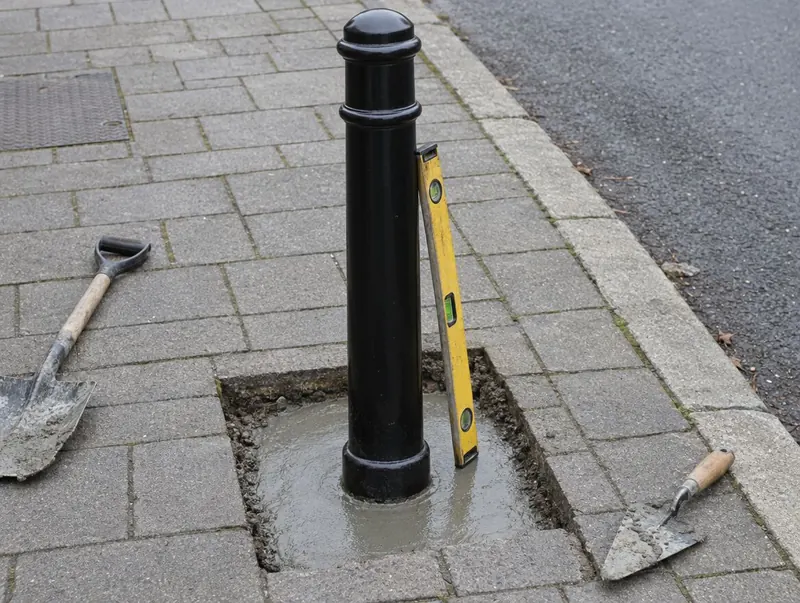 Computer-generated image
A bollard's foundation is whatever holds it in place: concrete around a buried root on a root-fixed post, anchors through a plate on a base-plated post, a socket or cassette cast into concrete for removable and telescopic posts, or an engineered foundation for a crash-rated bollard. The right one depends on the bollard's job, the ground and what lies beneath it. For a rated bollard the foundation is part of the tested product, so the rating only holds if it is installed to the foundation design it was tested with.
What are the main types of bollard foundation?
There are three everyday types, plus engineered foundations for rated bollards.
| Type | How it is held | Typical use | Watch for |
|---|---|---|---|
| Root-fixed | Post extends below ground, set in concrete | Fixed steel, cast iron, timber and ram-raid posts | Buried services; drainage at the base |
| Base-plated or resin-anchored | Plate fixed with resin or through-anchors | Warehouse slabs, decks, fold-down posts | Slab thickness, strength and edge distances |
| Socket or cassette | Steel socket or cassette cast into concrete | Removable, telescopic and semi-automatic posts | Depth and drainage, especially telescopic |
| Shallow-mount (rated) | Engineered shallow foundation to the tested design | Security lines over buried services | Must match the tested detail |
| Deep rated | Reinforced foundation to the tested design | Crash-rated static and automatic bollards | Excavation volume, services and cost |
Should a bollard be root-fixed or bolted down?
Root-fix it if you can dig, and bolt it down if you can't. A root-fixed post uses the surrounding concrete and ground to resist a knock and is the normal choice for fixed external posts. A base-plated post is quicker, needs no excavation and can be moved later, but every load goes through the anchors into the slab, so it is only as strong as the concrete beneath. Tarmac and block paving don't hold anchors well, so a small concrete pad is cut in first. On car park decks, podium slabs and heated floors, drilling must not hit reinforcement, tendons, membranes or heating, so the slab is scanned and the building owner consulted before any hole is made.
What do the rated foundation classes mean?
They describe how a crash-rated bollard was fixed when it was tested. Under ISO 22343-1 (Frontier Pitts summary):
- Class A: freestanding
- Class Ap: surface mounted and pinned or bolted
- Class B: less than 0.5 m deep
- Class C: more than 0.5 m deep
The NPSA list records a foundation depth for each rated product, and Secured by Design says the listed standards depend on correct installation, so we build rated foundations to the manufacturer's drawings and nothing else. TAL 1/11 also warns that later street works can damage a structural foundation and compromise the barrier, which is why rated foundations in the highway should go on the authority's asset register.
How long does bollard concrete take to cure?
As long as the manufacturer or concrete specification says, which ranges from hours for a rapid-setting mix around a light post to several days for a structural pour. Cold weather slows curing and frost can damage fresh concrete, so winter pours need protecting. Until the concrete has gained enough strength, the post is taped or coned off, and a telescopic or removable post is not used. Rated foundations come with a specified concrete strength and curing period before the bollard can be relied on, and we follow it.
How do you avoid hitting buried services?
By planning the dig, locating services and excavating carefully, the three parts of a safe system in HSE's HSG47, Avoiding danger from underground services. HSG47 says:
- plans alone are not enough and shouldn't be relied on for distances or depths
- use a locator, with a signal generator wherever possible, because they greatly increase accuracy
- people using locators need thorough training
- mark services on the ground, and use trial holes to confirm a service and its depth
- keep power tools at least 500 mm from the indicated line of a service where practicable
- re-scan frequently as the dig goes deeper
LinesearchbeforeUdig is a free online service for requesting utility owners' plans. It says it has over 160 member asset owners covering more than 60% of Great Britain's utility infrastructure, so it is a useful start, but it is not a complete search and doesn't replace locating on site.
What are my CDM duties as the client?
That depends on whether the work is for a business or your own home. Commercial clients carry the CDM 2015 client duties in full: make suitable arrangements and allow enough time and resources, provide pre-construction information, make sure a construction phase plan exists before work starts, and make sure welfare is provided. Where more than one contractor is involved, the client must appoint a principal designer and a principal contractor. A project must be notified to HSE if it lasts more than 30 working days with more than 20 workers at once, or exceeds 500 person-days; most bollard jobs are well below that, but the other duties still apply.
For domestic clients, the client duties pass to the contractor, or to the principal contractor where there is more than one. In Northern Ireland the CDM (NI) Regulations 2016 work the same way, with notification to HSENI. Useful pre-construction information for a bollard job includes service drawings, slab details and anything known about the ground.
How does the foundation affect price and programme?
The foundation is often the main cost. Break-out and reinstatement add £40–£150 per post on block paving or slabs and £60–£250 for core drilling concrete, and taking out an old post and footing adds £80–£345, all plus VAT. For crash-rated bollards, the tested foundation is usually a bigger cost than the post. At the free survey we locate services, dig trial holes where needed and agree the foundation type before giving a fixed written quote, and installation crews working under our management build it to that detail.
Prepared by the Bollard Installers team · Last reviewed 01 November 2026 · Prices and rules change; check the rules pages and your written quote.
Questions
How deep does a bollard foundation need to be?
It depends on the product. Removable sockets are often a few hundred millimetres deep, telescopic cassettes around a metre or more, and rated bollards follow their tested class, either side of 0.5 m.
Can bollards be fixed to a car park deck or over a basement?
Usually with base-plated or shallow-mount products, once the building owner or a structural engineer has confirmed what the slab can take and where it is safe to drill. Decks can contain reinforcement, tendons or membranes that must not be damaged.
Is an LSBUD search enough before digging?
No. LSBUD is a useful free plan request, but it is not a complete search. HSG47 expects services to be located on site, marked and confirmed with trial holes.
Can a new bollard go in an old foundation?
Sometimes, if the old footing or socket is sound and suits the new post, and like-for-like replacements are often fitted that way. A crash-rated bollard always needs its own tested foundation.
What happens to the foundation when a bollard is removed?
The footing is broken out below the surface, the hole backfilled and the surface made good, typically £80–£345 per post plus VAT. Large reinforced security foundations are priced separately after survey.
Related services
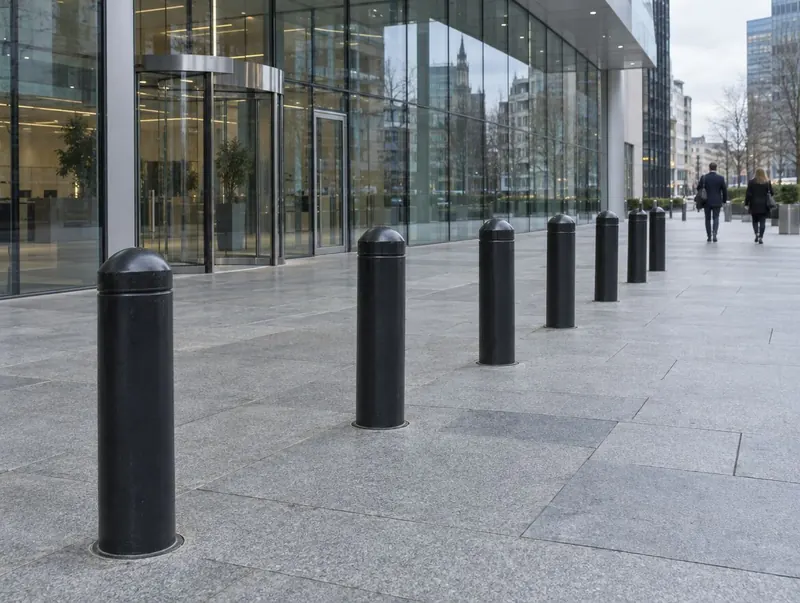
Crash-rated (HVM) bollards
Installation of impact-tested HVM bollards rated to ISO 22343-1 (or the superseded, still-accepted PAS 68 / IWA 14-1) on the tested foundation.
Learn more →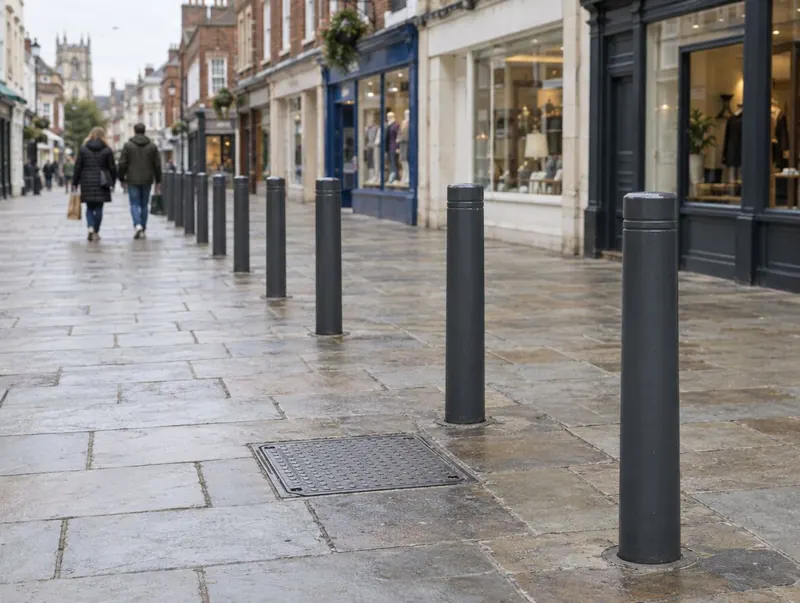
Shallow-mount security bollards
Rated shallow-foundation bollard systems installed where buried services, basements or slabs rule out deep excavation.
Learn more →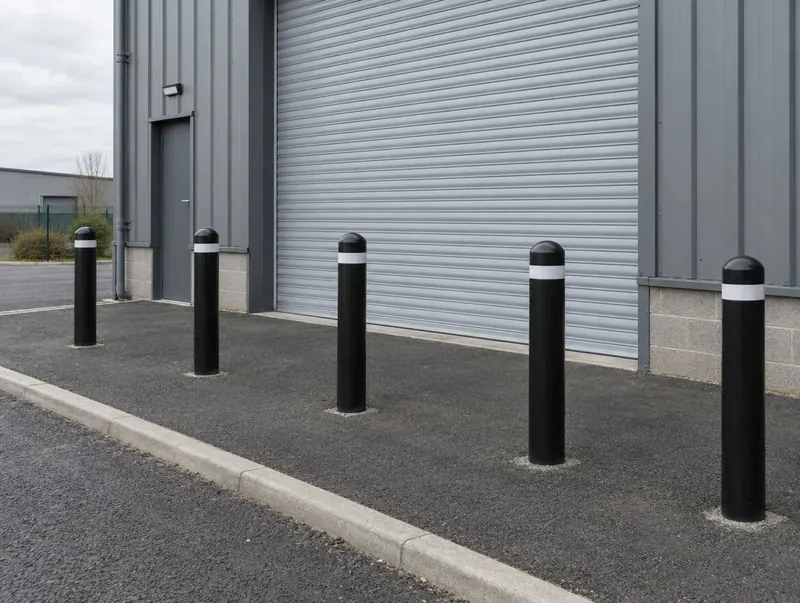
Steel security bollards (unrated)
Concrete-filled steel bollards, root-fixed or base-plated, for car parks, forecourts, boundaries and nuisance vehicle control.
Learn more →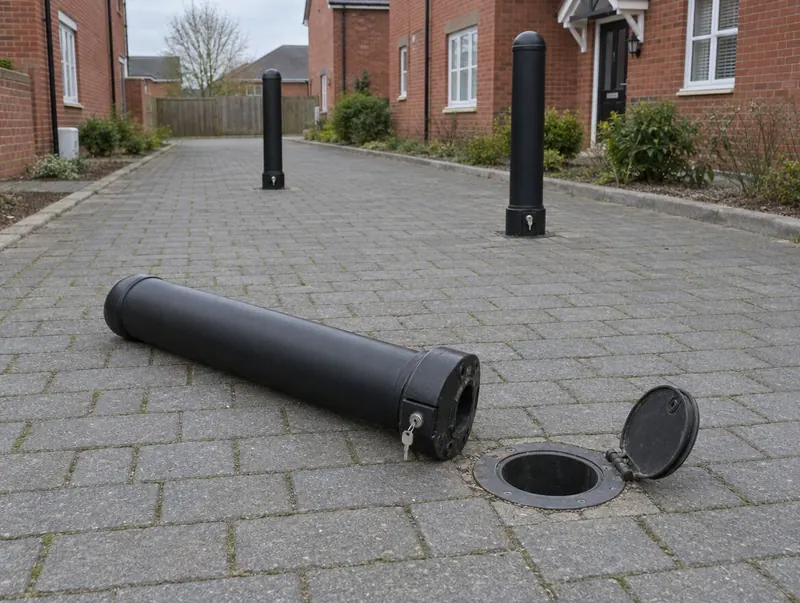
Removable bollards
Lift-out bollards in lockable ground sockets for driveways, delivery routes, access roads and emergency access points.
Learn more →