Security & anti-ram
Ram-raid protection bollards
Bollards fitted in front of shopfronts, ATMs, jewellers and convenience stores to stop vehicles being used to break in.
- Typically £395–£1,495 per bollard + VAT; minimum job £945
- Free survey and fixed written quote
- Foundations and reinstatement included
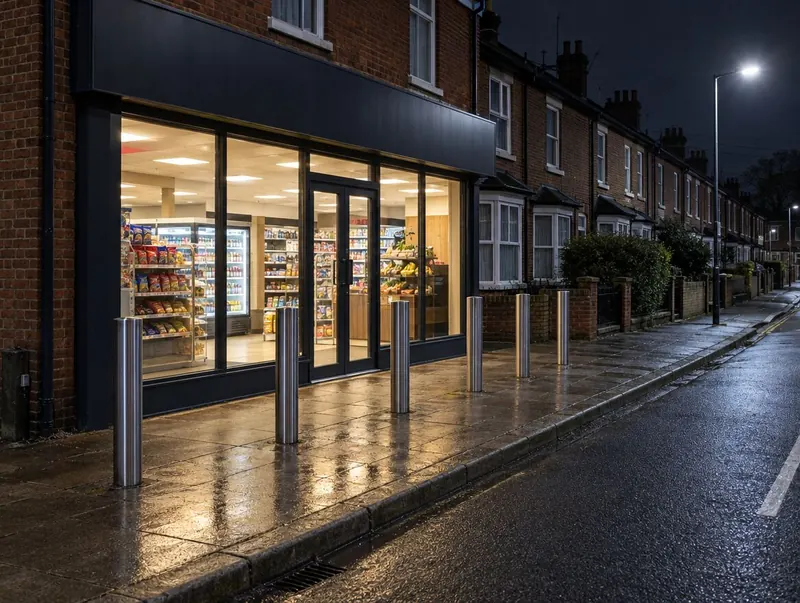 Computer-generated image
What is it?
What are ram-raid protection bollards?
Ram-raid bollards are heavy-duty posts set in front of a shopfront, ATM or entrance to stop a vehicle being reversed or driven through it to gain entry or rip out a cash machine. They range from deep-founded, concrete-filled steel posts to products tested under PAS 170-1 or full crash standards. Their job is to keep a vehicle back from the glazing or wall, close enough together that a car cannot pass between them.
Ram raids are short, violent and often repeated at the same premises. A stolen car or van is reversed into a shop door, a forecourt kiosk or an ATM surround, sometimes with towing gear to drag a machine out. The damage to the building and the time a shop is closed afterwards usually cost far more than the stock taken. Bollards set a fixed physical stand-off, so a vehicle never reaches the frontage.
We install ram-raid bollards for shops, pharmacies, jewellers, convenience stores, filling stations and bank branches, using installation crews working under our management. Because shopfronts usually sit on or next to a public footway, much of the planning is about ownership, consent and keeping the pavement usable, as well as choosing a post that will genuinely stop a vehicle.
Where ram-raid bollards make sense
- Convenience stores and off-licences with glazed frontages
- Jewellers, pawnbrokers and phone shops holding high-value stock
- Through-the-wall and freestanding ATMs
- Filling station kiosks and forecourt shops
- Pharmacies and late-opening premises
- Warehouses and trade counters with roller-shutter entrances
- Premises that have already been targeted once
How it works
A ram raid tends to happen at low to moderate speed over a short distance, because the vehicle is usually reversed off the road or forecourt. That makes the depth and mass of the foundation more important than the height of the post. A typical unrated ram-raid bollard is a thick-walled steel tube, filled with concrete and set deep into a reinforced base, so it resists being pushed over or snapped off at ground level.
Where an insurer, landlord or security adviser asks for tested performance, there are two routes. PAS 170-1 covers products tested against low-speed vehicle impacts, which closely matches the way many ram raids are carried out. Full crash-rated products tested to IWA 14-1, ISO 22343-1 or PAS 68 suit higher-risk premises or longer run-ups. Rated products must be installed to the tested foundation design.
Placement matters as much as strength. Posts usually sit a short distance in front of the glazing and close enough together to stop a car passing between them, while leaving room for customers, wheelchairs and buggies. At ATMs, posts are set to protect the machine surround and the wall either side, where towing chains are often attached.
Options and finishes
| Option | Detail |
|---|---|
| Concrete-filled steel posts | Thick-walled steel tube root-fixed in a deep reinforced base. The usual unrated choice for shopfronts and ATMs. |
| PAS 170-1 tested bollards | Tested against low-speed vehicle impacts and suited to ram-raid risks where a tested product is requested. |
| Crash-rated bollards | Tested to IWA 14-1, ISO 22343-1 or PAS 68 for high-value premises or where a vehicle could build up speed. |
| Removable posts | Lockable removable positions allow deliveries, shopfitting or shutter maintenance without leaving the frontage open permanently. |
| Stainless or decorative covers | Covers over steel cores for shopping streets and branded frontages where plain steel would look out of place. |
| Reflective and contrasting bands | Bands near the top help pedestrians, including partially sighted people, see the posts on a busy pavement. |
Typical specification
| Item | Typical |
|---|---|
| Typical post | Concrete-filled steel tube, often 140–219 mm diameter |
| Exposed height | Typically 900–1,000 mm |
| Foundation | Deep reinforced base for unrated posts; tested design for rated ones |
| Gap between posts | Usually around 1,000–1,200 mm clear |
| Stand-off from glazing | Set on site to suit the pavement and frontage |
| Tested options | PAS 170-1 for low-speed impacts; IWA 14-1, ISO 22343-1 or PAS 68 |
| Finish | Galvanised and powder-coated, or stainless cover |
Typical values only — the survey and the product's data sheet set the final specification.
How we install it
Look at how a vehicle would approach
At the free site survey we look at where a vehicle could reverse from, the kerb line, the forecourt and the frontage construction. Ownership of the pavement in front of the shop is checked at the same time.
Agree the post type and positions
We agree unrated or tested posts with you, your landlord and any insurer or security adviser involved. A fixed written quote sets out the positions, foundations and reinstatement.
Arrange consents
If the posts will stand on public highway, the highway authority's agreement is needed before work starts. Landlord consent is usually needed for leased units.
Excavate and set the posts
Each position is hand-dug near services and taken to depth, then the post is set plumb in a reinforced concrete base. Work is planned around trading hours where possible.
Reinstate the pavement
Paving, tarmac or forecourt concrete is made good flush with the base of each post, leaving no trip edges.
Ground, foundations and buried services
Shopfronts often sit over cellars, coal holes, vaults and service entries, so what lies under the pavement can be more complicated than it looks. Shop forecourts may be thin concrete over old fill, and filling station forecourts carry fuel lines, tank vents and interceptors that must be located precisely before anything is dug. Deep foundations need care near the building's own footings and basement walls. We hand-dig near known services, adjust positions if a vault or duct is found, and reinstate the surface to match, whether that is slabs, block paving, asphalt or a sealed forecourt finish.
Rules and checks before you order
- Check who owns the ground in front of the shop; if it is public highway, the highway authority's agreement is needed.
- Ask your landlord, and check any lease restrictions on alterations to the frontage.
- Leave clear gaps for wheelchairs and buggies, typically at least 1,000 mm, and keep the footway width usable, referring to Inclusive Mobility guidance.
- In conservation areas or on listed buildings, ask the local planning authority whether consent is needed.
- If an insurer has asked for protection, confirm what standard or product they expect before ordering.
See rules and standards by nation for highway consent, accessibility and security standards.
Maintenance
Ram-raid bollards are robust but not maintenance-free. Check them after any knock, because a post that has been hit may have cracked its foundation even if it still looks straight. Keep visibility bands clean, repaint chips before rust sets in on steel, and keep locks on removable posts lubricated so staff can actually use them. If you have been raided despite having bollards, look again at the positions and gaps, because offenders tend to aim at any weak point.
What affects the price
- Unrated, PAS 170-1 or crash-rated product
- Number of posts across the frontage or ATM
- Foundation depth and what is found under the pavement
- Removable positions and their locks
- Covers and finishes for shopping streets
- Out-of-hours working to avoid closing the shop
- Reinstatement of forecourt or natural stone surfaces
Guide prices: ram-raid bollards
Three typical specifications. The middle one is the specification we usually recommend for durability and visibility.
Standard
per bollard + VAT
- Standard post or product for the type
- Foundation and fixing to manufacturer's details
- Surface reinstated to match
Upgraded
per bollard + VAT
- Upgraded finish (RAL colour, stainless or sleeve)
- Retroreflective band and matched keys
- Everything in Standard
Premium
per bollard + VAT
- Heavy-duty or architectural specification
- Premium finish and fittings
- Everything in Upgraded
Guide prices for the UK base region; local pages adjust for your area. Per bollard, supplied and installed. Minimum job £945 + VAT. Your fixed price comes in writing after survey.
Ram-raid bollards: questions answered
How much does ram-raid protection bollards cost?
Typically £395–£1,495 per bollard, supplied and installed, plus VAT. Small jobs carry a minimum charge of £945 plus VAT. Ground conditions, access, buried services and consents move the figure; the fixed price comes in writing after survey.
How many bollards does a shopfront need?
Enough to leave no gap a car could pass through across the vulnerable part of the frontage. For a typical small shop that is often three to five posts, but it depends on the frontage width and where a vehicle could approach from. The survey sets the number.
Will bollards stop an ATM being ripped out?
Correctly placed bollards stop a vehicle getting close enough to attach chains or ram the surround. They work alongside the machine's own anchoring and the bank's security measures. Positions need to cover the wall either side of the ATM as well as the front.
What is PAS 170-1 and do I need it?
PAS 170-1 is a standard for testing vehicle security barriers against low-speed impacts. It suits ram-raid risks where someone has asked for tested performance, such as an insurer or security adviser. If nobody has asked for a tested product, a well-founded unrated post is often adequate.
Can bollards go on the pavement outside my shop?
Only if you own the ground or have the highway authority's agreement. Many shop frontages include a strip of private forecourt, which is simpler. We check ownership as part of the survey.
Can we still take deliveries through the front?
Yes, if one or more positions are removable. Staff unlock and lift out the post for deliveries, then refit it. The socket is designed to sit flush when the post is out.
Will bollards spoil the look of the shop?
They change the frontage, but stainless or powder-coated finishes in shopfront colours can make them look deliberate rather than defensive. Many shopping streets already have similar posts, so new ones can be matched to what is there.
Related bollard services
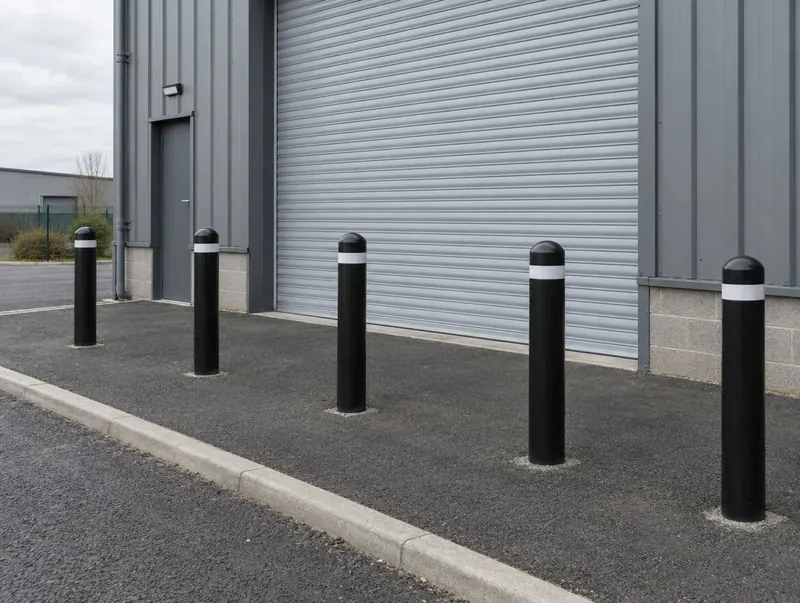
Steel security bollards (unrated)
Concrete-filled steel bollards, root-fixed or base-plated, for car parks, forecourts, boundaries and nuisance vehicle control.
Learn more →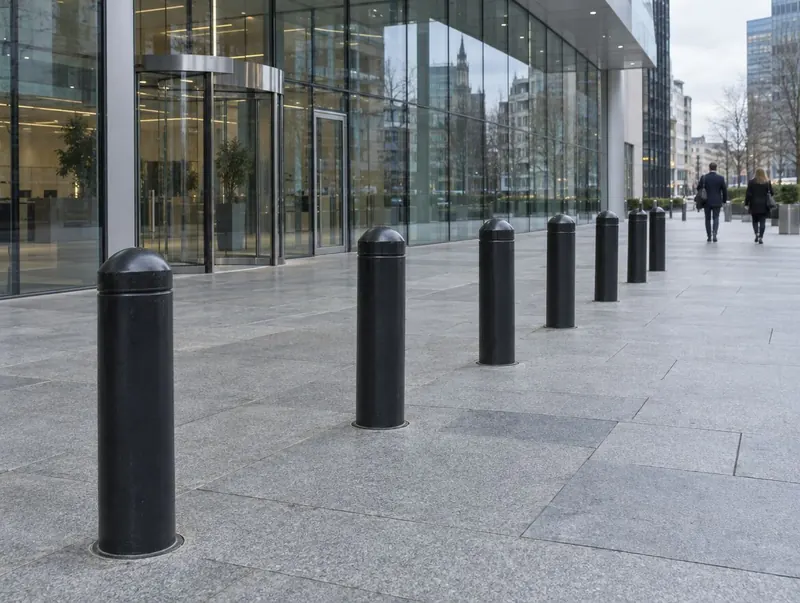
Crash-rated (HVM) bollards
Installation of impact-tested HVM bollards rated to ISO 22343-1 (or the superseded, still-accepted PAS 68 / IWA 14-1) on the tested foundation.
Learn more →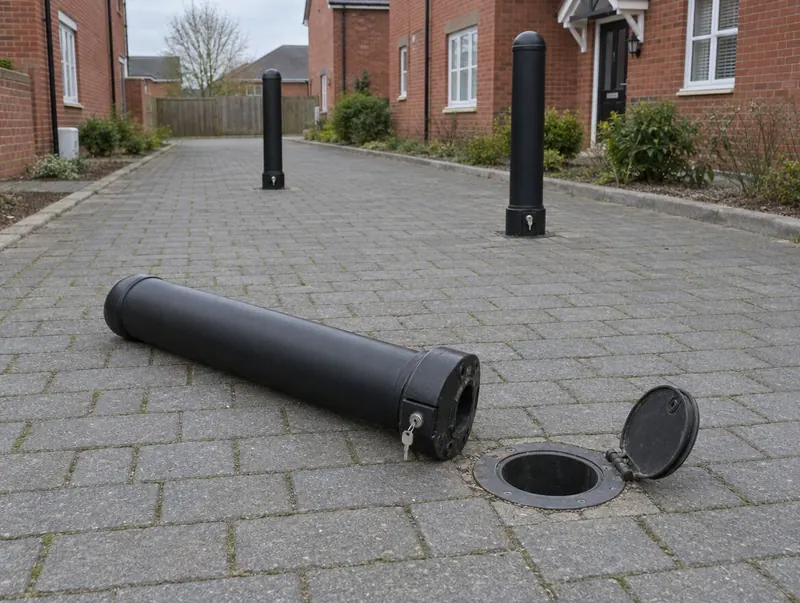
Removable bollards
Lift-out bollards in lockable ground sockets for driveways, delivery routes, access roads and emergency access points.
Learn more →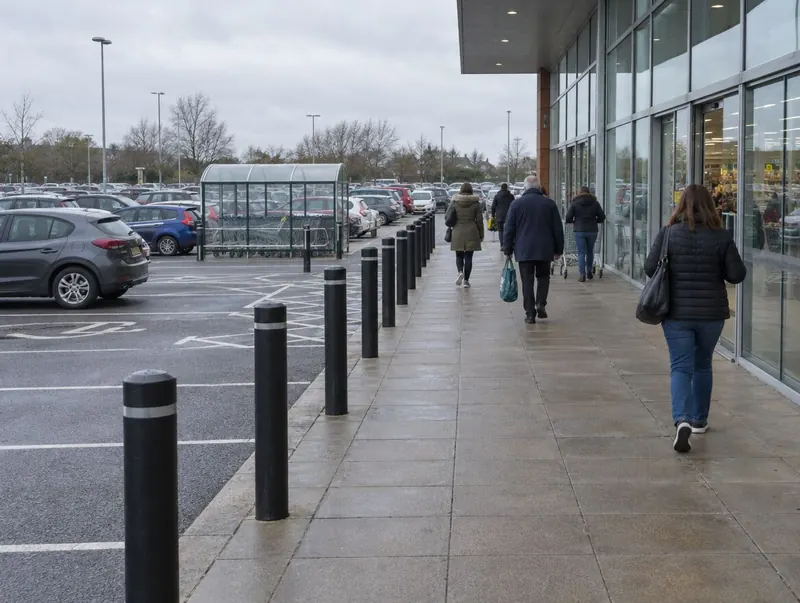
Pedestrian and shopfront protection bollards
Bollards that separate people from vehicles at car parks, forecourts, walkways, drive-thrus and shop entrances.
Learn more →Ram-raid bollards near you
Local pages show the highway authority, postcodes covered and regional prices.
- Bedfordshire
- Berkshire
- Bristol
- Buckinghamshire
- Cambridgeshire
- Cheshire
- Cornwall
- County Durham
- Cumbria
- Derbyshire
- Devon
- Dorset
- East Riding of Yorkshire
- East Sussex
- Essex
- Gloucestershire
- Greater Manchester
- Hampshire
- Herefordshire
- Hertfordshire
- Isle of Wight
- Kent
- Lancashire
- Leicestershire
- Lincolnshire
- London
- Merseyside
- Norfolk
- North Yorkshire
- Northamptonshire
- Northumberland
- Nottinghamshire
- Oxfordshire
- Rutland
- Shropshire
- Somerset
- South Yorkshire
- Staffordshire
- Suffolk
- Surrey
- Tyne and Wear
- Warwickshire
- West Midlands
- West Sussex
- West Yorkshire
- Wiltshire
- Worcestershire
- Blaenau Gwent
- Bridgend
- Caerphilly
- Cardiff
- Carmarthenshire
- Ceredigion
- Conwy
- Denbighshire
- Flintshire
- Gwynedd
- Isle of Anglesey
- Merthyr Tydfil
- Monmouthshire
- Neath Port Talbot
- Newport
- Pembrokeshire
- Powys
- Rhondda Cynon Taf
- Swansea
- Torfaen
- Vale of Glamorgan
- Wrexham
- Aberdeen City
- Aberdeenshire
- Angus
- Argyll and Bute
- City of Edinburgh
- Clackmannanshire
- Dumfries and Galloway
- Dundee City
- East Ayrshire
- East Dunbartonshire
- East Lothian
- East Renfrewshire
- Falkirk
- Fife
- Glasgow City
- Highland
- Inverclyde
- Midlothian
- Moray
- North Ayrshire
- North Lanarkshire
- Perth and Kinross
- Renfrewshire
- Scottish Borders
- South Ayrshire
- South Lanarkshire
- Stirling
- West Dunbartonshire
- West Lothian
- Antrim and Newtownabbey
- Ards and North Down
- Armagh City, Banbridge and Craigavon
- Belfast
- Causeway Coast and Glens
- Derry City and Strabane
- Fermanagh and Omagh
- Lisburn and Castlereagh
- Mid Ulster
- Mid and East Antrim
- Newry, Mourne and Down