Traffic & site protection
Concrete bollard installation
Precast concrete and reconstituted stone bollards for public realm, parks, boundaries and estates, dowelled or bedded in place.
- Typically £175–£595 per bollard + VAT; minimum job £595
- Free survey and fixed written quote
- Foundations and reinstatement included
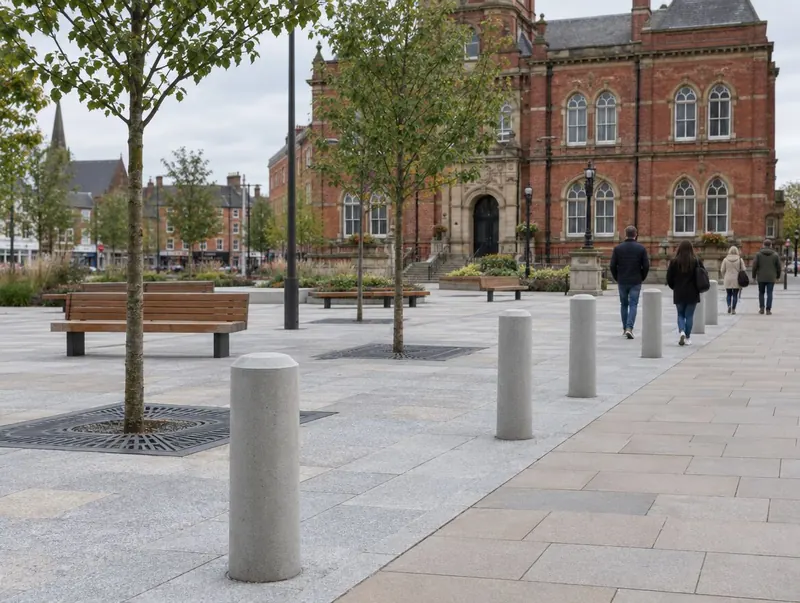 Computer-generated image
What is it?
What are concrete bollards?
A concrete bollard is a heavy precast post made from concrete or reconstituted stone, used to stop vehicles entering pedestrian spaces, verges and open land. Its weight and mass give it presence, and it is fixed by a steel dowel into a foundation, bedded in the ground, or in some cases simply placed. Finishes range from plain grey concrete to exposed aggregate and stone-effect surfaces that suit civic and landscaped settings.
Concrete bollards are the solid, low-maintenance choice for public spaces: town squares, park entrances, library and school forecourts, retail parks and the edges of open land where vehicles should not go. They do not rust or need painting, they are hard to steal or vandalise, and they suit landscape schemes where steel posts would look too utilitarian.
The main practical issue is weight. A single concrete bollard can weigh well over a hundred kilograms and larger ones several times that, so delivery, handling and setting all need lifting equipment and a plan. Our installation crews, working under our management, set concrete and stone bollards on proper foundations so they stay plumb and do not settle or rock.
Where concrete bollards make sense
- Town centre squares and pedestrianised streets
- Park entrances and greens where vehicles should not drive
- School, library and civic building forecourts
- Edges of open land and verges subject to unauthorised vehicle access
- Retail parks and landscaped car parks
- Housing estates and communal areas
- Rural and coastal sites where steel would corrode
How it works
Most concrete bollards are made in moulds in a factory, with steel reinforcement inside and a cast-in socket or protruding dowel at the base. On site, a small foundation is dug and concreted, with a hole or sleeve left for the dowel, and the bollard is lowered onto a mortar bed with the dowel grouted in. That holds it against being pushed or rocked. Some designs have a root section that is buried in the ground instead.
Reconstituted stone is a concrete made with crushed natural stone and a surface treatment that gives it the look of Portland, York or granite. It costs less than natural stone and is more consistent in colour. Exposed aggregate, acid-etched and shot-blasted finishes give texture and help hide weathering. Colour and texture vary slightly between production batches, so bollards for one scheme should be ordered together, and spares for future replacements are worth considering at the same time.
Weight helps a concrete bollard deter vehicles, but an untested concrete post is not crash-rated. When struck hard it can chip, crack or shear at the dowel. Some precast products have been crash-tested, often with steel cores or special foundations, and these are the only concrete bollards that should be relied on for security.
Options and finishes
| Option | Detail |
|---|---|
| Precast concrete | Grey or coloured concrete in round, square, tapered or domed shapes, the economical public realm option. |
| Reconstituted stone | Crushed natural stone in a concrete mix, giving a Portland, buff or granite-like appearance for civic and heritage settings. |
| Surface finishes | Smooth, exposed aggregate, acid-etched or shot-blasted, chosen to suit paving and resist visible weathering. |
| Dowel-fixed or root-set | Dowels grouted into a foundation for most installations; root-set posts buried in the ground on softer sites. |
| Reflective and contrasting details | Inset reflective bands, contrasting tops or rings for visibility to drivers and partially sighted pedestrians. |
| Planters and blocks | Concrete planters and seating blocks used in place of bollards where a softer look is wanted. |
Typical specification
| Item | Typical |
|---|---|
| Height | Typically 500–1,000 mm |
| Diameter or width | Commonly 250–500 mm |
| Weight | Often well over 100 kg each; larger units much more |
| Fixing | Steel dowel grouted into a concrete foundation, or buried root |
| Handling | Vacuum lifter, crane arm or lifting attachment |
| Finish | Smooth, exposed aggregate, etched or stone-effect |
| Rating | Untested unless the product has its own crash test |
Typical values only — the survey and the product's data sheet set the final specification.
How we install it
Survey and choose
A free site survey looks at the setting, ground, delivery access and where a lifting vehicle can stand. You receive a fixed written quote with the product, finish and fixing.
Plan lifting
Each bollard's weight is checked, and a lifting method is chosen, such as a vacuum lifter or crane arm, with an exclusion zone set during lifts.
Excavate and cast foundations
Small foundations are excavated, checked for services and cast with a dowel hole or sleeve at the right position and level.
Set the bollards
Each bollard is lowered onto a mortar bed with its dowel grouted in, checked plumb and aligned with its neighbours.
Reinstate and clean
Paving is made good around each base and the bollards are cleaned of mortar and handling marks.
Protect while the grout cures
Bollards are left undisturbed until the grout and foundation have gained strength, with temporary barriers if vehicles use the area. Lines that need to open to traffic quickly can use faster-setting grouts where the product allows.
Ground, foundations and buried services
Because concrete bollards are heavy, a weak foundation shows itself quickly as a tilt. Each post sits on a concrete base on firm ground, and on soft verges or made ground the base is deepened or widened to suit. Park and verge locations often have tree roots nearby, which need protecting and can push bollards over time if set too close. Services under footways are traced before excavation. Access for the lifting vehicle matters: soft grass, paving and kerbs can be damaged by an outrigger, so ground protection mats are often laid before lifting begins.
Rules and checks before you order
- Keep clear gaps of typically at least 1,000–1,200 mm where pedestrians pass, checking against Inclusive Mobility guidance.
- Use contrasting colours or bands so grey bollards stand out against grey paving.
- Plan lifts with an exclusion zone and suitable lifting equipment, and record the method for the site.
- On public highway or council land, agree positions and specification with the highway authority or landowner.
- Do not present untested concrete bollards as crash-rated protection.
See rules and standards by nation for highway consent, accessibility and security standards.
Maintenance
Concrete bollards need very little: occasional washing, removal of graffiti with suitable cleaners, and checks for chips, cracks and lean. Small chips can be repaired with a colour-matched mortar, but a bollard that has cracked through or sheared at the dowel needs replacing. In areas salted heavily in winter, check for surface spalling. If a line is regularly struck by vehicles, consider whether steel cores, a tested product or a different layout would suit better. Keep a note of the product name, finish and supplier, because matching a single damaged bollard years later is much easier when the original specification is known.
What affects the price
- Precast concrete or reconstituted stone
- Size, shape and surface finish
- Number of bollards
- Lifting equipment and access for delivery
- Foundation depth and ground conditions
- Reinstatement of paving or turf
Guide prices: concrete bollards
Three typical specifications. The middle one is the specification we usually recommend for durability and visibility.
Standard
per bollard + VAT
- Standard post or product for the type
- Foundation and fixing to manufacturer's details
- Surface reinstated to match
Upgraded
per bollard + VAT
- Upgraded finish (RAL colour, stainless or sleeve)
- Retroreflective band and matched keys
- Everything in Standard
Premium
per bollard + VAT
- Heavy-duty or architectural specification
- Premium finish and fittings
- Everything in Upgraded
Guide prices for the UK base region; local pages adjust for your area. Per bollard, supplied and installed. Minimum job £595 + VAT. Your fixed price comes in writing after survey.
Concrete bollards: questions answered
How much does concrete bollard installation cost?
Typically £175–£595 per bollard, supplied and installed, plus VAT. Small jobs carry a minimum charge of £595 plus VAT. Ground conditions, access, buried services and consents move the figure; the fixed price comes in writing after survey.
How heavy are concrete bollards?
Often well over a hundred kilograms each, and larger designs several times that. The exact weight depends on size and shape. It means they are delivered and set using lifting equipment rather than by hand.
Are concrete bollards anti-ram?
Only if that specific product has been crash-tested. Weight alone does not make a bollard crash-rated, and an untested concrete post can crack or shear when hit hard. Tested concrete-clad products exist for security use.
How are concrete bollards fixed down?
Usually with a steel dowel at the base grouted into a small concrete foundation, so they cannot be pushed or rocked. Some designs have a root buried in the ground instead. Free-standing placement is used only for temporary layouts.
Can a chipped concrete bollard be repaired?
Small chips and edge damage can be filled with colour-matched mortar. A bollard cracked through or broken at its base needs replacing. Matching finishes is easier if the original product is still made.
Should we use concrete or steel bollards?
Concrete suits landscaped and public spaces where appearance and low maintenance matter and where impacts are rare. Steel suits car parks and yards where knocks are frequent, because it bends rather than shatters. Many schemes use both in different places.
Can concrete bollards be moved later?
Yes, though it takes lifting equipment. Dowel-fixed bollards can be lifted off once the grout is broken out, and the foundation removed or reused. Plan for it if you think the layout may change.
Related bollard services
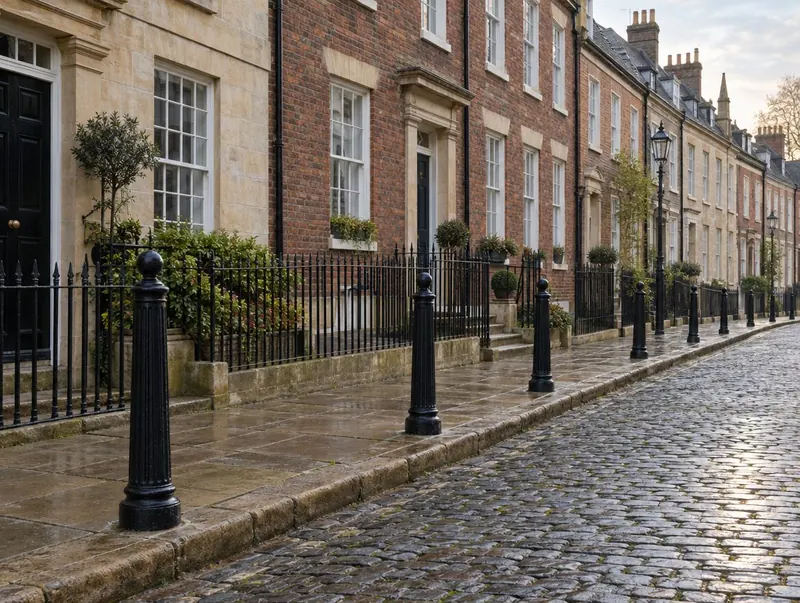
Cast iron and heritage bollards
Traditional cast and ductile iron bollards for conservation areas, period streets and historic estates, installed and reset.
Learn more →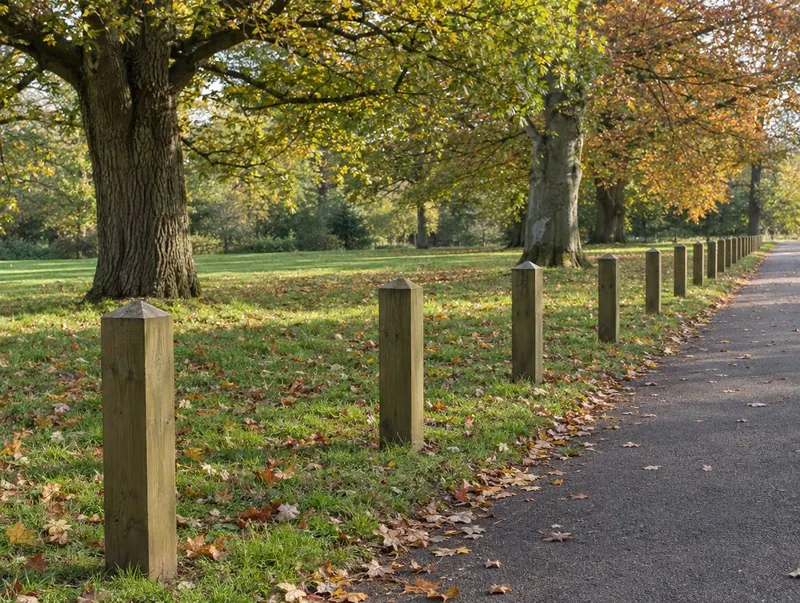
Timber bollards
Oak, hardwood and treated softwood bollards for parks, verges, rural sites, car parks and school frontages.
Learn more →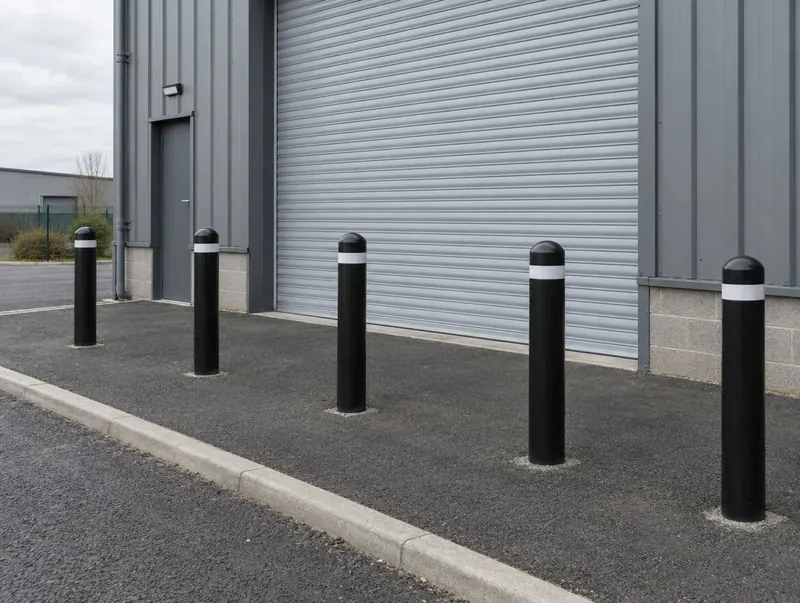
Steel security bollards (unrated)
Concrete-filled steel bollards, root-fixed or base-plated, for car parks, forecourts, boundaries and nuisance vehicle control.
Learn more →
Bollard removal
Removal of fixed, removable, telescopic and automatic bollards, including foundations, with the surface made good to match.
Learn more →Concrete bollards near you
Local pages show the highway authority, postcodes covered and regional prices.
- Bedfordshire
- Berkshire
- Bristol
- Buckinghamshire
- Cambridgeshire
- Cheshire
- Cornwall
- County Durham
- Cumbria
- Derbyshire
- Devon
- Dorset
- East Riding of Yorkshire
- East Sussex
- Essex
- Gloucestershire
- Greater Manchester
- Hampshire
- Herefordshire
- Hertfordshire
- Isle of Wight
- Kent
- Lancashire
- Leicestershire
- Lincolnshire
- London
- Merseyside
- Norfolk
- North Yorkshire
- Northamptonshire
- Northumberland
- Nottinghamshire
- Oxfordshire
- Rutland
- Shropshire
- Somerset
- South Yorkshire
- Staffordshire
- Suffolk
- Surrey
- Tyne and Wear
- Warwickshire
- West Midlands
- West Sussex
- West Yorkshire
- Wiltshire
- Worcestershire
- Blaenau Gwent
- Bridgend
- Caerphilly
- Cardiff
- Carmarthenshire
- Ceredigion
- Conwy
- Denbighshire
- Flintshire
- Gwynedd
- Isle of Anglesey
- Merthyr Tydfil
- Monmouthshire
- Neath Port Talbot
- Newport
- Pembrokeshire
- Powys
- Rhondda Cynon Taf
- Swansea
- Torfaen
- Vale of Glamorgan
- Wrexham
- Aberdeen City
- Aberdeenshire
- Angus
- Argyll and Bute
- City of Edinburgh
- Clackmannanshire
- Dumfries and Galloway
- Dundee City
- East Ayrshire
- East Dunbartonshire
- East Lothian
- East Renfrewshire
- Falkirk
- Fife
- Glasgow City
- Highland
- Inverclyde
- Midlothian
- Moray
- North Ayrshire
- North Lanarkshire
- Perth and Kinross
- Renfrewshire
- Scottish Borders
- South Ayrshire
- South Lanarkshire
- Stirling
- West Dunbartonshire
- West Lothian
- Antrim and Newtownabbey
- Ards and North Down
- Armagh City, Banbridge and Craigavon
- Belfast
- Causeway Coast and Glens
- Derry City and Strabane
- Fermanagh and Omagh
- Lisburn and Castlereagh
- Mid Ulster
- Mid and East Antrim
- Newry, Mourne and Down