England · 10 towns
Concrete bollard installation in Devon
Concrete bollards for sites across Devon: surveyed, quoted in writing and installed by our crews.
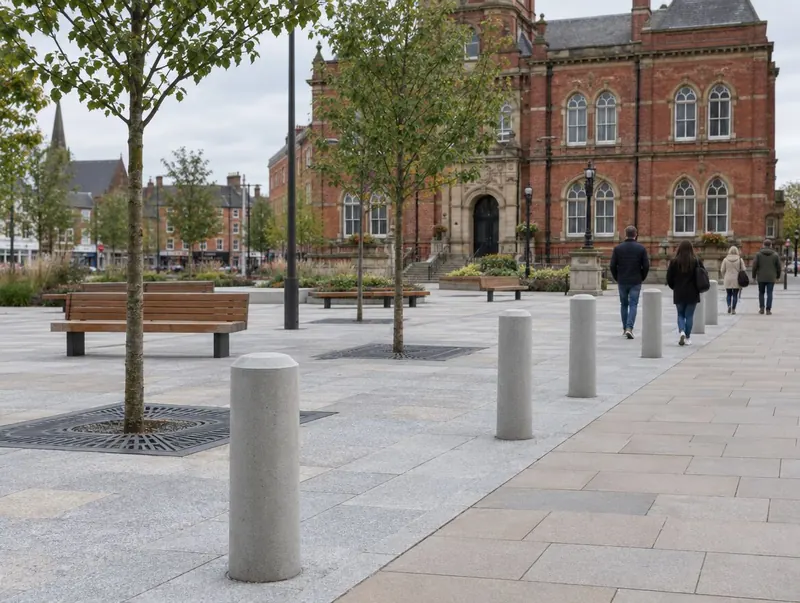 Computer-generated image
Concrete bollards in Devon
Across Devon, typical sites for concrete bollards include stadium approaches, city-centre plazas and pedestrianised streets. Precast concrete and reconstituted stone bollards for public realm, parks, boundaries and estates, dowelled or bedded in place.
Highway authorities for local roads in Devon: Devon County Council, Plymouth City Council and Torbay Council.
Choose your town in Devon
Guide prices in Devon
| Specification | Guide price | Includes |
|---|---|---|
| Standard | £175–£355 + VAT | Standard post, foundation, reinstatement |
| Upgraded | £305–£475 + VAT | Upgraded finish or fittings, reflective band, matched keys |
| Premium | £425–£595 + VAT | Heavy-duty or architectural spec, premium finish |
Per bollard, supplied and installed; no regional adjustment. Guide only — the fixed price follows a survey.
Who looks after the roads in Devon
| Town | Highway / roads authority | Planning authority |
|---|---|---|
| Plymouth | Plymouth City Council | Plymouth City Council |
| Exeter | Devon County Council | the council for Exeter |
| Paignton | Torbay Council | Torbay Council |
| Torquay | Torbay Council | Torbay Council |
| Newton Abbot | Devon County Council | the council for Teignbridge |
| Exmouth | Devon County Council | the council for East Devon |
| Barnstaple | Devon County Council | the council for North Devon |
| Bideford | Devon County Council | the council for Torridge |
| Plymstock | Plymouth City Council | Plymouth City Council |
| Tiverton | Devon County Council | the council for Mid Devon |
Rules for concrete bollards in England
Bollards on adopted highway are a matter for the highway authority under the Highways Act 1980, so they need its written agreement. On private land the owner's agreement is what matters; listed buildings and conservation areas need a word with the planning team first. Accessibility guidance asks for posts at least 1,000 mm high with contrasting tops and no chains between them.
Details and sources: bollard rules in England.
How installation works
Survey and choose
A free site survey looks at the setting, ground, delivery access and where a lifting vehicle can stand. You receive a fixed written quote with the product, finish and fixing.
Excavate and cast foundations
Small foundations are excavated, checked for services and cast with a dowel hole or sleeve at the right position and level.
Reinstate and clean
Paving is made good around each base and the bollards are cleaned of mortar and handling marks.
Protect while the grout cures
Bollards are left undisturbed until the grout and foundation have gained strength, with temporary barriers if vehicles use the area. Lines that need to open to traffic quickly can use faster-setting grouts where the product allows.
Concrete bollards in Devon: FAQs
Do you cover all of Devon for concrete bollards?
Yes — including Plymouth, Exeter, Paignton, Torquay, Newton Abbot, Exmouth, Barnstaple and Bideford. Enter your postcode in the price calculator to confirm.
How much do concrete bollards cost in Devon?
In Devon, typically £175–£595 per bollard, supplied and installed, plus VAT, with a minimum job of £595 plus VAT, using our South West guide prices. The fixed figure comes in writing after we've seen the site.
Who do I ask about bollards on public land in Devon?
For local roads, Devon County Council, Plymouth City Council and Torbay Council; National Highways covers motorways and trunk roads. Bollards on adopted highway need the highway authority's written agreement.
Can concrete bollards be moved later?
Yes, though it takes lifting equipment. Dowel-fixed bollards can be lifted off once the grout is broken out, and the foundation removed or reused. Plan for it if you think the layout may change.
How are concrete bollards fixed down?
Usually with a steel dowel at the base grouted into a small concrete foundation, so they cannot be pushed or rocked. Some designs have a root buried in the ground instead. Free-standing placement is used only for temporary layouts.