Repairs, servicing & removal
Bollard removal
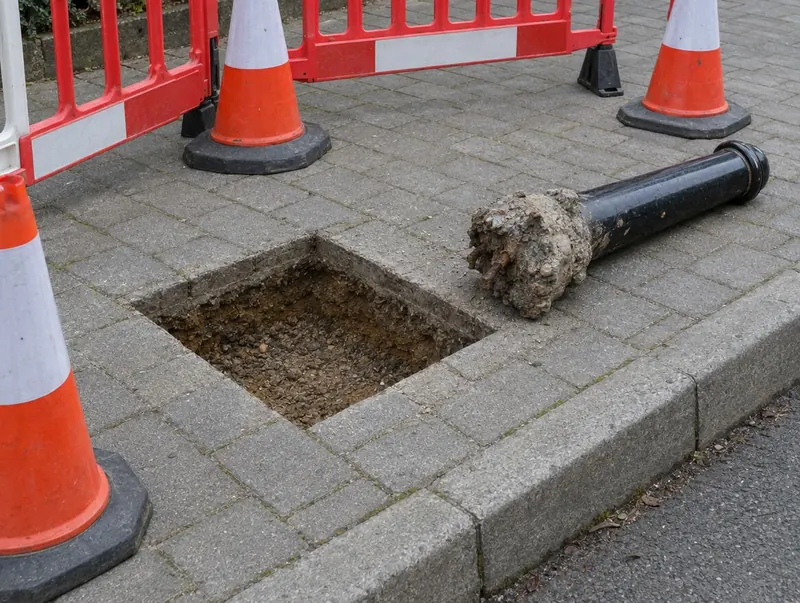
Removal of fixed, removable, telescopic and automatic bollards, including foundations, with the surface made good to match.
- Typically £80–£345 per post + VAT (£95–£405 inc VAT for homes); minimum job £295
- Free survey and fixed written quote
- Surface made good afterwards
 Computer-generated image
What is it?
What is bollard removal?
Bollard removal is taking out unwanted posts and, where needed, their foundations, sockets or cassettes, then filling and reinstating the surface so no trace or trip hazard remains. Posts can be cut off at or below ground level or fully extracted with their concrete. Automatic and lighting bollards also need their electrical supply made safe by a qualified electrician.
Sites change. A car park is redesigned, a shop changes use, an access route is no longer needed, or old bollards are simply in the way of a new scheme. Removing bollards properly means dealing with what is under the ground as well as above it, because a stub of steel or an empty socket left in a footway is a trip hazard and an obstacle for anyone digging later.
We remove single posts and full lines, from simple base-plated bollards to automatic systems with cassettes, ducts and power. Removal is quoted after a free site survey with a fixed written price, and carried out by installation crews working under our management, with a qualified electrician wherever there is a supply to make safe. Before anything comes out, it is worth asking why the bollards were put there in the first place; some protect a gas meter, a building corner or a route that still needs protecting, and others were a condition of a planning permission or lease.
When to remove bollards
- Car park and forecourt redesigns
- Clearing old bollards before resurfacing
- Access routes no longer needing control
- Decommissioning automatic bollards that are no longer used
- Removing redundant lighting bollards
- Taking out broken stubs and empty sockets
- Moving bollards to new positions on the same site
How it works
There are two levels of removal. Cutting off removes the post at or just below the surface and leaves the foundation in the ground, which is quicker and causes less disruption, but leaves concrete that may get in the way of future work. Full extraction breaks out the foundation as well, leaving clean ground for new surfacing, planting or other installations. The right choice depends on what will happen to the area next. Where a crash-rated line is being removed, the foundations are usually large reinforced blocks; cutting the posts below the surface and leaving the base in place is common unless the ground is needed for something else.
Removable bollard sockets and telescopic cassettes are extracted whole, because a buried steel sleeve left under a new surface tends to show through as a crack or depression. Base-plated bollards are unbolted and the anchors cut flush or drilled out, and the holes filled. Concrete and stone bollards are lifted with suitable equipment after their dowels are broken free.
Automatic and lighting bollards need more care. A qualified electrician isolates and disconnects the supply and terminates or removes the cables. Hydraulic units are drained so that oil is collected and disposed of properly rather than left in the ground. Cassettes are lifted out, ducts are capped or removed and the pits are backfilled and compacted in layers.
Options and finishes
| Option | Detail |
|---|---|
| Cut off below surface | Post removed at or below finished level, foundation left in place and the surface patched. Quick and low-disruption. |
| Full extraction | Post and foundation broken out, leaving clear ground for resurfacing or new works. |
| Socket and cassette removal | Removable sockets and telescopic or semi-automatic cassettes extracted whole and the hole filled. |
| Automatic bollard decommissioning | Electrical isolation, hydraulic drain-down, cassette removal and capping of ducts. |
| Lighting bollard removal | Supply made dead and cables terminated or removed by a qualified electrician before posts are lifted. |
| Relocation | Careful removal of reusable posts and reinstallation in new positions on the same site. |
Typical specification
| Item | Typical |
|---|---|
| Visit type | Free site survey and fixed written quote |
| Removal level | Cut below surface or full foundation extraction |
| Electrical work | Isolation and termination by a qualified electrician |
| Hydraulic units | Drained and fluid disposed of properly |
| Backfill | Compacted sub-base or concrete, by surface type |
| Reinstatement | Tarmac, block paving, flags, resin, concrete or turf |
| Waste | Steel and iron recycled where possible; spoil removed |
Typical values only — the survey and the product's data sheet set the final specification.
How we do it
Survey what is in the ground
The free site survey identifies bollard types, likely foundation sizes, any power or ducts, and what the area will be used for next. You receive a fixed written quote for the agreed level of removal.
Check consents and reasons
Before removal, check whether the bollards were required by a planning condition, a lease, a security plan or the highway authority, and whether they protect something such as a meter or a building corner.
Make supplies safe
For automatic and lighting bollards, a qualified electrician isolates and disconnects the supply, and hydraulic units are drained.
Remove posts and foundations
Posts are cut off or extracted, foundations broken out where agreed, and sockets, cassettes and ducts removed or capped.
Backfill and reinstate
Holes are backfilled in compacted layers and the surface reinstated to match, so there is no settlement or trip edge.
Ground, foundations and buried services
Foundations are rarely the size anyone expects. Older bollards may sit in large blocks of concrete, and rated bollards in very large reinforced bases, so full extraction can mean substantial breaking out and spoil removal. Cables and pipes are often laid close to existing posts after they were installed, so breaking out is done carefully and services are traced first. Backfilling in compacted layers stops later settlement, which otherwise shows as a dip in the new surface. Where the area is being resurfaced anyway, removal is timed to happen first so the patching disappears under the new surface.
Rules and checks before you order
- Check whether the bollards were required by a planning condition, lease, security plan or the highway authority before removing them.
- Have automatic and lighting bollard supplies isolated and made safe by a qualified electrician.
- Collect and dispose of hydraulic fluid and waste properly rather than leaving it in the ground.
- In conservation areas, check before removing historic bollards, as consent may be needed or retention expected.
- Consider whether removal leaves an asset or route unprotected and record the decision in your risk assessment.
See rules and standards by nation for highway consent, accessibility and security standards.
Maintenance
After removal, keep an eye on reinstated areas for settlement over the following months, particularly where large foundations were broken out. If foundations were left in place, record their positions on site drawings so future contractors are not surprised by buried concrete. Where cables were terminated rather than removed, record where they are and confirm with the electrician that they are dead and labelled. Keep any keys, manuals and records from removed automatic bollards until the controller and cabling have also been dealt with, as they help an electrician confirm what was connected.
What affects the price
- Number and type of bollards
- Cutting off or full foundation extraction
- Size of foundations and amount of spoil
- Electrical isolation and hydraulic drain-down
- Surface type and reinstatement
- Access, working hours and waste disposal
Guide prices: bollard removal
Three typical specifications. The middle one is the specification we usually recommend for durability and visibility.
Standard
per post + VAT · homes £95–£215 inc VAT
- Post removed and taken away
- Hole backfilled
- Simple surface made good
Upgraded
per post + VAT · homes £185–£315 inc VAT
- Concrete footing broken out
- Tarmac or block paving reinstated
- Everything in Standard
Premium
per post + VAT · homes £275–£405 inc VAT
- Large or deep footings
- Concrete slab or natural stone reinstated
- Everything in Upgraded
Guide prices for the UK base region; local pages adjust for your area. Per post removed with footing, surface made good. Minimum job £295 + VAT. Your fixed price comes in writing after survey.
Bollard removal: questions answered
How much does bollard removal cost?
Typically £80–£345 per post removed with footing, surface made good, plus VAT. For homeowners that's £95–£405 including VAT. Small jobs carry a minimum charge of £295 plus VAT. Ground conditions, access, buried services and consents move the figure; the fixed price comes in writing after survey.
Should bollards be cut off or fully removed?
Cut off if the area is staying as it is and nothing will be built or dug there later. Fully remove if you are resurfacing, planting or installing something new, because buried concrete gets in the way. The quote can price both.
Can automatic bollards be removed safely?
Yes, once the supply has been isolated and disconnected by a qualified electrician and any hydraulic fluid drained. The cassette is then lifted and the pit backfilled. Ducts are capped or removed.
Will the surface look patched after removal?
On block paving it can be nearly invisible, as the blocks are relaid. Tarmac, resin and concrete usually show a patch, especially on older weathered surfaces. Timing removal before resurfacing avoids that.
Do we need permission to remove bollards?
Sometimes. Bollards required by a planning condition, lease, security plan or the highway authority should not be removed without checking. Historic bollards in conservation areas may also be protected.
Can removed bollards be reused elsewhere on site?
Often, if they come out undamaged. Steel posts and removable bollards relocate well. New foundations are formed at the new positions.
What happens to the waste?
Steel and iron are recycled where possible, concrete and spoil are taken away, and hydraulic fluid is disposed of properly. You are left with a clean, reinstated area.
Related bollard services
Bollard replacement
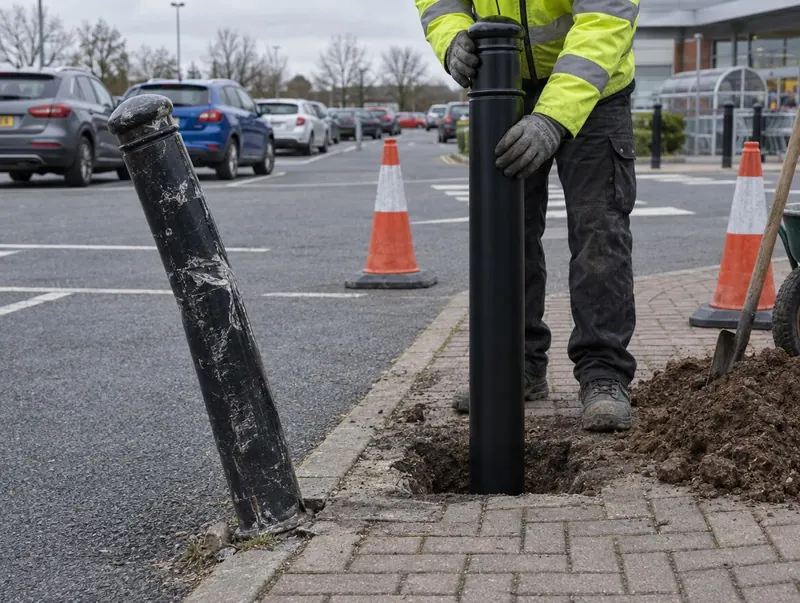
Like-for-like or upgraded replacement of bollards damaged by vehicles, corrosion or wear, matched to the existing line.
Learn more →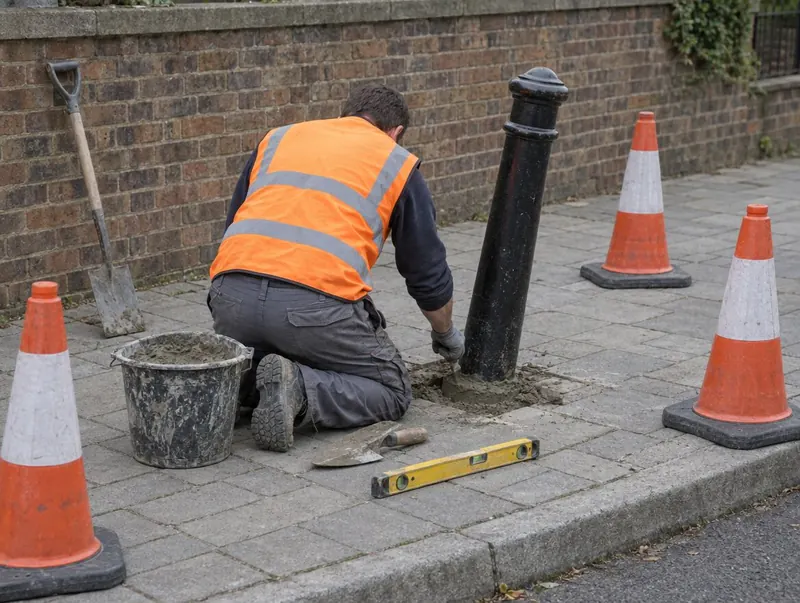
Bollard repairs
Paid repair visits for loose, leaning and damaged bollards: re-bedding, re-fixing, new sockets, locks, caps and reflective bands.
Learn more →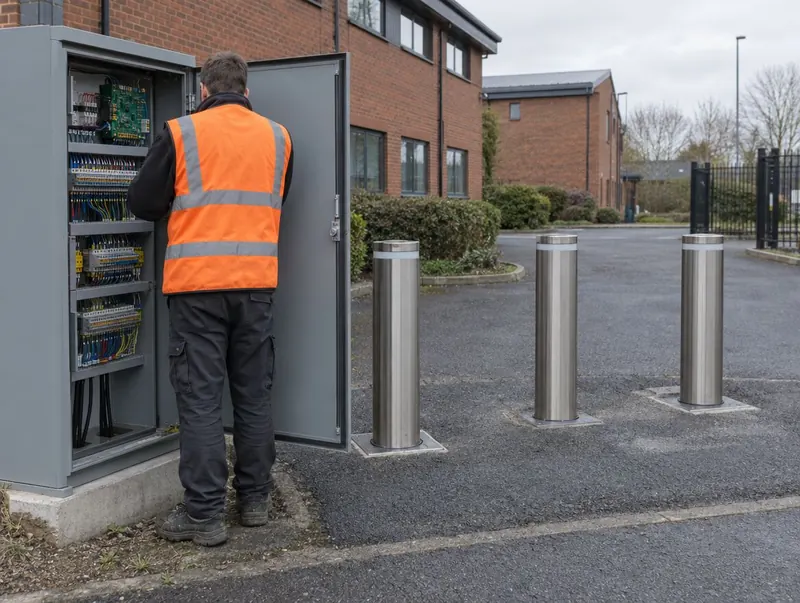
Automatic bollard repairs
Paid repair visits for rising bollards: hydraulics, motors, controllers, loops, flooded pits and heads damaged by vehicles.
Learn more →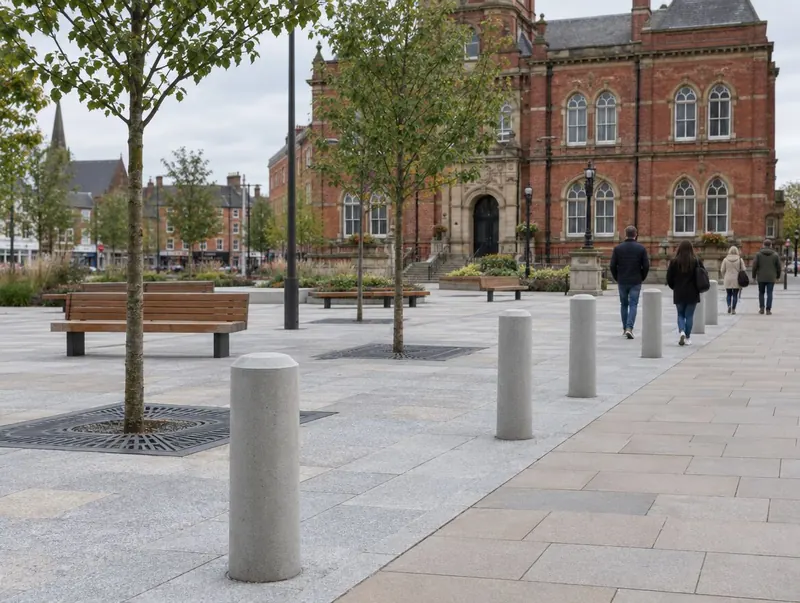
Concrete bollards
Precast concrete and reconstituted stone bollards for public realm, parks, boundaries and estates, dowelled or bedded in place.
Learn more →Bollard removal near you
Local pages show the highway authority, postcodes covered and regional prices.
- Bedfordshire
- Berkshire
- Bristol
- Buckinghamshire
- Cambridgeshire
- Cheshire
- Cornwall
- County Durham
- Cumbria
- Derbyshire
- Devon
- Dorset
- East Riding of Yorkshire
- East Sussex
- Essex
- Gloucestershire
- Greater Manchester
- Hampshire
- Herefordshire
- Hertfordshire
- Isle of Wight
- Kent
- Lancashire
- Leicestershire
- Lincolnshire
- London
- Merseyside
- Norfolk
- North Yorkshire
- Northamptonshire
- Northumberland
- Nottinghamshire
- Oxfordshire
- Rutland
- Shropshire
- Somerset
- South Yorkshire
- Staffordshire
- Suffolk
- Surrey
- Tyne and Wear
- Warwickshire
- West Midlands
- West Sussex
- West Yorkshire
- Wiltshire
- Worcestershire
- Blaenau Gwent
- Bridgend
- Caerphilly
- Cardiff
- Carmarthenshire
- Ceredigion
- Conwy
- Denbighshire
- Flintshire
- Gwynedd
- Isle of Anglesey
- Merthyr Tydfil
- Monmouthshire
- Neath Port Talbot
- Newport
- Pembrokeshire
- Powys
- Rhondda Cynon Taf
- Swansea
- Torfaen
- Vale of Glamorgan
- Wrexham
- Aberdeen City
- Aberdeenshire
- Angus
- Argyll and Bute
- City of Edinburgh
- Clackmannanshire
- Dumfries and Galloway
- Dundee City
- East Ayrshire
- East Dunbartonshire
- East Lothian
- East Renfrewshire
- Falkirk
- Fife
- Glasgow City
- Highland
- Inverclyde
- Midlothian
- Moray
- North Ayrshire
- North Lanarkshire
- Perth and Kinross
- Renfrewshire
- Scottish Borders
- South Ayrshire
- South Lanarkshire
- Stirling
- West Dunbartonshire
- West Lothian
- Antrim and Newtownabbey
- Ards and North Down
- Armagh City, Banbridge and Craigavon
- Belfast
- Causeway Coast and Glens
- Derry City and Strabane
- Fermanagh and Omagh
- Lisburn and Castlereagh
- Mid Ulster
- Mid and East Antrim
- Newry, Mourne and Down