Security & anti-ram
Steel security bollard installation
Concrete-filled steel bollards, root-fixed or base-plated, for car parks, forecourts, boundaries and nuisance vehicle control.
- Typically £195–£895 per bollard + VAT (£225–£1,045 inc VAT for homes); minimum job £595
- Free survey and fixed written quote
- Foundations and reinstatement included
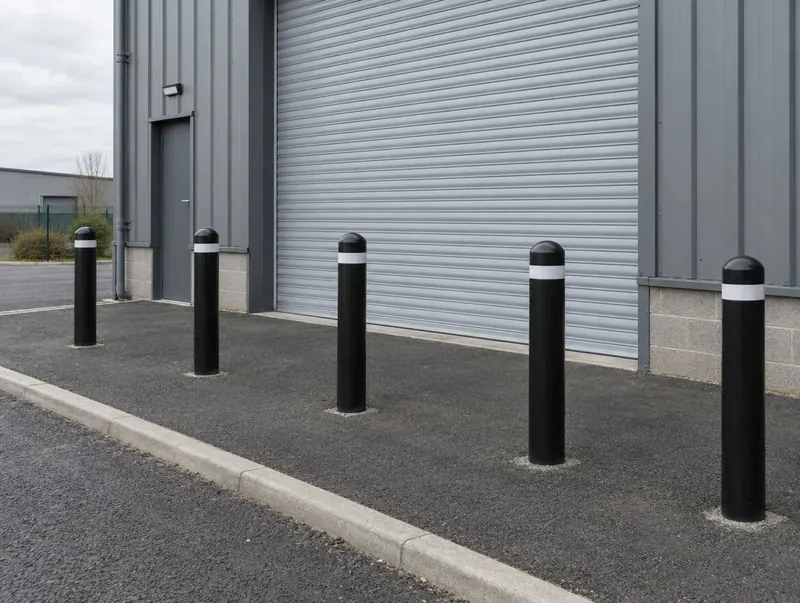 Computer-generated image
What is it?
What is steel security bollards (unrated)?
A steel security bollard is a fixed post made from steel tube or section, usually galvanised, often filled with concrete, and either cast into the ground or bolted down on a base plate. Unrated steel bollards have not been crash-tested, so they deter vehicles and stop low-speed knocks and casual misuse rather than a determined attack. They are the everyday bollard for car parks, verges, forecourts and boundaries.
Most of the bollards people walk past every day are plain steel posts. They stop cars mounting kerbs, keep vans off grass verges, mark the edge of a pedestrian route and stop drivers cutting through a car park. For these jobs a crash-tested product is not needed, and a correctly specified steel post does the work at a fraction of the complexity.
The decisions that make a steel bollard last are mostly about the tube, the fixing and the finish. We install root-fixed and base-plated posts using installation crews working under our management, and we are clear about what an unrated post can and cannot do. Where a site needs proven resistance to a vehicle attack, we point you towards tested products instead.
Where steel security bollards make sense
- Car park perimeters, end-of-bay protection and walkway edges
- Grass verges and landscaped areas that vans keep driving over
- Forecourts and building entrances needing a visible boundary
- Stopping cut-through traffic on private roads and estates
- Protecting meter boxes, gas kiosks, pillars and corners
- Lines between pedestrian routes and service yards
- Social housing estates with nuisance parking
How it works
Strength in an unrated bollard comes from three things: the tube, the infill and the anchorage. Circular hollow section is the usual choice, with diameter and wall thickness chosen for the likely knocks; a 114 mm tube suits a car park walkway, while 168 or 219 mm with a thicker wall suits a service yard. Filling the post with concrete adds mass and helps resist denting and cutting.
Root-fixed posts have a length of tube, often with a cross-bar or anchor plate welded to it, cast into a concrete foundation below the surface. They resist being pushed over and are the stronger choice where the ground can be dug. Base-plated posts are welded to a steel plate that is bolted to an existing slab with resin anchors. They go in quickly and avoid excavation, but their strength is limited by the slab and the anchors, so they suit lighter duty.
Neither type has a tested rating, which means nobody can say precisely what vehicle at what speed it will stop. That is not a flaw for nuisance control, but it is why steel posts should not be presented as protection against a deliberate attack.
Options and finishes
| Option | Detail |
|---|---|
| Root-fixed | Cast into a concrete foundation, typically with several hundred millimetres of post below ground. The usual choice where digging is possible. |
| Base-plated | Bolted to a sound concrete slab with resin anchors. Quick to fit and easy to remove later, suited to light-duty and indoor use. |
| Tube size and wall thickness | Common diameters include 76, 114, 140, 168 and 219 mm, with heavier walls for service yards and vehicle routes. |
| Concrete infill | Adds mass and stiffness and makes the post harder to cut or dent. Usually specified for security and impact positions. |
| Caps and heads | Dome, flat, chamfered or ball tops, with welded caps to keep water out of hollow posts. |
| Finishes | Hot-dip galvanised, then powder-coated in a RAL colour if wanted. Black, grey, yellow and green are common. |
| Visibility bands | Reflective or contrasting bands near the top for drivers at night and for partially sighted pedestrians. |
Typical specification
| Item | Typical |
|---|---|
| Exposed height | Typically 900–1,000 mm |
| Diameter | Commonly 76–219 mm, by duty |
| Root length | Often 300–600 mm below ground, set by post size and ground |
| Foundation | Concrete surround, often around 300–450 mm square, depth to suit |
| Base-plate fixing | Resin anchors into a sound slab of adequate thickness |
| Finish | Hot-dip galvanised, optional polyester powder coat |
| Rating | None; for tested performance see crash-rated or PAS 170-1 products |
Typical values only — the survey and the product's data sheet set the final specification.
How we install it
Survey and set out
A free site survey confirms positions, surfaces, buried services and whether root-fixing or base plates suit the ground. You receive a fixed written quote listing post size, finish and fixing.
Break out and excavate
For root-fixed posts, the surface is cut neatly and each hole is dug to depth, by hand near known services. For base plates, the slab is checked for thickness and soundness.
Set the posts
Posts are set plumb and to a consistent height along the line, and concreted in. Base-plated posts are drilled, anchored with resin and torqued once cured.
Fill and cap
Where specified, posts are filled with concrete and capped so water cannot collect inside the tube.
Reinstate and finish
The surface around each post is made good to match, and reflective bands are fitted. Damaged galvanising from handling is touched up.
Ground, foundations and buried services
Root-fixed posts need firm ground and enough depth to carry the post's root plus a concrete surround. Verges are often softer than they look, and the edges of car parks may be thin tarmac over hardcore, so the foundation is sized to the ground found. Service runs commonly follow kerb lines and verges, which is exactly where steel posts tend to go, so positions are checked with records and scanning before digging. Base plates must sit on a slab thick and sound enough to hold resin anchors; cracked or thin concrete will let the anchors pull out on the first knock. Reinstatement matches the surface, whether tarmac, block paving, flags or turf.
Rules and checks before you order
- Keep clear gaps of typically at least 1,000–1,200 mm where pedestrians, wheelchair users or buggies pass between posts.
- Fit contrasting or reflective bands near the top so posts are visible, as Inclusive Mobility guidance recommends.
- Check whether the land is public highway or adopted verge before installing; the highway authority's agreement is usually needed.
- Avoid linking posts with chains across pedestrian routes, which can be a trip hazard for blind and partially sighted people.
- Do not describe unrated posts as anti-ram or HVM protection in risk assessments or to insurers.
See rules and standards by nation for highway consent, accessibility and security standards.
Maintenance
Galvanised steel posts need little attention for years at a time. Check periodically for impact damage, loose base plates and cracked surfacing around the root. Powder coat chipped by vehicles should be touched up before the galvanising underneath starts to weather. Reflective bands fade and peel and are easy to renew. A post that leans after a knock usually means the foundation has moved or cracked; it should be re-bedded or replaced rather than left as a trip or snag hazard.
What affects the price
- Number of posts and length of the line
- Tube diameter, wall thickness and concrete infill
- Root-fixed or base-plated installation
- Ground conditions and buried services
- Finish: galvanised only or powder-coated
- Surface reinstatement such as block paving or tarmac
Guide prices: steel security bollards
Three typical specifications. The middle one is the specification we usually recommend for durability and visibility.
Standard
per bollard + VAT · homes £225–£575 inc VAT
- Standard post or product for the type
- Foundation and fixing to manufacturer's details
- Surface reinstated to match
Upgraded
per bollard + VAT · homes £485–£825 inc VAT
- Upgraded finish (RAL colour, stainless or sleeve)
- Retroreflective band and matched keys
- Everything in Standard
Premium
per bollard + VAT · homes £735–£1,045 inc VAT
- Heavy-duty or architectural specification
- Premium finish and fittings
- Everything in Upgraded
Guide prices for the UK base region; local pages adjust for your area. Per bollard, supplied and installed. Minimum job £595 + VAT. Your fixed price comes in writing after survey.
Steel security bollards: questions answered
How much does steel security bollard installation cost?
Typically £195–£895 per bollard, supplied and installed, plus VAT. For homeowners that's £225–£1,045 including VAT. Small jobs carry a minimum charge of £595 plus VAT. Ground conditions, access, buried services and consents move the figure; the fixed price comes in writing after survey.
Should I choose root-fixed or base-plated steel bollards?
Root-fixed where you can dig and want the stronger post; base-plated where there is a sound slab and you want quick installation or the option to remove posts later. Base plates are limited by the slab and anchors, so they are not the right choice where vehicles hit hard.
What diameter of steel bollard do I need?
Match it to the job. Around 114 mm suits car park walkways and verges; 168 or 219 mm with a heavier wall suits service yards and corners that lorries pass. The survey looks at what is likely to hit the posts.
Why fill a steel bollard with concrete?
Concrete infill adds weight and stiffness, so the post dents less and is harder to cut. It also stops water collecting inside a hollow tube. It is usual for security and impact positions.
Are unrated steel bollards anti-ram?
No. They have not been crash-tested, so their performance against a deliberate vehicle attack is unknown. They are suited to nuisance parking and low-speed knocks; tested products are needed where an attack is the concern.
Will galvanised posts rust?
Hot-dip galvanising protects steel for a long time in normal outdoor conditions. Powder coat over the galvanising adds colour and extra protection. Touch up chips promptly in coastal or heavily salted locations.
Can new posts match our existing ones?
Usually, if we can measure the existing diameter, height, cap and colour. Galvanised steel in standard sizes is easy to match; older or unusual sections may need a close equivalent.
Related bollard services
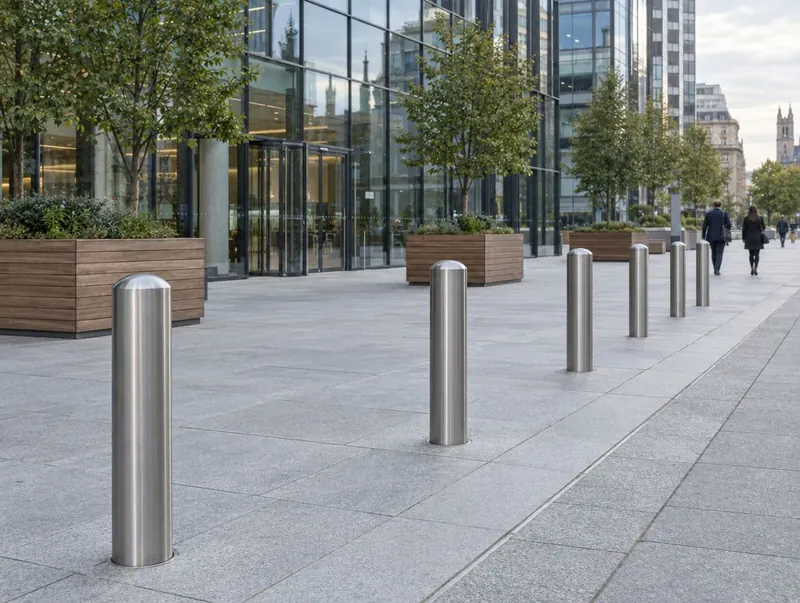
Stainless steel bollards and bollard covers
Stainless steel bollards and sleeve covers in 304 or 316 grade, for building entrances, plazas and upgrading tired steel posts.
Learn more →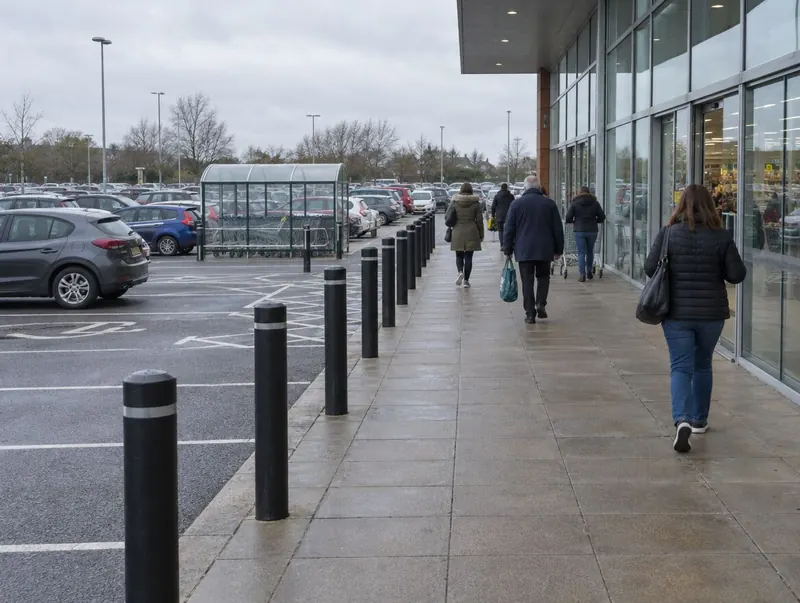
Pedestrian and shopfront protection bollards
Bollards that separate people from vehicles at car parks, forecourts, walkways, drive-thrus and shop entrances.
Learn more →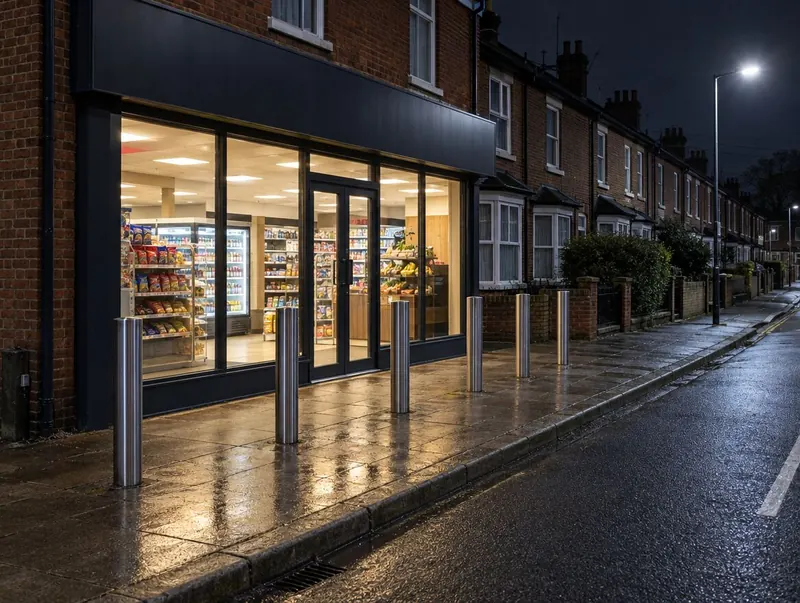
Ram-raid protection bollards
Bollards fitted in front of shopfronts, ATMs, jewellers and convenience stores to stop vehicles being used to break in.
Learn more →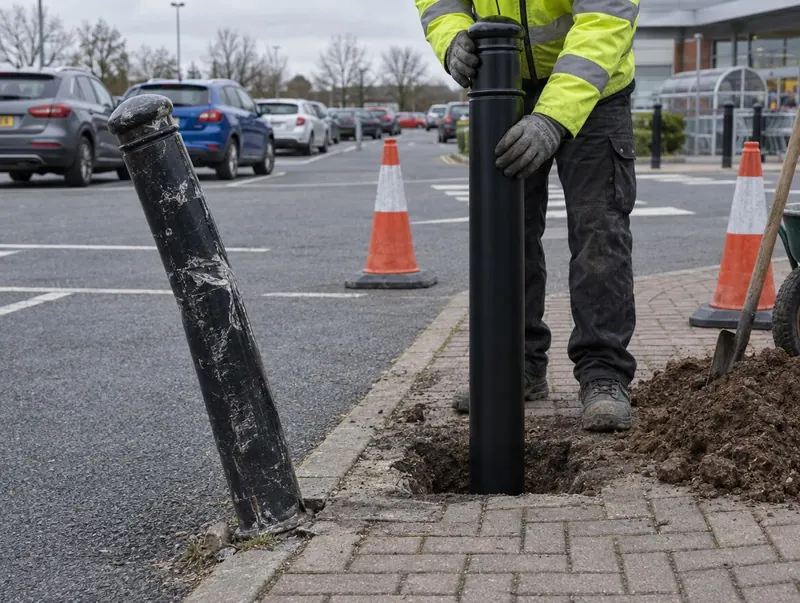
Bollard replacement
Like-for-like or upgraded replacement of bollards damaged by vehicles, corrosion or wear, matched to the existing line.
Learn more →Steel security bollards near you
Local pages show the highway authority, postcodes covered and regional prices.
- Bedfordshire
- Berkshire
- Bristol
- Buckinghamshire
- Cambridgeshire
- Cheshire
- Cornwall
- County Durham
- Cumbria
- Derbyshire
- Devon
- Dorset
- East Riding of Yorkshire
- East Sussex
- Essex
- Gloucestershire
- Greater Manchester
- Hampshire
- Herefordshire
- Hertfordshire
- Isle of Wight
- Kent
- Lancashire
- Leicestershire
- Lincolnshire
- London
- Merseyside
- Norfolk
- North Yorkshire
- Northamptonshire
- Northumberland
- Nottinghamshire
- Oxfordshire
- Rutland
- Shropshire
- Somerset
- South Yorkshire
- Staffordshire
- Suffolk
- Surrey
- Tyne and Wear
- Warwickshire
- West Midlands
- West Sussex
- West Yorkshire
- Wiltshire
- Worcestershire
- Blaenau Gwent
- Bridgend
- Caerphilly
- Cardiff
- Carmarthenshire
- Ceredigion
- Conwy
- Denbighshire
- Flintshire
- Gwynedd
- Isle of Anglesey
- Merthyr Tydfil
- Monmouthshire
- Neath Port Talbot
- Newport
- Pembrokeshire
- Powys
- Rhondda Cynon Taf
- Swansea
- Torfaen
- Vale of Glamorgan
- Wrexham
- Aberdeen City
- Aberdeenshire
- Angus
- Argyll and Bute
- City of Edinburgh
- Clackmannanshire
- Dumfries and Galloway
- Dundee City
- East Ayrshire
- East Dunbartonshire
- East Lothian
- East Renfrewshire
- Falkirk
- Fife
- Glasgow City
- Highland
- Inverclyde
- Midlothian
- Moray
- North Ayrshire
- North Lanarkshire
- Perth and Kinross
- Renfrewshire
- Scottish Borders
- South Ayrshire
- South Lanarkshire
- Stirling
- West Dunbartonshire
- West Lothian
- Antrim and Newtownabbey
- Ards and North Down
- Armagh City, Banbridge and Craigavon
- Belfast
- Causeway Coast and Glens
- Derry City and Strabane
- Fermanagh and Omagh
- Lisburn and Castlereagh
- Mid Ulster
- Mid and East Antrim
- Newry, Mourne and Down