Traffic & site protection
Pedestrian protection bollards
Bollards that separate people from vehicles at car parks, forecourts, walkways, drive-thrus and shop entrances.
- Typically £245–£1,195 per bollard + VAT; minimum job £595
- Free survey and fixed written quote
- Foundations and reinstatement included
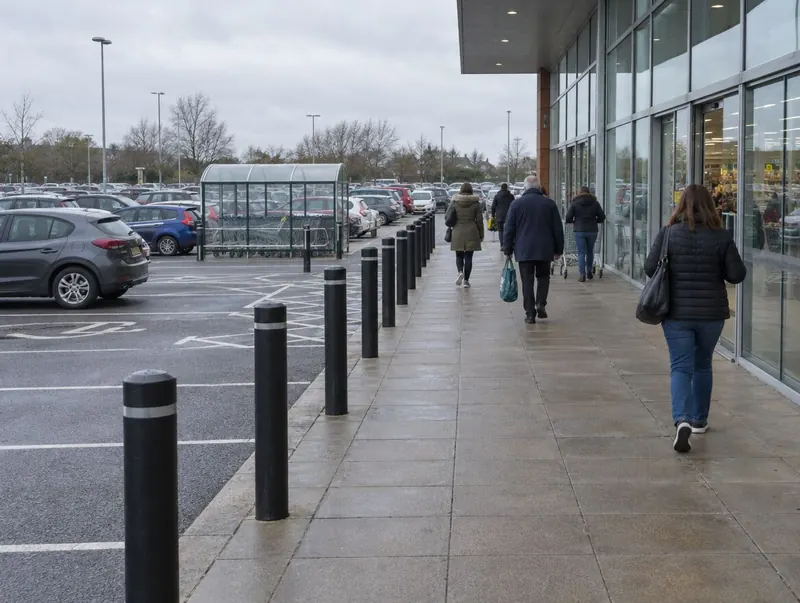 Computer-generated image
What is it?
What are pedestrian and shopfront protection bollards?
Pedestrian protection bollards are posts placed between vehicle areas and places where people walk, wait or sit, to stop cars that are parking, reversing or mis-driven from reaching them. They are used along walkways, at the ends of parking bays facing shop entrances, at forecourts and around seating areas. Products range from unrated steel posts to bollards tested against low-speed impacts under PAS 170-1.
Vehicle incidents involving pedestrians at retail parks, supermarkets, petrol stations and drive-thrus tend to happen at low speed: a driver presses the accelerator instead of the brake, misjudges a reverse or creeps forward while distracted. The consequences can be serious because people are standing close by, often at glass frontages, trolley bays or outdoor seating. A line of well-placed posts stops the car before it reaches them.
Protection bollards are not hostile vehicle mitigation; they are about everyday mistakes rather than attacks. That changes the decisions. The important questions are where cars stop, how far bumpers overhang, where people queue and how to keep routes open for wheelchairs and buggies. Our installation crews, working under our management, set out lines to match how the site is actually used.
Where pedestrian protection make sense
- Shop entrances facing nose-in parking bays
- Walkways through supermarket and retail park car parks
- Drive-thru lanes and order points next to seating
- Petrol station forecourts and kiosk frontages
- Outdoor seating at cafes, pubs and restaurants
- School and hospital drop-off zones
- EV charging points and trolley shelters
How it works
A car that mounts a kerb at low speed carries enough energy to break glass, crush street furniture and seriously injure anyone in the way. A protection bollard resists that impact by being firmly founded and of sufficient section; a concrete-filled steel post root-fixed in concrete is the usual unrated choice. Where an owner, insurer or designer asks for proven performance, products tested under PAS 170-1 give a known result against low-speed impacts.
Position is where most schemes go wrong. Cars parked nose-in overhang the kerb by a fair distance, so bollards placed right at the kerb edge get nudged daily and gradually work loose. Set them back too far and they eat into the walkway. The right setback depends on the bay layout and the kerb height, and it is set on site rather than taken from a standard drawing.
Gaps between posts need to stop a car but let people through. In practice that means a clear opening that takes a wheelchair or a double buggy, with posts that are easy to see against the background. At drive-thrus and order points the geometry is different again: vehicles are moving slowly but continuously beside a queue of people or a seating area, and the line usually needs to follow the curve of the lane rather than a straight kerb. Corners, where drivers misjudge the turn, deserve the closest spacing.
Options and finishes
| Option | Detail |
|---|---|
| Concrete-filled steel posts | Root-fixed galvanised and powder-coated steel, the standard unrated choice for walkways and frontages. |
| PAS 170-1 tested bollards | Tested against low-speed vehicle impacts, for sites where proven performance has been asked for. |
| Stainless or architectural finishes | Stainless sleeves or decorative posts for shop entrances and public-facing frontages. |
| Lit bollards | Low-level lighting bollards double as protection on walkways where the product is robust enough for the job. |
| Wheel stops and kerbs | Used with bollards to stop cars before they reach the posts, reducing daily knocks. |
| Visibility bands | Reflective and contrasting bands help drivers and partially sighted pedestrians see posts. |
Typical specification
| Item | Typical |
|---|---|
| Exposed height | Typically 900–1,000 mm |
| Diameter | Commonly 114–219 mm steel |
| Clear gap | Typically at least 1,000–1,200 mm for wheelchairs and buggies |
| Setback from kerb | Set on site to allow for bumper overhang |
| Foundation | Root-fixed in concrete; tested design for PAS 170-1 products |
| Finish | Galvanised, powder-coated or stainless |
| Visibility | Contrasting or reflective band near the top |
Typical values only — the survey and the product's data sheet set the final specification.
How we install it
Watch how the site works
The free site survey looks at where cars park, where people walk and queue, and where incidents or near misses have happened. You receive a fixed written quote with positions marked.
Set out the line
Posts are set out allowing for bumper overhang and keeping clear routes for pedestrians, trolleys and wheelchairs.
Excavate and set
Each position is cut, dug and checked for services, and the posts are set plumb in concrete to a consistent height.
Reinstate
Paving, tarmac or concrete is made good flush around each post, with tactile paving reinstated where it was disturbed.
Add bands and markings
Reflective bands are fitted and any wheel stops or line markings agreed in the scheme are installed.
Agree a plan for live trading
Work is phased so entrances and walkways stay open, with each section fenced while it is dug and set. Busy sites often prefer early starts or quieter weekdays.
Ground, foundations and buried services
Car park edges and walkways tend to be built quickly over shallow hardcore, and their kerb lines often carry lighting cables, drainage channels and ducts for EV chargers or signs. Positions are scanned and hand-dug before committing, and foundations are sized for the ground found rather than a fixed hole size. Where bollards protect a shopfront, the building's own foundations and any canopy columns may sit close to the line, which limits how deep and wide each base can go. Raised kerbs also change the picture: a high kerb slows a wheel but does not stop a bumper, so the post still needs to sit within reach of the overhang rather than behind it. Reinstatement keeps walkways level and flush, because a trip edge around a new post in a busy car park creates the very hazard the posts are meant to reduce.
Rules and checks before you order
- Keep clear gaps of typically at least 1,000–1,200 mm and keep main walkways wide enough, referring to Inclusive Mobility guidance.
- Use contrasting bands so posts are visible to partially sighted people, and avoid linking chains across routes.
- Record why posts are where they are in the site's risk assessment, especially at drive-thrus and seating areas.
- If a tested product has been requested, confirm PAS 170-1 or another stated standard and install to the tested foundation.
See rules and standards by nation for highway consent, accessibility and security standards.
Maintenance
Protection bollards take the knocks they are there for, so inspect them regularly and after any reported strike. A post that leans or rocks has lost much of its value and should be re-bedded or replaced. Touch up chipped coatings, renew faded bands, and check the surface around each base for cracks that suggest movement. If one post keeps being hit, look at the bay layout or add a wheel stop rather than replacing the same post repeatedly. Keep a simple note of strikes and their locations; over a year it shows which parts of the car park drivers find awkward, which is useful when the site is next resurfaced or re-lined. Damaged posts near entrances should be dealt with quickly, as a bent post with a torn edge is a hazard in its own right.
What affects the price
- Number of posts and length of line
- Unrated steel or PAS 170-1 tested products
- Ground conditions and services along kerb lines
- Finishes such as stainless or decorative posts
- Reinstatement of tactile paving and walkway surfaces
- Working around trading hours and live car parks
Guide prices: pedestrian protection
Three typical specifications. The middle one is the specification we usually recommend for durability and visibility.
Standard
per bollard + VAT
- Standard post or product for the type
- Foundation and fixing to manufacturer's details
- Surface reinstated to match
Upgraded
per bollard + VAT
- Upgraded finish (RAL colour, stainless or sleeve)
- Retroreflective band and matched keys
- Everything in Standard
Premium
per bollard + VAT
- Heavy-duty or architectural specification
- Premium finish and fittings
- Everything in Upgraded
Guide prices for the UK base region; local pages adjust for your area. Per bollard, supplied and installed. Minimum job £595 + VAT. Your fixed price comes in writing after survey.
Pedestrian protection: questions answered
How much does pedestrian protection bollards cost?
Typically £245–£1,195 per bollard, supplied and installed, plus VAT. Small jobs carry a minimum charge of £595 plus VAT. Ground conditions, access, buried services and consents move the figure; the fixed price comes in writing after survey.
How far from the kerb should car park bollards go?
Far enough back that parked bumpers do not hit them, but not so far that they narrow the walkway. That distance depends on the bay length and kerb height. We set it on site with the layout in front of us.
Do pedestrian protection bollards need to be crash-rated?
Not usually. They deal with low-speed driver errors, so firmly founded steel posts often suffice. Where an owner, insurer or designer wants proven performance, PAS 170-1 tested products are the usual choice.
Our outdoor seating faces the car park: what should we do?
Put a line of posts between the seating and the nearest parking or driving lane, with gaps narrow enough to stop a car. Positions should allow for cars that overshoot a bay. It is worth recording the decision in your risk assessment.
Will bollards block trolleys?
They should not if gaps are planned for trolleys and wheelchairs. Main routes to trolley bays need wider openings. We set gaps to suit the way the site works.
Are wheel stops enough on their own?
Wheel stops help drivers judge where to stop but a car can mount them with a firm press on the accelerator. Used with bollards, they reduce daily knocks on the posts. On their own they are not a barrier.
Should bollards be added at a drive-thru order point?
Often, yes, where people queue or sit beside the lane. Posts should follow the curve of the lane and be closest together at corners, where drivers tend to misjudge the turn. The positions are agreed on site with the operator.
Related bollard services
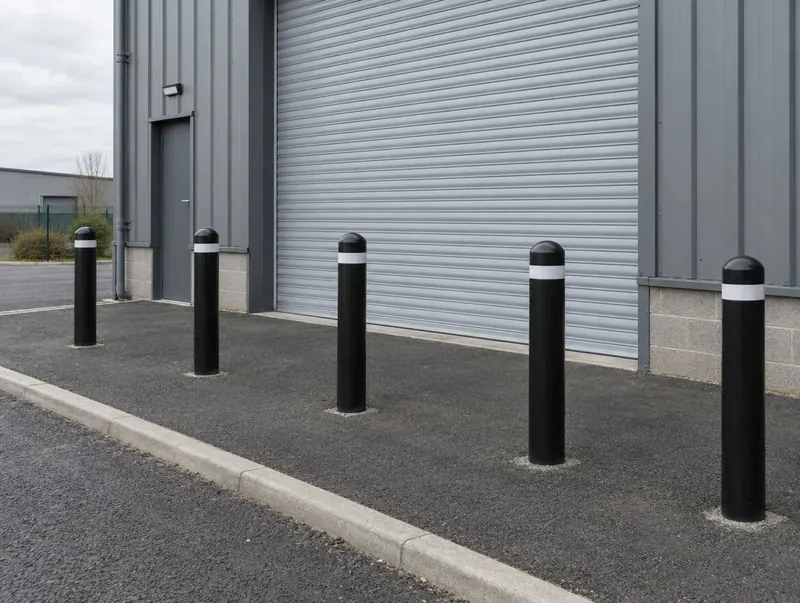
Steel security bollards (unrated)
Concrete-filled steel bollards, root-fixed or base-plated, for car parks, forecourts, boundaries and nuisance vehicle control.
Learn more →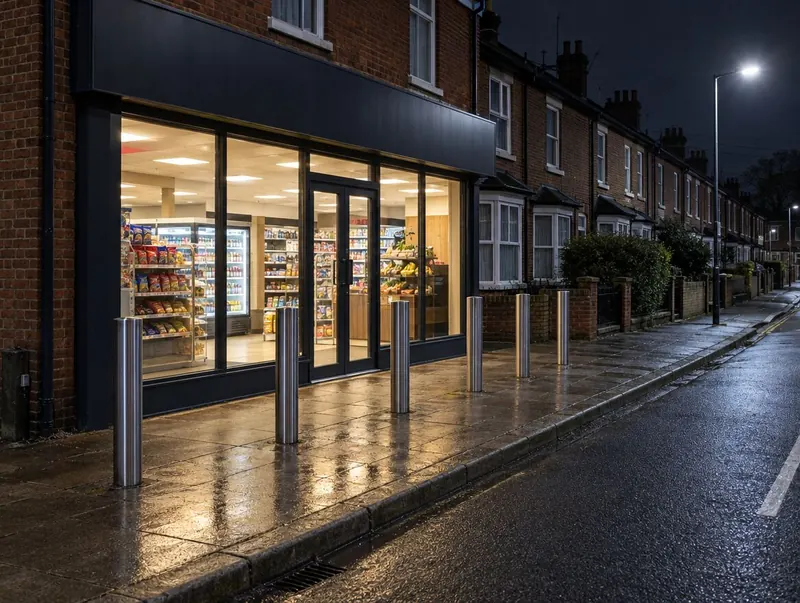
Ram-raid protection bollards
Bollards fitted in front of shopfronts, ATMs, jewellers and convenience stores to stop vehicles being used to break in.
Learn more →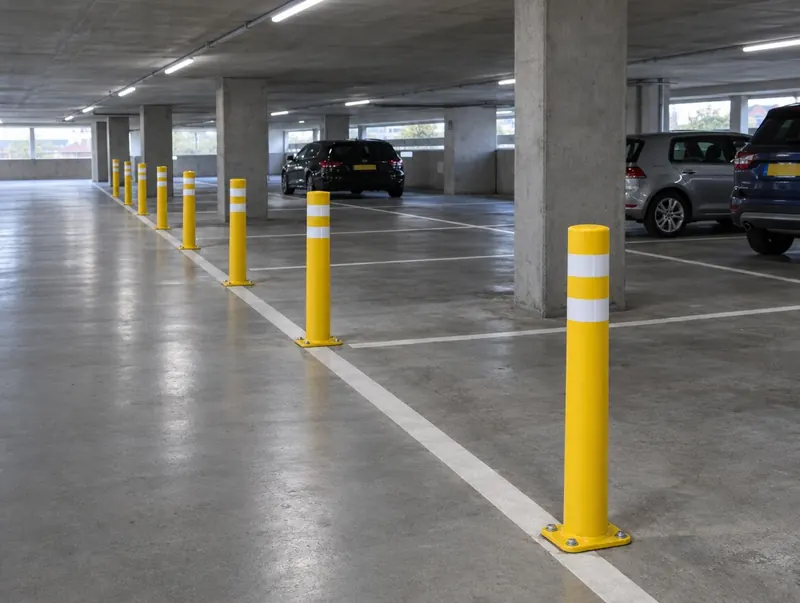
Flexible impact-recoverable bollards
Polyurethane and spring-based bollards that bend when hit and return upright, for car parks, depots and lane separation.
Learn more →
Lighting bollards
Low-level LED bollard lights for paths, car parks, entrances and gardens, installed with a qualified electrician.
Learn more →Pedestrian protection near you
Local pages show the highway authority, postcodes covered and regional prices.
- Bedfordshire
- Berkshire
- Bristol
- Buckinghamshire
- Cambridgeshire
- Cheshire
- Cornwall
- County Durham
- Cumbria
- Derbyshire
- Devon
- Dorset
- East Riding of Yorkshire
- East Sussex
- Essex
- Gloucestershire
- Greater Manchester
- Hampshire
- Herefordshire
- Hertfordshire
- Isle of Wight
- Kent
- Lancashire
- Leicestershire
- Lincolnshire
- London
- Merseyside
- Norfolk
- North Yorkshire
- Northamptonshire
- Northumberland
- Nottinghamshire
- Oxfordshire
- Rutland
- Shropshire
- Somerset
- South Yorkshire
- Staffordshire
- Suffolk
- Surrey
- Tyne and Wear
- Warwickshire
- West Midlands
- West Sussex
- West Yorkshire
- Wiltshire
- Worcestershire
- Blaenau Gwent
- Bridgend
- Caerphilly
- Cardiff
- Carmarthenshire
- Ceredigion
- Conwy
- Denbighshire
- Flintshire
- Gwynedd
- Isle of Anglesey
- Merthyr Tydfil
- Monmouthshire
- Neath Port Talbot
- Newport
- Pembrokeshire
- Powys
- Rhondda Cynon Taf
- Swansea
- Torfaen
- Vale of Glamorgan
- Wrexham
- Aberdeen City
- Aberdeenshire
- Angus
- Argyll and Bute
- City of Edinburgh
- Clackmannanshire
- Dumfries and Galloway
- Dundee City
- East Ayrshire
- East Dunbartonshire
- East Lothian
- East Renfrewshire
- Falkirk
- Fife
- Glasgow City
- Highland
- Inverclyde
- Midlothian
- Moray
- North Ayrshire
- North Lanarkshire
- Perth and Kinross
- Renfrewshire
- Scottish Borders
- South Ayrshire
- South Lanarkshire
- Stirling
- West Dunbartonshire
- West Lothian
- Antrim and Newtownabbey
- Ards and North Down
- Armagh City, Banbridge and Craigavon
- Belfast
- Causeway Coast and Glens
- Derry City and Strabane
- Fermanagh and Omagh
- Lisburn and Castlereagh
- Mid Ulster
- Mid and East Antrim
- Newry, Mourne and Down