Northern Ireland · 3 towns
Pedestrian protection bollards in Mid and East Antrim
Pedestrian protection for sites across Mid and East Antrim: surveyed, quoted in writing and installed by our crews.
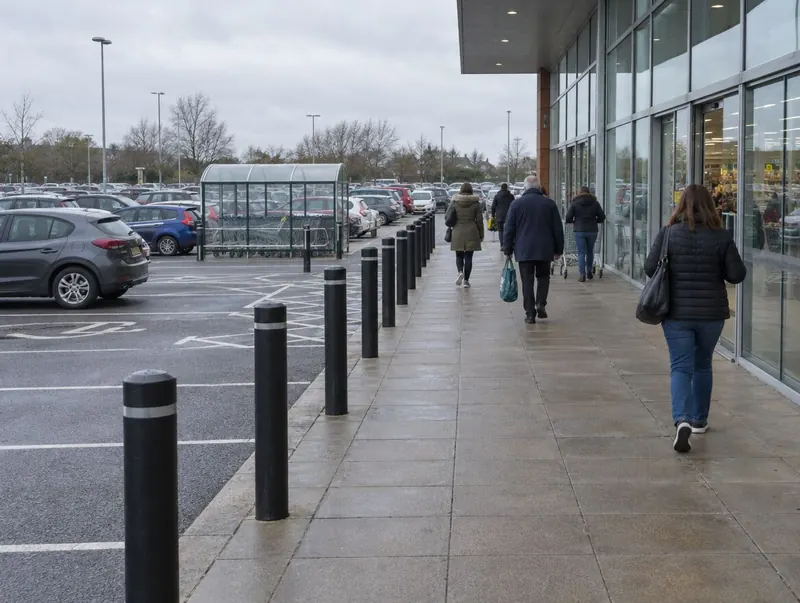 Computer-generated image
Pedestrian protection in Mid and East Antrim
Across Mid and East Antrim, typical sites for pedestrian protection bollards include small industrial units, local parades and high street shopfronts. Bollards that separate people from vehicles at car parks, forecourts, walkways, drive-thrus and shop entrances.
Across Northern Ireland, DfI Roads (the Department for Infrastructure) is the roads authority for public roads and footways; councils handle planning.
Choose your town in Mid and East Antrim
Guide prices in Mid and East Antrim
| Specification | Guide price | Includes |
|---|---|---|
| Standard | £245–£635 + VAT | Standard post, foundation, reinstatement |
| Upgraded | £515–£915 + VAT | Upgraded finish or fittings, reflective band, matched keys |
| Premium | £795–£1,195 + VAT | Heavy-duty or architectural spec, premium finish |
Per bollard, supplied and installed; -2% for Northern Ireland. Guide only — the fixed price follows a survey.
Local authorities across Mid and East Antrim
| Town | Highway / roads authority | Planning authority |
|---|---|---|
| Carrickfergus | the Department for Infrastructure (DfI Roads) | Mid and East Antrim Borough Council |
| Ballymena | the Department for Infrastructure (DfI Roads) | Mid and East Antrim Borough Council |
| Larne | the Department for Infrastructure (DfI Roads) | Mid and East Antrim Borough Council |
Rules for pedestrian protection bollards in Northern Ireland
Bollards on public footways and roads need DfI Roads consent under the Roads (NI) Order 1993; councils deal with planning. On private land the owner's agreement is what matters; listed buildings and conservation areas need a word with the planning team first. Accessibility guidance asks for posts at least 1,000 mm high with contrasting tops and no chains between them.
Details and sources: bollard rules in Northern Ireland.
How installation works
Watch how the site works
The free site survey looks at where cars park, where people walk and queue, and where incidents or near misses have happened. You receive a fixed written quote with positions marked.
Set out the line
Posts are set out allowing for bumper overhang and keeping clear routes for pedestrians, trolleys and wheelchairs.
Add bands and markings
Reflective bands are fitted and any wheel stops or line markings agreed in the scheme are installed.
Agree a plan for live trading
Work is phased so entrances and walkways stay open, with each section fenced while it is dug and set. Busy sites often prefer early starts or quieter weekdays.
Pedestrian protection in Mid and East Antrim: FAQs
Do you cover all of Mid and East Antrim for pedestrian protection bollards?
Yes — including Carrickfergus, Ballymena and Larne. Enter your postcode in the price calculator to confirm.
How much do pedestrian protection bollards cost in Mid and East Antrim?
In Mid and East Antrim, typically £245–£1,195 per bollard, supplied and installed, plus VAT, with a minimum job of £575 plus VAT, using our Northern Ireland guide prices. The fixed figure comes in writing after we've seen the site.
Who do I ask about bollards on public land in Mid and East Antrim?
DfI Roads (the Department for Infrastructure) is the roads authority for public roads and footways throughout Northern Ireland; councils handle planning.
Should bollards be added at a drive-thru order point?
Often, yes, where people queue or sit beside the lane. Posts should follow the curve of the lane and be closest together at corners, where drivers tend to misjudge the turn. The positions are agreed on site with the operator.
Do pedestrian protection bollards need to be crash-rated?
Not usually. They deal with low-speed driver errors, so firmly founded steel posts often suffice. Where an owner, insurer or designer wants proven performance, PAS 170-1 tested products are the usual choice.