Security & anti-ram
Stainless steel bollards and covers
Stainless steel bollards and sleeve covers in 304 or 316 grade, for building entrances, plazas and upgrading tired steel posts.
- Typically £295–£1,195 per bollard + VAT (£345–£1,445 inc VAT for homes); minimum job £695
- Free survey and fixed written quote
- Foundations and reinstatement included
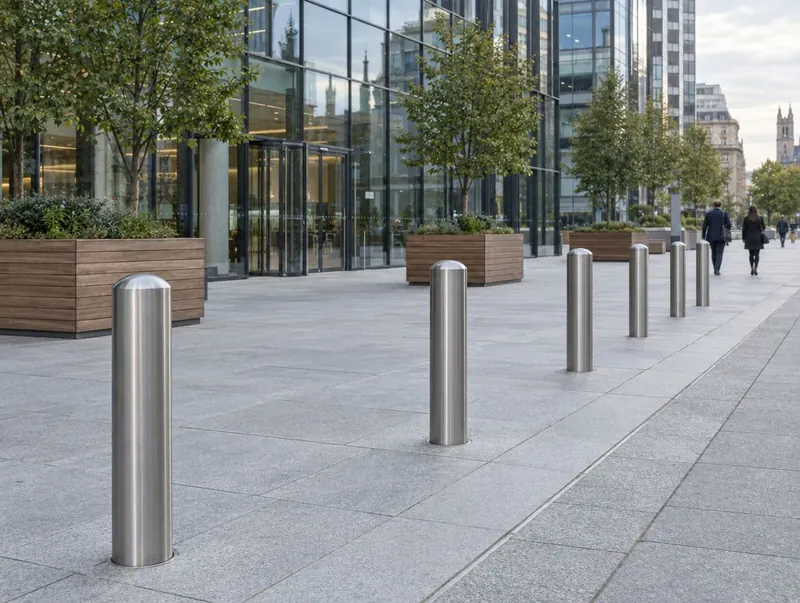 Computer-generated image
What is it?
What are stainless steel bollards and bollard covers?
A stainless steel bollard is a post made from, or clad in, corrosion-resistant stainless steel, chosen mainly for appearance and low maintenance at building entrances and public spaces. A stainless bollard cover is a sleeve that slides over an existing or new steel core, changing its look without replacing the structural post. Grade 304 suits most inland sites, while 316 is preferred near the coast, pools or heavy de-icing salt.
Stainless steel is the finish people associate with office entrances, hotel forecourts, retail parks and civic squares. It does not need painting, it suits glass and metal facades, and it can be brushed or polished to match ironmongery and signage. It is also the usual way to make a security bollard look like street furniture, by sleeving a steel or crash-tested core.
Getting stainless right is mostly about grade, surface finish and fixing. Poorly chosen stainless develops brown tea staining within a season, and covers fitted carelessly rattle or trap water. Our installation crews, working under our management, fit solid stainless posts and sleeve covers over new or existing cores, including covers supplied by manufacturers for their rated products.
Where stainless steel bollards make sense
- Office, hotel and hospital entrances
- Retail parks and shopping centre frontages
- Civic squares and pedestrianised plazas
- Sleeving existing painted steel posts that have become tatty
- Disguising crash-rated cores as ordinary street furniture
- Coastal and poolside sites where paint finishes fail
- Matching stainless canopies, handrails and signage
How it works
Solid stainless bollards are fabricated from stainless tube, either fixed into the ground with a stainless or galvanised root, bolted down on a plate, or set in a socket so they can be removed. Because stainless tube is usually thinner-walled than structural steel, solid stainless posts are often filled with concrete or fitted over a steel insert for strength.
Covers work the other way round. The structural job is done by a steel core, which may be a plain galvanised post or a crash-tested bollard, and a stainless sleeve is slid over it and fixed with concealed grub screws or a capping arrangement. The cover adds no strength. On rated bollards, covers should come from the manufacturer or be approved by them, because a cover that changes how the post deforms could affect the tested performance.
The grade decides how the steel copes with its surroundings. 304 performs well inland in normal urban air. 316 contains molybdenum and resists chlorides from sea spray, swimming pools and road salt much better. Surface finish matters too: a smooth polished or fine-brushed surface sheds dirt and resists staining better than a coarse finish.
Options and finishes
| Option | Detail |
|---|---|
| Grade 304 or 316 | 304 for most inland locations; 316 near the coast, swimming pools, or roads and car parks salted heavily in winter. |
| Brushed or polished finish | Satin brushed finishes hide fingerprints and light scratches; mirror polish is striking but shows every mark. |
| Solid stainless posts | Root-fixed, base-plated or removable posts, often concrete-filled or with a steel insert for strength. |
| Sleeve covers | Stainless sleeves over existing or new steel cores, sized to the core diameter, to refresh or upgrade appearance. |
| Covers for rated bollards | Manufacturer-supplied or approved covers for crash-tested cores so the security rating is not compromised. |
| Heads and details | Domed, flat, angled or ball tops, grooved bands, engraved logos and inset reflective strips. |
| Contrasting bands | Dark or reflective bands so posts stand out against pale paving, which bare stainless often does not. |
Typical specification
| Item | Typical |
|---|---|
| Grades | 304 for general use, 316 for coastal or chloride exposure |
| Exposed height | Typically 800–1,000 mm |
| Diameters | Commonly 76–273 mm; covers sized to the core |
| Finish | Satin brushed or polished; fine finishes resist staining better |
| Fixing | Root-fixed, base plate, socket, or sleeve over a core |
| Cover fixing | Concealed grub screws, cap fixings or adhesive, product dependent |
| Visibility | Contrasting or reflective band recommended |
Typical values only — the survey and the product's data sheet set the final specification.
How we install it
Survey and match
A free site survey records existing cores, diameters, heights and the setting, including any salt or coastal exposure that points to 316. You receive a fixed written quote covering grade, finish and fixing.
Prepare the cores
For covers, existing posts are checked for straightness, loose foundations and corrosion. Cores that lean or move are re-bedded first, because a cover will not hide a failing post for long.
Install new posts
New solid stainless posts are set in concrete, bolted down or fitted into sockets, with care taken not to scratch the finish or contaminate it with carbon steel tools.
Fit covers
Sleeves are slid over the cores, packed so they cannot rattle, and fixed with concealed fixings. A gap or drainage detail at the base stops water being trapped inside.
Clean and protect
Fingerprints, grinding dust and adhesive residue are cleaned off with suitable stainless cleaners, and the protective film is removed only when surrounding work is finished.
Ground, foundations and buried services
For solid stainless posts the foundation work is the same as for steel: dig to depth, check for services, set in concrete and reinstate. The difference is in handling. Stainless can be stained by iron particles from cutting discs, drills and steel tools used nearby, and those particles rust on the surface within days. Paving around new posts is cut before the posts arrive, or the posts are protected while it happens. Where covers go over existing posts, there is usually no excavation at all, but the base of the old post often sits in broken surfacing that is worth making good at the same time so the cover finishes neatly against a clean edge.
Rules and checks before you order
- Add a contrasting band near the top, because bare stainless can blend into pale paving for partially sighted people.
- Keep clear gaps of typically at least 1,000–1,200 mm on pedestrian routes, in line with Inclusive Mobility guidance.
- On crash-rated bollards, confirm with the manufacturer that the cover is approved for the tested product.
- Check with the local planning authority before installing in conservation areas or beside listed buildings, where stainless may not be considered appropriate.
See rules and standards by nation for highway consent, accessibility and security standards.
Maintenance
Stainless steel is low maintenance, not no maintenance. Wash it periodically with water and a mild detergent, more often near the coast or busy roads, and rinse off road salt after winter. Light tea staining can be removed with a stainless cleaner and a non-scratch pad, working with the grain of a brushed finish. Avoid wire wool and steel brushes, which leave particles that rust. Check covers for loose fixings and rattles, and look at the base for trapped water or rust from an old core underneath.
What affects the price
- Grade 304 or 316 and the surface finish
- Solid posts or covers over existing cores
- Diameter and height, and any custom heads or engraving
- Condition of existing cores and any re-bedding needed
- Manufacturer-approved covers for rated bollards
- Surface reinstatement and protection of the finish during works
Guide prices: stainless steel bollards
Three typical specifications. The middle one is the specification we usually recommend for durability and visibility.
Standard
per bollard + VAT · homes £345–£805 inc VAT
- Standard post or product for the type
- Foundation and fixing to manufacturer's details
- Surface reinstated to match
Upgraded
per bollard + VAT · homes £675–£1,145 inc VAT
- Upgraded finish (RAL colour, stainless or sleeve)
- Retroreflective band and matched keys
- Everything in Standard
Premium
per bollard + VAT · homes £995–£1,445 inc VAT
- Heavy-duty or architectural specification
- Premium finish and fittings
- Everything in Upgraded
Guide prices for the UK base region; local pages adjust for your area. Per bollard, supplied and installed. Minimum job £695 + VAT. Your fixed price comes in writing after survey.
Stainless steel bollards: questions answered
How much does stainless steel bollards and covers cost?
Typically £295–£1,195 per bollard, supplied and installed, plus VAT. For homeowners that's £345–£1,445 including VAT. Small jobs carry a minimum charge of £695 plus VAT. Ground conditions, access, buried services and consents move the figure; the fixed price comes in writing after survey.
Should I choose 304 or 316 stainless for bollards?
Choose 316 if the bollards are near the sea, a swimming pool or a road that is salted heavily; choose 304 for most other locations. The extra resistance of 316 to chlorides is what stops brown staining in those settings.
Can stainless covers go over our existing steel bollards?
Yes, if the existing posts are straight, firmly fixed and a size the covers can be made to fit. Leaning or loose posts are re-bedded first. It is often a quicker way to refresh a frontage than replacing every post.
Why has our stainless steel gone brown?
Usually because of tea staining from chlorides, a grade unsuited to the location, a coarse finish that holds dirt, or iron contamination from nearby cutting. Most of it cleans off. If it keeps returning, the grade or finish may be wrong for the site.
Do stainless covers affect a crash rating?
They can if they are not part of the tested product. Use covers supplied or approved by the bollard manufacturer. We fit approved covers and leave the core and foundation exactly as installed.
Are stainless bollards stronger than steel ones?
Not necessarily. Stainless tube is often thinner-walled, so strength depends on wall thickness, infill and fixing. Many stainless posts get their strength from a concrete fill or a steel core inside.
How should stainless bollards be cleaned?
With water and mild detergent, then rinsed and dried, more often in coastal or salty conditions. Use stainless cleaners and non-scratch pads for marks. Never use wire wool or steel brushes.
Related bollard services
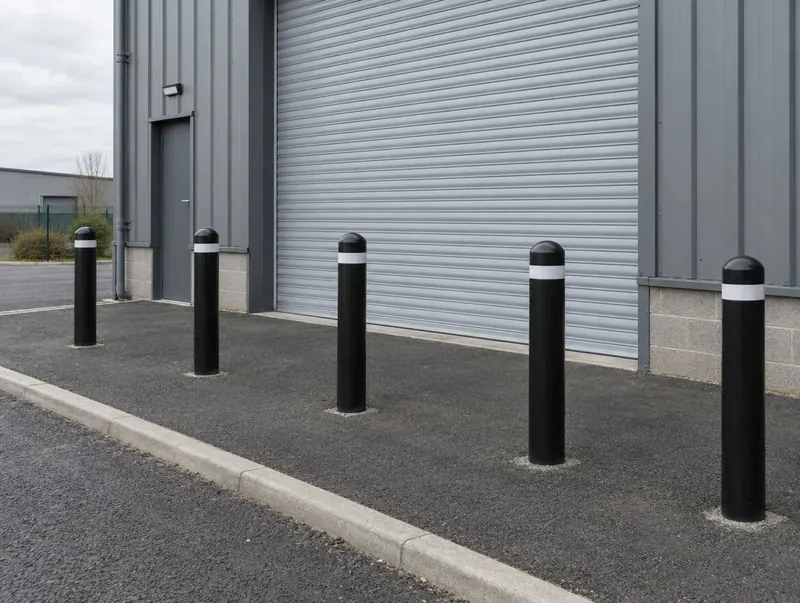
Steel security bollards (unrated)
Concrete-filled steel bollards, root-fixed or base-plated, for car parks, forecourts, boundaries and nuisance vehicle control.
Learn more →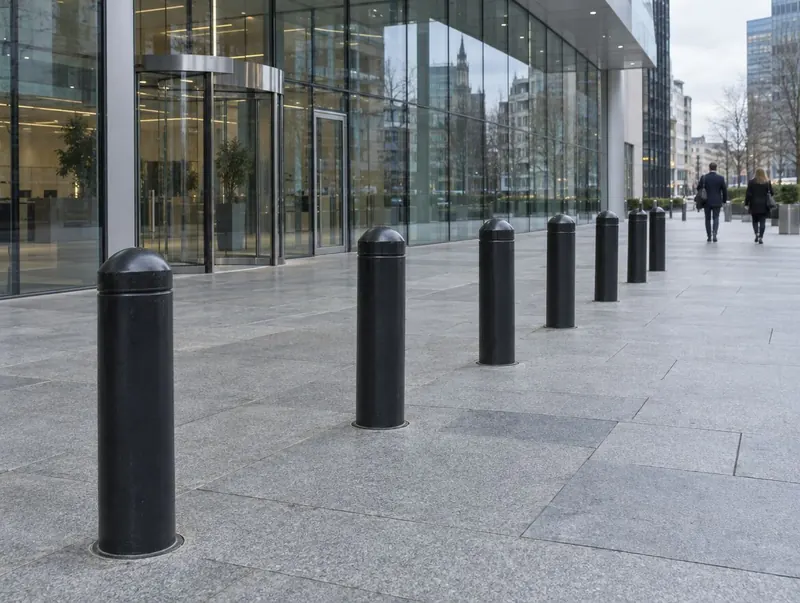
Crash-rated (HVM) bollards
Installation of impact-tested HVM bollards rated to ISO 22343-1 (or the superseded, still-accepted PAS 68 / IWA 14-1) on the tested foundation.
Learn more →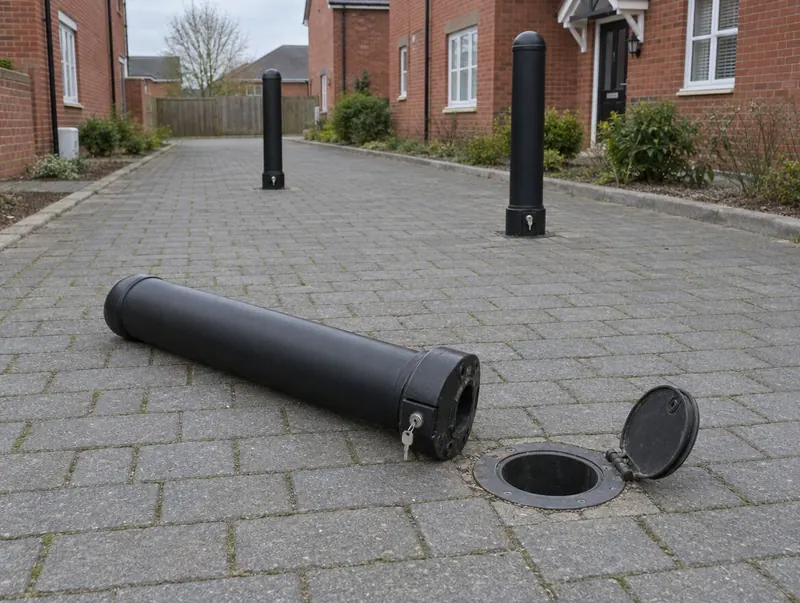
Removable bollards
Lift-out bollards in lockable ground sockets for driveways, delivery routes, access roads and emergency access points.
Learn more →
Lighting bollards
Low-level LED bollard lights for paths, car parks, entrances and gardens, installed with a qualified electrician.
Learn more →Stainless steel bollards near you
Local pages show the highway authority, postcodes covered and regional prices.
- Bedfordshire
- Berkshire
- Bristol
- Buckinghamshire
- Cambridgeshire
- Cheshire
- Cornwall
- County Durham
- Cumbria
- Derbyshire
- Devon
- Dorset
- East Riding of Yorkshire
- East Sussex
- Essex
- Gloucestershire
- Greater Manchester
- Hampshire
- Herefordshire
- Hertfordshire
- Isle of Wight
- Kent
- Lancashire
- Leicestershire
- Lincolnshire
- London
- Merseyside
- Norfolk
- North Yorkshire
- Northamptonshire
- Northumberland
- Nottinghamshire
- Oxfordshire
- Rutland
- Shropshire
- Somerset
- South Yorkshire
- Staffordshire
- Suffolk
- Surrey
- Tyne and Wear
- Warwickshire
- West Midlands
- West Sussex
- West Yorkshire
- Wiltshire
- Worcestershire
- Blaenau Gwent
- Bridgend
- Caerphilly
- Cardiff
- Carmarthenshire
- Ceredigion
- Conwy
- Denbighshire
- Flintshire
- Gwynedd
- Isle of Anglesey
- Merthyr Tydfil
- Monmouthshire
- Neath Port Talbot
- Newport
- Pembrokeshire
- Powys
- Rhondda Cynon Taf
- Swansea
- Torfaen
- Vale of Glamorgan
- Wrexham
- Aberdeen City
- Aberdeenshire
- Angus
- Argyll and Bute
- City of Edinburgh
- Clackmannanshire
- Dumfries and Galloway
- Dundee City
- East Ayrshire
- East Dunbartonshire
- East Lothian
- East Renfrewshire
- Falkirk
- Fife
- Glasgow City
- Highland
- Inverclyde
- Midlothian
- Moray
- North Ayrshire
- North Lanarkshire
- Perth and Kinross
- Renfrewshire
- Scottish Borders
- South Ayrshire
- South Lanarkshire
- Stirling
- West Dunbartonshire
- West Lothian
- Antrim and Newtownabbey
- Ards and North Down
- Armagh City, Banbridge and Craigavon
- Belfast
- Causeway Coast and Glens
- Derry City and Strabane
- Fermanagh and Omagh
- Lisburn and Castlereagh
- Mid Ulster
- Mid and East Antrim
- Newry, Mourne and Down