England · 10 towns
Stainless steel bollards and covers in Devon
Stainless steel bollards for sites across Devon: surveyed, quoted in writing and installed by our crews.
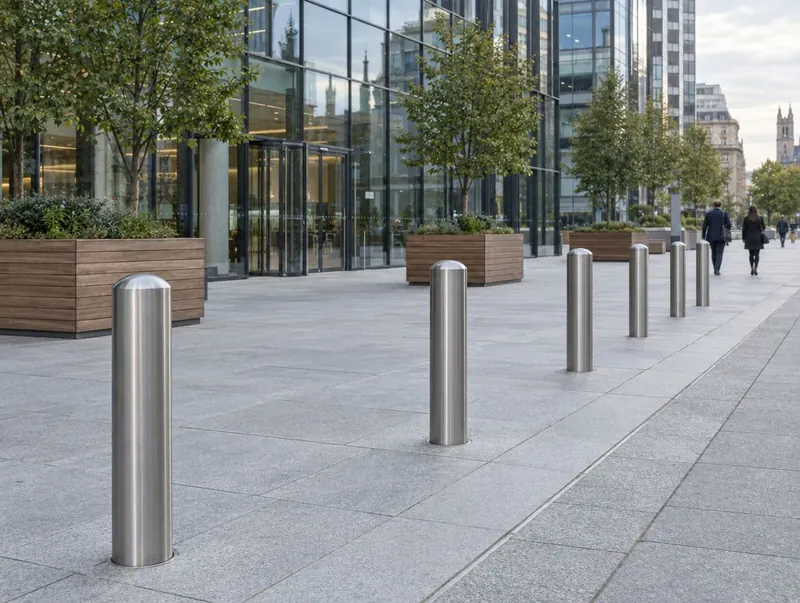 Computer-generated image
Stainless steel bollards in Devon
We supply and install stainless steel bollards across Devon, with local pages for 10 towns below. Stainless steel bollards and sleeve covers in 304 or 316 grade, for building entrances, plazas and upgrading tired steel posts.
Highway authorities for local roads in Devon: Devon County Council, Plymouth City Council and Torbay Council.
Choose your town in Devon
Guide prices in Devon
| Specification | Guide price | Includes |
|---|---|---|
| Standard | £295–£675 + VAT · £345–£805 inc VAT | Standard post, foundation, reinstatement |
| Upgraded | £565–£945 + VAT · £675–£1,145 inc VAT | Upgraded finish or fittings, reflective band, matched keys |
| Premium | £835–£1,195 + VAT · £995–£1,445 inc VAT | Heavy-duty or architectural spec, premium finish |
Per bollard, supplied and installed; no regional adjustment. Guide only — the fixed price follows a survey.
Highway and planning authorities in Devon
| Town | Highway / roads authority | Planning authority |
|---|---|---|
| Plymouth | Plymouth City Council | Plymouth City Council |
| Exeter | Devon County Council | the council for Exeter |
| Paignton | Torbay Council | Torbay Council |
| Torquay | Torbay Council | Torbay Council |
| Newton Abbot | Devon County Council | the council for Teignbridge |
| Exmouth | Devon County Council | the council for East Devon |
| Barnstaple | Devon County Council | the council for North Devon |
| Bideford | Devon County Council | the council for Torridge |
| Plymstock | Plymouth City Council | Plymouth City Council |
| Tiverton | Devon County Council | the council for Mid Devon |
Rules for stainless steel bollards in England
Bollards on adopted highway are a matter for the highway authority under the Highways Act 1980, so they need its written agreement. On private land the owner's agreement is what matters; listed buildings and conservation areas need a word with the planning team first.
Details and sources: bollard rules in England.
How installation works
Prepare the cores
For covers, existing posts are checked for straightness, loose foundations and corrosion. Cores that lean or move are re-bedded first, because a cover will not hide a failing post for long.
Install new posts
New solid stainless posts are set in concrete, bolted down or fitted into sockets, with care taken not to scratch the finish or contaminate it with carbon steel tools.
Fit covers
Sleeves are slid over the cores, packed so they cannot rattle, and fixed with concealed fixings. A gap or drainage detail at the base stops water being trapped inside.
Clean and protect
Fingerprints, grinding dust and adhesive residue are cleaned off with suitable stainless cleaners, and the protective film is removed only when surrounding work is finished.
Stainless steel bollards in Devon: FAQs
Do you cover all of Devon for stainless steel bollards?
Yes — including Plymouth, Exeter, Paignton, Torquay, Newton Abbot, Exmouth, Barnstaple and Bideford. Enter your postcode in the price calculator to confirm.
How much do stainless steel bollards cost in Devon?
In Devon, typically £295–£1,195 per bollard, supplied and installed, plus VAT (£345–£1,445 including VAT for homeowners), with a minimum job of £695 plus VAT, using our South West guide prices. The fixed figure comes in writing after we've seen the site.
Who do I ask about bollards on public land in Devon?
For local roads, Devon County Council, Plymouth City Council and Torbay Council; National Highways covers motorways and trunk roads. Bollards on adopted highway need the highway authority's written agreement.
How should stainless bollards be cleaned?
With water and mild detergent, then rinsed and dried, more often in coastal or salty conditions. Use stainless cleaners and non-scratch pads for marks. Never use wire wool or steel brushes.
Should I choose 304 or 316 stainless for bollards?
Choose 316 if the bollards are near the sea, a swimming pool or a road that is salted heavily; choose 304 for most other locations. The extra resistance of 316 to chlorides is what stops brown staining in those settings.