Traffic & site protection
Flexible bollard installation
Polyurethane and spring-based bollards that bend when hit and return upright, for car parks, depots and lane separation.
- Typically £195–£595 per bollard + VAT; minimum job £445
- Free survey and fixed written quote
- Foundations and reinstatement included
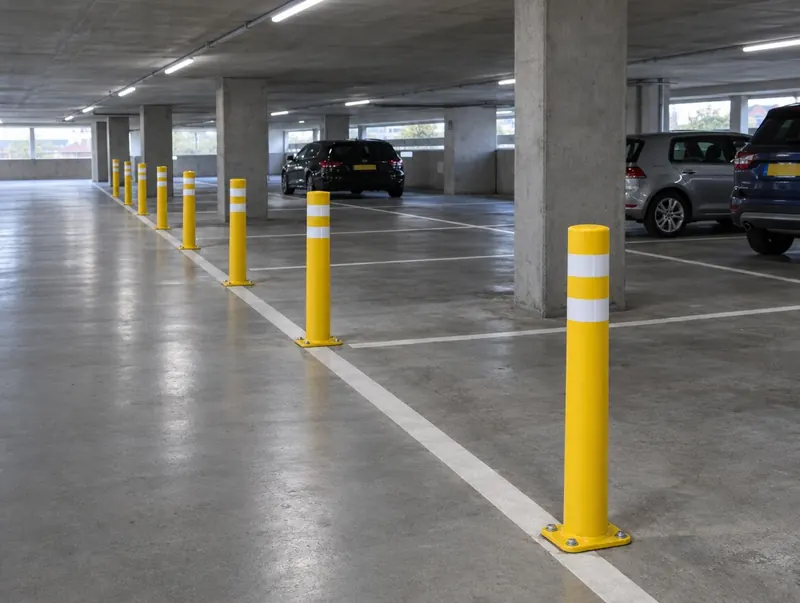 Computer-generated image
What is it?
What are flexible impact-recoverable bollards?
A flexible bollard is a post made from polyurethane or another resilient polymer, or mounted on a sprung base, that bends over when struck by a vehicle and returns upright afterwards. It guides and separates traffic without damaging the vehicle or itself in a typical low-speed knock. Flexible bollards are traffic management products, not barriers, and will not stop a vehicle that is driven at them.
In car parks, depots, bus stations and service yards, drivers clip posts constantly. Rigid steel bollards in those positions get bent, crack their foundations and scratch every vehicle that touches them, and the repair bill for both builds up. Flexible bollards take the opposite approach: they mark the edge clearly, give way under impact and spring back, so the line stays in place and nobody's bumper is ruined.
They suit places where the aim is to guide drivers rather than physically stop them: lane dividers, entry and exit splits, the edges of pedestrian routes inside car parks and the approaches to barriers and pay stations. Our installation crews, working under our management, fit surface-mounted and socket-based flexible posts, and we are clear about the places where a rigid post is still the right answer.
Where flexible bollards make sense
- Lane separation at car park entrances and exits
- Approaches to barriers, pay stations and ticket machines
- Depot and yard routes where vehicles knock posts daily
- Marking pedestrian routes inside multi-storey car parks
- Bus stations and coach parks
- Drive-thru lanes and fuel forecourts
- Temporary or trial layouts before permanent kerbs
How it works
Two designs dominate. Solid or hollow polymer posts flex along their length and recover their shape because the material itself has memory. Sprung-base posts are stiffer, often steel or rigid plastic, mounted on a heavy spring or elastomer joint at ground level so the whole post tilts over and returns. Polymer posts give a softer impact; sprung posts look more like conventional bollards and stand up better to wind and vandalism.
Either type is fixed to a base. Bolt-down bases are anchored to the slab or surface with resin anchors or through-bolts. Socket bases are set flush in the ground, and the post plugs into them, which means a damaged post can be swapped quickly without disturbing the fixing. On car park decks, low-profile bases avoid drilling deep into the structure.
A flexible bollard's recovery depends on the impact. It is designed for the glancing blows and low-speed bumps of everyday driving. A lorry running fully over a post, or a vehicle hitting it at speed, can tear the post or its base. Cold weather also makes polymers stiffer, so recovery is slower in winter. Spacing also changes how the line reads. Posts set close together look like a continuous edge and drivers respect them; posts spread too far apart look optional and get driven between, which defeats the purpose of a lane divider.
Options and finishes
| Option | Detail |
|---|---|
| Polyurethane posts | Flex along their length and return to shape. Gentle on vehicles and common in car parks and on forecourts. |
| Sprung-base bollards | A rigid post on a heavy spring or elastomer base that tilts and returns. Looks like a conventional bollard. |
| Bolt-down or socket bases | Bolt-down for existing slabs; socket bases allow posts to be replaced without new fixings. |
| Heights and diameters | Commonly 750–1,000 mm high and around 80–200 mm diameter, with slimmer wand-style posts for lane lines. |
| Colours and reflective sleeves | Yellow, black, red, white or orange, with reflective sleeves for visibility in low light. |
| Low-profile deck bases | Shallow fixings for multi-storey decks where deep drilling is not permitted. |
Typical specification
| Item | Typical |
|---|---|
| Material | Polyurethane or similar polymer, or rigid post on a sprung base |
| Height | Typically 750–1,000 mm |
| Diameter | Commonly 80–200 mm |
| Fixing | Resin anchors or through-bolts; flush socket bases on some models |
| Recovery | Returns upright after typical low-speed impacts; slower in cold weather |
| Visibility | Reflective sleeves or bands |
| Role | Traffic guidance only; not a security or stopping barrier |
Typical values only — the survey and the product's data sheet set the final specification.
How we install it
Survey traffic movements
The free site survey looks at vehicle sizes, turning paths and where drivers currently clip posts or kerbs. You receive a fixed written quote with post type and fixing.
Check the surface
Slabs and decks are checked for thickness, reinforcement and waterproofing before drilling. Weak tarmac may need a concrete pad or socket base.
Set out the line
Posts are set out to guide vehicles along the intended path, with spacing that reads as a line to drivers.
Fix the bases
Holes are drilled and cleaned, resin anchors or bolts are set and the bases fixed and torqued once cured. Socket bases are set flush in concrete.
Fit posts and test
Posts are fitted and bent by hand to confirm they return upright, and reflective sleeves are applied.
Hand over spares and records
Post and base details are recorded so replacements match, and spare posts can be left on site for busy locations. Staff are shown how a post is swapped on its base.
Ground, foundations and buried services
Flexible bollards put repeated load on their fixings, because every knock rocks the base. Anchors therefore need sound concrete with enough edge distance; anchoring into thin, cracked or weak surfaces means the base works loose within weeks. On tarmac, a small concrete pad or a socket base cast in concrete is the reliable option. Multi-storey and rooftop decks are a special case: slabs may be post-tensioned or carry waterproofing and heating, so drilling depth and positions are agreed with the building owner and scanned first. Where posts go in a line across a drainage fall, positions avoid channels and gullies.
Rules and checks before you order
- Do not use flexible bollards where a physical barrier is needed to protect people or buildings; they guide rather than stop.
- Check drilling into car park decks or podium slabs with the building owner before fixing.
- On public highway, including cycle lane segregation, the highway authority's agreement and specification are needed.
- Keep pedestrian gaps and routes clear, referring to Inclusive Mobility guidance where people walk through the line.
See rules and standards by nation for highway consent, accessibility and security standards.
Maintenance
Check flexible bollards for splits, permanent bends and loose bases, and tighten or replace fixings that have worked loose. Clean reflective sleeves so they stay visible, and replace them when they fade or peel. Posts exposed to strong sunlight slowly lose flexibility and colour, and eventually crack; replacing the post on its existing base is usually quick. Keep a few spare posts on site where knocks are frequent, so a damaged one can be swapped before the line develops a gap. After resurfacing or line repainting, check that the bases were not disturbed or painted over, and that posts still line up with the new markings.
What affects the price
- Polymer posts or sprung-base bollards
- Number of posts and length of line
- Bolt-down or socket base
- Surface condition and need for concrete pads
- Deck scanning and restrictions on drilling
- Out-of-hours working in busy car parks
Guide prices: flexible bollards
Three typical specifications. The middle one is the specification we usually recommend for durability and visibility.
Standard
per bollard + VAT
- Standard post or product for the type
- Foundation and fixing to manufacturer's details
- Surface reinstated to match
Upgraded
per bollard + VAT
- Upgraded finish (RAL colour, stainless or sleeve)
- Retroreflective band and matched keys
- Everything in Standard
Premium
per bollard + VAT
- Heavy-duty or architectural specification
- Premium finish and fittings
- Everything in Upgraded
Guide prices for the UK base region; local pages adjust for your area. Per bollard, supplied and fixed. Minimum job £445 + VAT. Your fixed price comes in writing after survey.
Flexible bollards: questions answered
How much does flexible bollard installation cost?
Typically £195–£595 per bollard, supplied and fixed, plus VAT. Small jobs carry a minimum charge of £445 plus VAT. Ground conditions, access, buried services and consents move the figure; the fixed price comes in writing after survey.
Will a flexible bollard stop a car?
No. It is designed to bend and recover, so a car can push past it. It marks the line and discourages drivers from crossing it. Where a vehicle must be physically stopped, use a rigid bollard.
Do flexible bollards damage vehicles?
Typically very little in a low-speed knock, which is a large part of their appeal. They may leave a scuff on paintwork. A rigid post in the same position would usually dent the vehicle and bend itself.
How many times can a flexible bollard be hit?
Many times in normal use, as long as the impacts are the low-speed bumps it is designed for. A heavy vehicle running right over it, or a high-speed strike, can tear it. Manufacturers give guidance for their products.
Can flexible bollards go in a multi-storey car park?
Yes, often with low-profile bases. The deck has to be checked first, as some slabs contain tendons or waterproofing that must not be drilled. The building owner usually needs to agree the fixing method.
Can a damaged flexible post be replaced on the same base?
Usually, yes, especially with socket bases designed for it. The post is removed and a new one fitted. If the base itself is damaged or loose, it is re-fixed or replaced at the same time.
Do flexible bollards work in cold weather?
They do, but polymers become stiffer in cold conditions and recover more slowly after a knock. Sprung-base designs are less affected. Neither type is damaged by normal UK winter temperatures.
Related bollard services
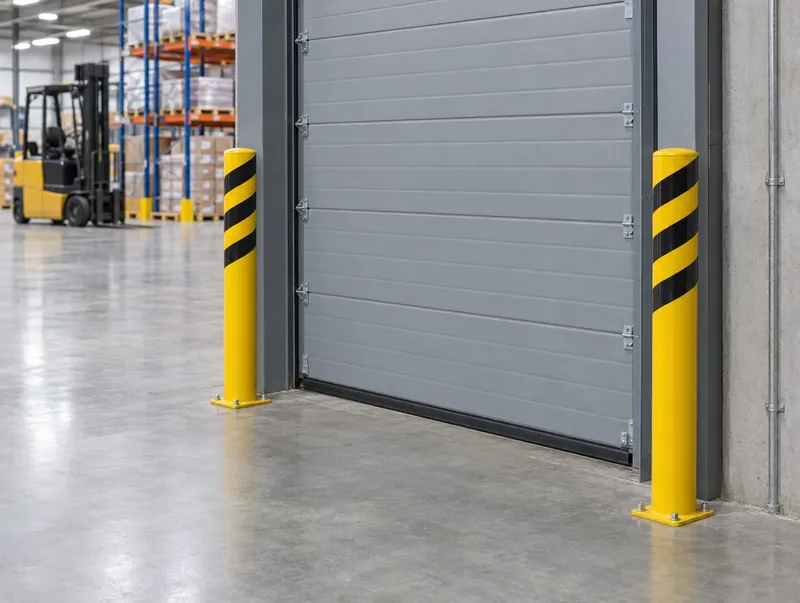
Warehouse and loading-bay impact bollards
Yellow steel and polymer impact bollards for forklift zones, loading bays, doors, columns and racking inside warehouses.
Learn more →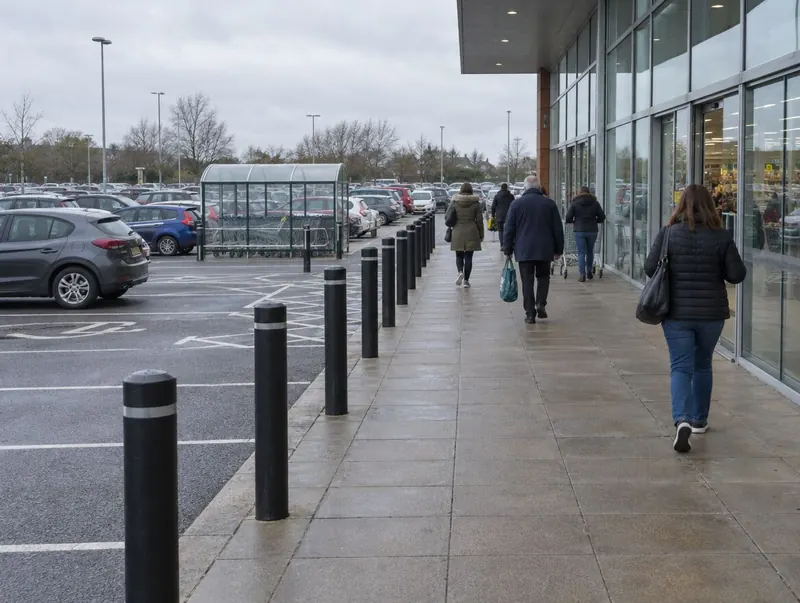
Pedestrian and shopfront protection bollards
Bollards that separate people from vehicles at car parks, forecourts, walkways, drive-thrus and shop entrances.
Learn more →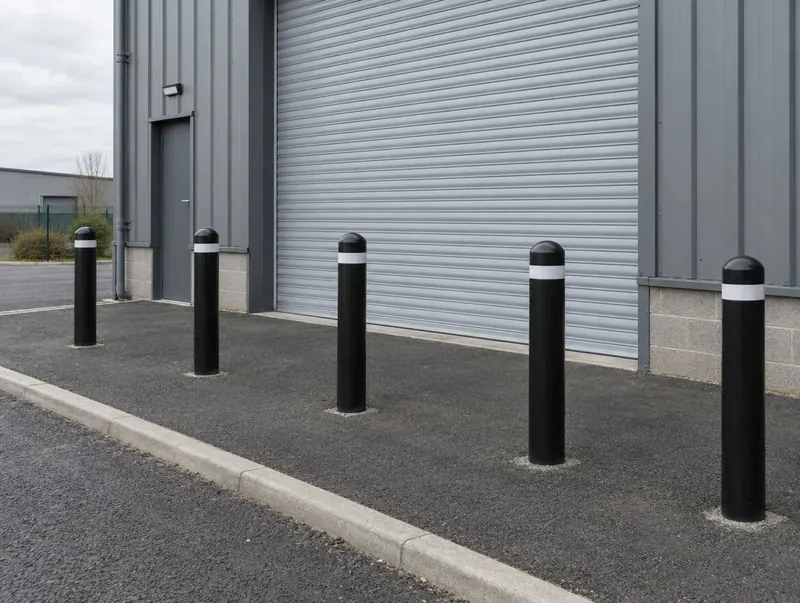
Steel security bollards (unrated)
Concrete-filled steel bollards, root-fixed or base-plated, for car parks, forecourts, boundaries and nuisance vehicle control.
Learn more →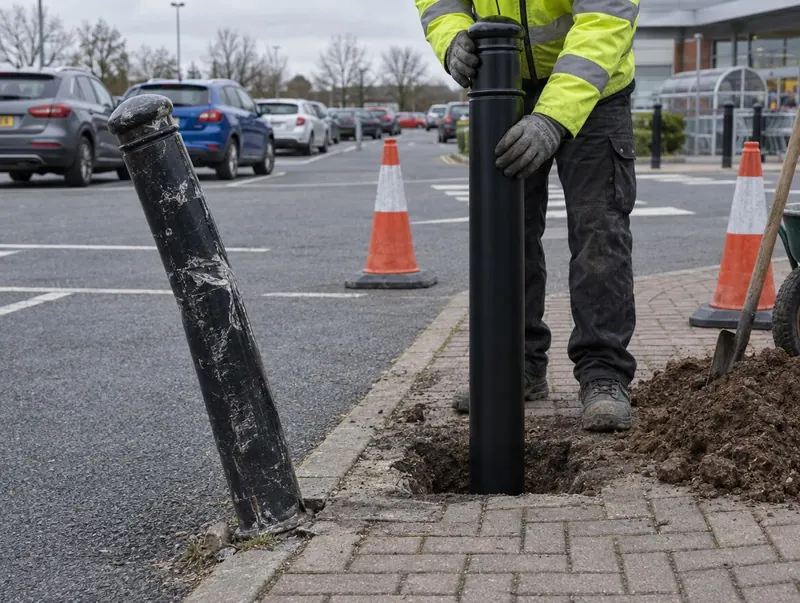
Bollard replacement
Like-for-like or upgraded replacement of bollards damaged by vehicles, corrosion or wear, matched to the existing line.
Learn more →Flexible bollards near you
Local pages show the highway authority, postcodes covered and regional prices.
- Bedfordshire
- Berkshire
- Bristol
- Buckinghamshire
- Cambridgeshire
- Cheshire
- Cornwall
- County Durham
- Cumbria
- Derbyshire
- Devon
- Dorset
- East Riding of Yorkshire
- East Sussex
- Essex
- Gloucestershire
- Greater Manchester
- Hampshire
- Herefordshire
- Hertfordshire
- Isle of Wight
- Kent
- Lancashire
- Leicestershire
- Lincolnshire
- London
- Merseyside
- Norfolk
- North Yorkshire
- Northamptonshire
- Northumberland
- Nottinghamshire
- Oxfordshire
- Rutland
- Shropshire
- Somerset
- South Yorkshire
- Staffordshire
- Suffolk
- Surrey
- Tyne and Wear
- Warwickshire
- West Midlands
- West Sussex
- West Yorkshire
- Wiltshire
- Worcestershire
- Blaenau Gwent
- Bridgend
- Caerphilly
- Cardiff
- Carmarthenshire
- Ceredigion
- Conwy
- Denbighshire
- Flintshire
- Gwynedd
- Isle of Anglesey
- Merthyr Tydfil
- Monmouthshire
- Neath Port Talbot
- Newport
- Pembrokeshire
- Powys
- Rhondda Cynon Taf
- Swansea
- Torfaen
- Vale of Glamorgan
- Wrexham
- Aberdeen City
- Aberdeenshire
- Angus
- Argyll and Bute
- City of Edinburgh
- Clackmannanshire
- Dumfries and Galloway
- Dundee City
- East Ayrshire
- East Dunbartonshire
- East Lothian
- East Renfrewshire
- Falkirk
- Fife
- Glasgow City
- Highland
- Inverclyde
- Midlothian
- Moray
- North Ayrshire
- North Lanarkshire
- Perth and Kinross
- Renfrewshire
- Scottish Borders
- South Ayrshire
- South Lanarkshire
- Stirling
- West Dunbartonshire
- West Lothian
- Antrim and Newtownabbey
- Ards and North Down
- Armagh City, Banbridge and Craigavon
- Belfast
- Causeway Coast and Glens
- Derry City and Strabane
- Fermanagh and Omagh
- Lisburn and Castlereagh
- Mid Ulster
- Mid and East Antrim
- Newry, Mourne and Down