Access & parking control
Semi-automatic bollard installation
Gas-strut assisted bollards that rise on their own when unlocked and lower by hand, with no mains power needed.
- Typically £1,095–£3,495 per bollard + VAT (£1,295–£4,195 inc VAT for homes); minimum job £1,195
- Free survey and fixed written quote
- Foundations and reinstatement included
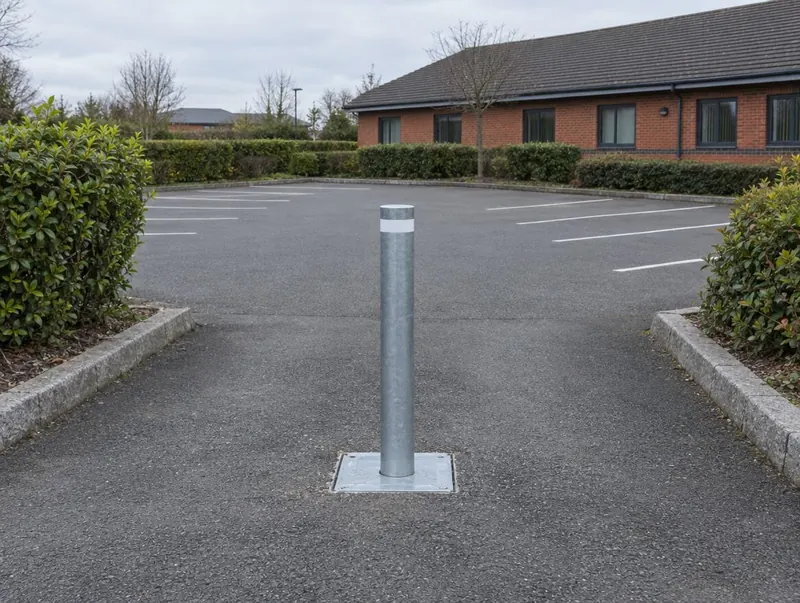 Computer-generated image
What is it?
What are semi-automatic bollards?
A semi-automatic bollard is a retractable post that rises by itself when unlocked, driven by a gas strut or spring inside its ground cassette, and is pushed back down by hand or foot until it locks below ground. It needs no electrical supply. It sits between telescopic bollards, which are lifted by hand, and automatic bollards, which are powered.
Semi-automatic bollards suit entrances used several times a day where lifting a post becomes a chore but power, loops and controls would be more than the site needs. The user turns a key and the post rises without help. To lower it, the key is used again and the post is pressed down until it latches flush. On staff car parks, delivery points and private roads that is quick enough to be practical.
The stored energy inside is what makes them convenient and also what needs respect. A gas strut pushes the post up with real force, so installation, maintenance and replacement of struts follow the manufacturer's procedures. Our installation crews, working under our management, set the cassettes, drainage and surrounds, and show site users how to operate the posts safely.
Where semi-automatic bollards make sense
- Staff car parks and reserved bays used several times a day
- Delivery entrances without a power supply nearby
- Private roads and courtyards with a small number of key holders
- Sites where telescopic posts are too heavy for regular users
- Driveways where the owner wants minimal effort
- Temporary closure points on campuses and estates
- Locations where automatic bollards are not justified
How it works
The bollard sits inside a cassette set into a concrete foundation, like a telescopic post, but with a gas strut or spring assembly in the base. When the post is pushed down, it compresses the strut and a latch holds it below ground. Turning the key releases the latch and the strut drives the post up until it locks at full height. Lowering is the reverse: release the upper lock and press the post down, usually with a hand or foot, until it latches again.
The strut provides the lifting force but slowly loses pressure over years of use. A post that rises sluggishly or stops short is usually telling you the strut needs replacing. Struts are a manufacturer-specified part, and replacement involves releasing stored energy safely, so it is done by someone who knows the product rather than improvised.
Cassette depth and drainage are similar to a telescopic bollard. Water and silt in the cassette slow the mechanism and corrode the latch, so the base must drain freely, and the top must be set exactly flush. Cold weather also affects gas struts, which push with less force at low temperatures, so a post that rises sluggishly on a frosty morning is not necessarily faulty.
Options and finishes
| Option | Detail |
|---|---|
| Gas strut or spring assist | Most models use a gas strut; some use springs. Both store energy to raise the post when unlocked. |
| Lock types | Keyed cylinder locks, typically operating at ground level, with keyed-alike options for multi-post sites. |
| Height and diameter | Raised heights commonly around 500–900 mm and diameters around 100–200 mm, depending on model and duty. |
| Finishes | Galvanised and powder-coated or stainless steel, with reflective bands for visibility. |
| Head lighting | Some models include battery or solar LEDs in the head to improve visibility on unlit sites. |
| Duty level | Light-duty domestic models and heavier commercial versions with stronger cassettes and posts. |
Typical specification
| Item | Typical |
|---|---|
| Operation | Key release, rises by gas strut or spring; lowered by hand |
| Raised height | Typically 500–900 mm |
| Diameter | Commonly around 100–200 mm |
| Excavation | Deep cassette pit, often around 1 m, model dependent |
| Power | None required |
| Drainage | Free-draining base or connection to surface water drainage |
| Service item | Gas strut replacement at intervals set by use and model |
Typical values only — the survey and the product's data sheet set the final specification.
How we install it
Survey use and ground
At the free site survey we look at how often the post will be used, who will operate it and what is under the surface. A fixed written quote follows, including drainage.
Excavate the pit
The surface is cut and the pit dug to the cassette depth plus a drainage layer, by hand near services.
Set the cassette
The cassette is set plumb and flush with the finished surface, connected to drainage and concreted in. The strut is fitted or released only as the manufacturer instructs.
Reinstate the surface
Paving or surfacing is made good tight to the cassette collar so there is no lip for tyres or feet to catch.
Test and show users
The post is cycled several times to check it rises fully, locks at both heights and lowers smoothly. Users are shown how to operate it and to keep clear of the head when it rises.
Ground, foundations and buried services
Because the cassette houses both the post and its strut mechanism, the pit is deep and must stay dry. On sandy or gravel ground a soakaway beneath the cassette often drains it adequately; on clay, chalk with poor drainage or where groundwater rises, a pipe to a surface water drain or a dedicated soakaway is needed. Buried services across the entrance are traced and the position adjusted if needed, as the cassette cannot simply be made shallower. Reinstatement around the collar has to be firm, because the post is pushed down by foot and any movement in the surround soon shows as cracking.
Rules and checks before you order
- Warn users and passers-by that the post rises on its own; fit reflective bands and consider a sign at busy sites.
- Keep clear gaps of typically at least 1,000–1,200 mm where pedestrians pass between posts, referring to Inclusive Mobility guidance.
- Check land ownership; bollards on public highway need the highway authority's agreement.
- Agree how emergency services will gain access if the post is locked up.
See rules and standards by nation for highway consent, accessibility and security standards.
Maintenance
Operate the bollard regularly and keep the head and lid clear of grit. Look into the cassette periodically for water or debris, and lubricate the lock and latch as the manufacturer suggests. Watch the rising speed: when it slows or the post no longer reaches full height, the strut is losing pressure and should be replaced before it fails altogether. Do not try to dismantle the strut assembly without the right procedure, as it holds stored energy. In winter, keep an eye on the lid after frost or snow; ice around the head can stop the post rising, and forcing the key or the post at that point damages the latch. If several posts on one site were installed at the same time, their struts tend to wear at a similar rate, so it can make sense to replace them together.
What affects the price
- Domestic or commercial duty model
- Excavation depth and services in the way
- Drainage method
- Finish and any head lighting
- Number of posts and keyed-alike locks
- Surface reinstatement
Guide prices: semi-automatic bollards
Three typical specifications. The middle one is the specification we usually recommend for durability and visibility.
Standard
per bollard + VAT · homes £1,295–£2,495 inc VAT
- Standard post or product for the type
- Foundation and fixing to manufacturer's details
- Surface reinstated to match
Upgraded
per bollard + VAT · homes £2,145–£3,395 inc VAT
- Upgraded finish (RAL colour, stainless or sleeve)
- Retroreflective band and matched keys
- Everything in Standard
Premium
per bollard + VAT · homes £3,045–£4,195 inc VAT
- Heavy-duty or architectural specification
- Premium finish and fittings
- Everything in Upgraded
Guide prices for the UK base region; local pages adjust for your area. Per bollard, supplied and installed. Minimum job £1,195 + VAT. Your fixed price comes in writing after survey.
Semi-automatic bollards: questions answered
How much does semi-automatic bollard installation cost?
Typically £1,095–£3,495 per bollard, supplied and installed, plus VAT. For homeowners that's £1,295–£4,195 including VAT. Small jobs carry a minimum charge of £1,195 plus VAT. Ground conditions, access, buried services and consents move the figure; the fixed price comes in writing after survey.
What makes a semi-automatic bollard rise without power?
A gas strut or spring inside the cassette. Pushing the post down compresses it and a latch holds the post below ground. Turning the key releases the latch and the stored energy lifts the post.
How is a semi-automatic bollard different from an automatic one?
An automatic bollard is powered and controlled by a panel, loops and access devices. A semi-automatic one rises on its own when unlocked but must be pushed down by hand. It needs no electrics, which keeps installation simpler.
Why has my semi-automatic bollard stopped rising fully?
Usually because the gas strut has lost pressure, or debris and water in the cassette are slowing it. Check and clean the cassette first. If it still stops short, the strut needs replacing.
Is it hard to push the bollard back down?
Not usually; most users press it down with a hand or foot. The strut resists, so it needs a steady push rather than a sharp kick. Heavier commercial models take more effort than domestic ones.
Can a semi-automatic bollard injure someone as it rises?
It rises with some force, so nobody should stand over it or put a hand on the head when releasing it. Users should be shown how to operate it safely. On busy sites, a sign and reflective bands help.
Do semi-automatic bollards suit domestic driveways?
Yes, if the owner wants less lifting than a telescopic post. The same depth and drainage checks apply. Domestic models are lighter duty than commercial ones.
Related bollard services
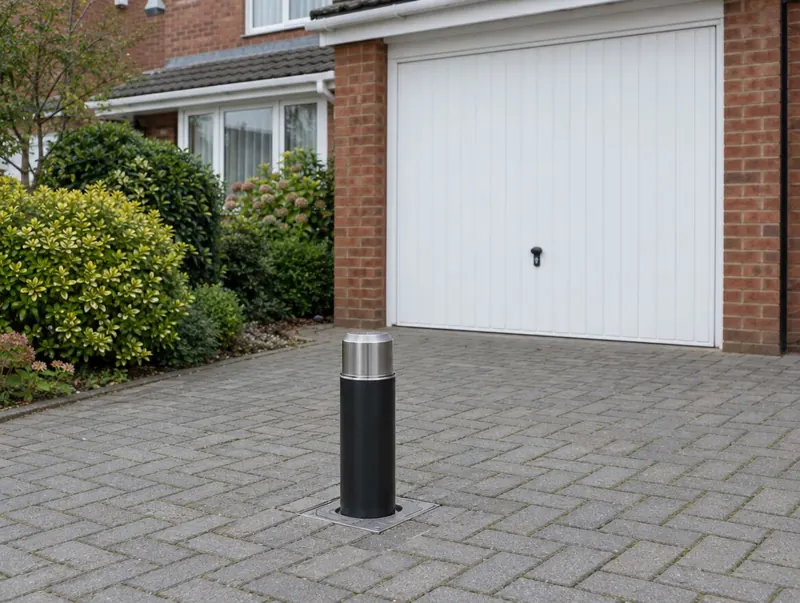
Telescopic bollards
Key-locked telescopic bollards that retract into a ground cassette, for driveways, private bays and access roads.
Learn more →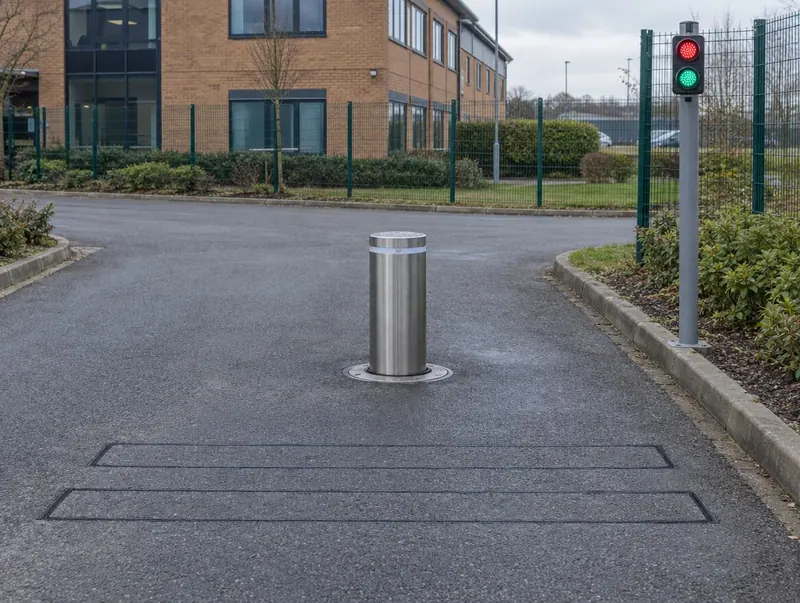
Automatic rising bollards
Hydraulic and electro-mechanical rising bollards installed with controls, safety loops, signals and power, for managed vehicle access.
Learn more →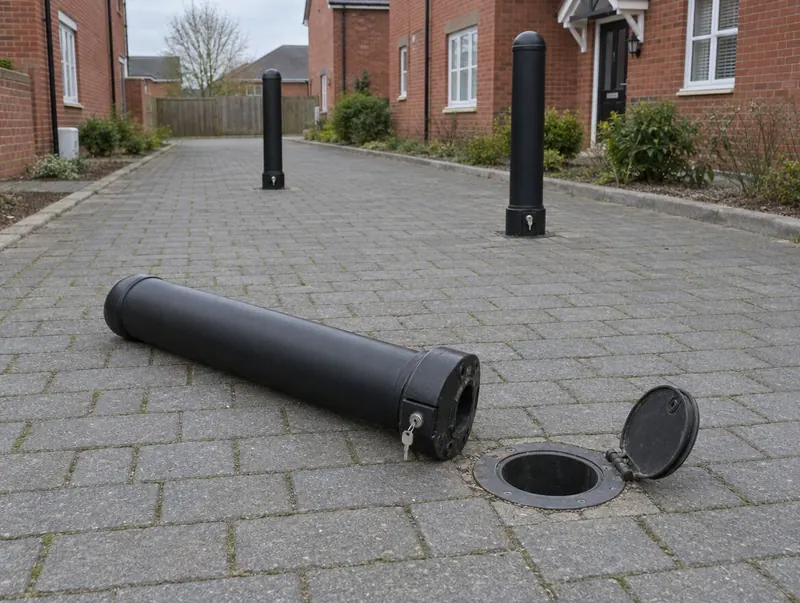
Removable bollards
Lift-out bollards in lockable ground sockets for driveways, delivery routes, access roads and emergency access points.
Learn more →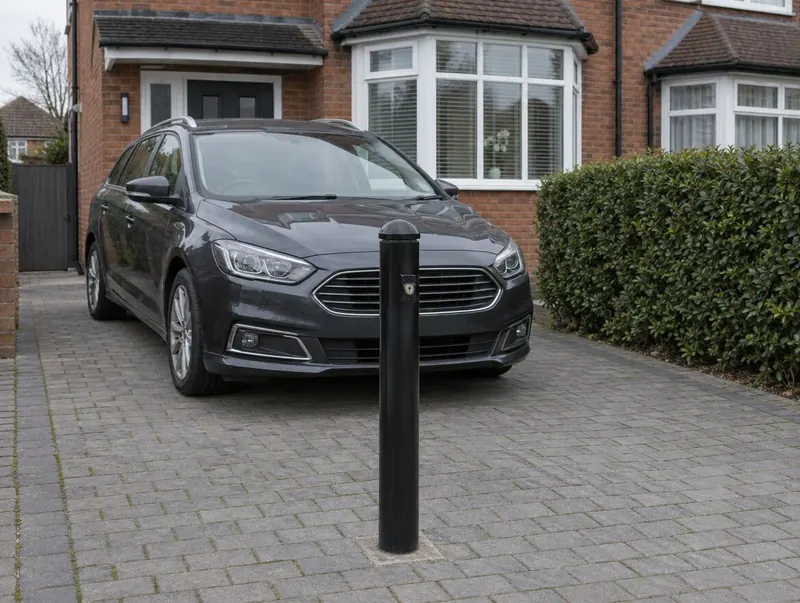
Driveway security posts
Telescopic, fold-down and removable security posts for home driveways, to deter car theft and stop unwanted parking.
Learn more →Semi-automatic bollards near you
Local pages show the highway authority, postcodes covered and regional prices.
- Bedfordshire
- Berkshire
- Bristol
- Buckinghamshire
- Cambridgeshire
- Cheshire
- Cornwall
- County Durham
- Cumbria
- Derbyshire
- Devon
- Dorset
- East Riding of Yorkshire
- East Sussex
- Essex
- Gloucestershire
- Greater Manchester
- Hampshire
- Herefordshire
- Hertfordshire
- Isle of Wight
- Kent
- Lancashire
- Leicestershire
- Lincolnshire
- London
- Merseyside
- Norfolk
- North Yorkshire
- Northamptonshire
- Northumberland
- Nottinghamshire
- Oxfordshire
- Rutland
- Shropshire
- Somerset
- South Yorkshire
- Staffordshire
- Suffolk
- Surrey
- Tyne and Wear
- Warwickshire
- West Midlands
- West Sussex
- West Yorkshire
- Wiltshire
- Worcestershire
- Blaenau Gwent
- Bridgend
- Caerphilly
- Cardiff
- Carmarthenshire
- Ceredigion
- Conwy
- Denbighshire
- Flintshire
- Gwynedd
- Isle of Anglesey
- Merthyr Tydfil
- Monmouthshire
- Neath Port Talbot
- Newport
- Pembrokeshire
- Powys
- Rhondda Cynon Taf
- Swansea
- Torfaen
- Vale of Glamorgan
- Wrexham
- Aberdeen City
- Aberdeenshire
- Angus
- Argyll and Bute
- City of Edinburgh
- Clackmannanshire
- Dumfries and Galloway
- Dundee City
- East Ayrshire
- East Dunbartonshire
- East Lothian
- East Renfrewshire
- Falkirk
- Fife
- Glasgow City
- Highland
- Inverclyde
- Midlothian
- Moray
- North Ayrshire
- North Lanarkshire
- Perth and Kinross
- Renfrewshire
- Scottish Borders
- South Ayrshire
- South Lanarkshire
- Stirling
- West Dunbartonshire
- West Lothian
- Antrim and Newtownabbey
- Ards and North Down
- Armagh City, Banbridge and Craigavon
- Belfast
- Causeway Coast and Glens
- Derry City and Strabane
- Fermanagh and Omagh
- Lisburn and Castlereagh
- Mid Ulster
- Mid and East Antrim
- Newry, Mourne and Down