Northern Ireland · 2 towns
Semi-automatic bollard installation in Antrim and Newtownabbey
Semi-automatic bollards for sites across Antrim and Newtownabbey: surveyed, quoted in writing and installed by our crews.
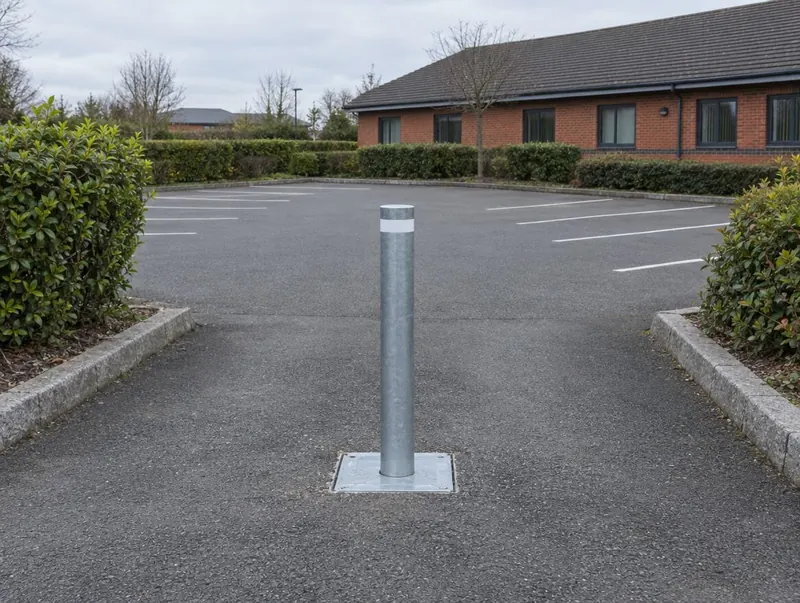 Computer-generated image
Semi-automatic bollards in Antrim and Newtownabbey
Across Antrim and Newtownabbey, typical sites for semi-automatic bollards include residential driveways, community car parks and small industrial units. Gas-strut assisted bollards that rise on their own when unlocked and lower by hand, with no mains power needed.
Across Northern Ireland, DfI Roads (the Department for Infrastructure) is the roads authority for public roads and footways; councils handle planning.
Choose your town in Antrim and Newtownabbey
Guide prices in Antrim and Newtownabbey
| Specification | Guide price | Includes |
|---|---|---|
| Standard | £1,095–£2,045 + VAT · £1,295–£2,445 inc VAT | Standard post, foundation, reinstatement |
| Upgraded | £1,795–£2,745 + VAT · £2,145–£3,295 inc VAT | Upgraded finish or fittings, reflective band, matched keys |
| Premium | £2,495–£3,445 + VAT · £2,995–£4,145 inc VAT | Heavy-duty or architectural spec, premium finish |
Per bollard, supplied and installed; -2% for Northern Ireland. Guide only — the fixed price follows a survey.
Local authorities across Antrim and Newtownabbey
| Town | Highway / roads authority | Planning authority |
|---|---|---|
| Newtownabbey | the Department for Infrastructure (DfI Roads) | Antrim and Newtownabbey Borough Council |
| Antrim | the Department for Infrastructure (DfI Roads) | Antrim and Newtownabbey Borough Council |
Rules for semi-automatic bollards in Northern Ireland
Bollards on public footways and roads need DfI Roads consent under the Roads (NI) Order 1993; councils deal with planning. On private land the owner's agreement is what matters; listed buildings and conservation areas need a word with the planning team first. Accessibility guidance asks for posts at least 1,000 mm high with contrasting tops and no chains between them.
Details and sources: bollard rules in Northern Ireland.
How installation works
Survey use and ground
At the free site survey we look at how often the post will be used, who will operate it and what is under the surface. A fixed written quote follows, including drainage.
Excavate the pit
The surface is cut and the pit dug to the cassette depth plus a drainage layer, by hand near services.
Set the cassette
The cassette is set plumb and flush with the finished surface, connected to drainage and concreted in. The strut is fitted or released only as the manufacturer instructs.
Reinstate the surface
Paving or surfacing is made good tight to the cassette collar so there is no lip for tyres or feet to catch.
Semi-automatic bollards in Antrim and Newtownabbey: FAQs
Do you cover all of Antrim and Newtownabbey for semi-automatic bollards?
Yes — including Newtownabbey and Antrim. Enter your postcode in the price calculator to confirm.
How much do semi-automatic bollards cost in Antrim and Newtownabbey?
In Antrim and Newtownabbey, typically £1,095–£3,445 per bollard, supplied and installed, plus VAT (£1,295–£4,145 including VAT for homeowners), with a minimum job of £1,145 plus VAT, using our Northern Ireland guide prices. The fixed figure comes in writing after we've seen the site.
Who do I ask about bollards on public land in Antrim and Newtownabbey?
DfI Roads (the Department for Infrastructure) is the roads authority for public roads and footways throughout Northern Ireland; councils handle planning.
What makes a semi-automatic bollard rise without power?
A gas strut or spring inside the cassette. Pushing the post down compresses it and a latch holds the post below ground. Turning the key releases the latch and the stored energy lifts the post.
How is a semi-automatic bollard different from an automatic one?
An automatic bollard is powered and controlled by a panel, loops and access devices. A semi-automatic one rises on its own when unlocked but must be pushed down by hand. It needs no electrics, which keeps installation simpler.