Repairs, servicing & removal
Bollard replacement
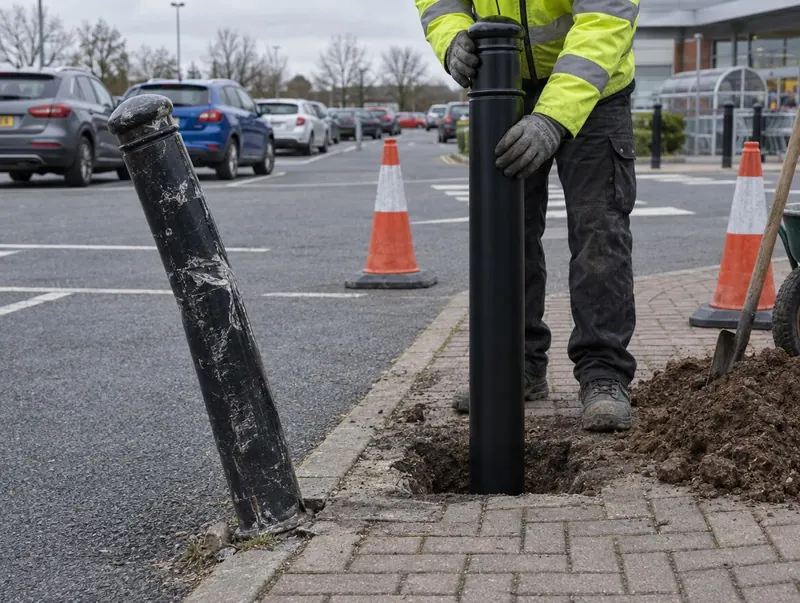
Like-for-like or upgraded replacement of bollards damaged by vehicles, corrosion or wear, matched to the existing line.
- Typically £215–£1,195 per post + VAT (£255–£1,445 inc VAT for homes); minimum job £445
- Free survey and fixed written quote
- Surface made good afterwards
 Computer-generated image
What is it?
What is bollard replacement?
Bollard replacement is the removal of a damaged, corroded or unsuitable bollard and the installation of a new one in its place, either matching the original or upgraded to a stronger or more suitable type. It usually involves breaking out the old foundation or socket and forming a new one. Replacement is the right answer when a post is too damaged to repair or no longer suits how the site is used.
Some bollards cannot be saved. A post that has been folded over by a van, a cast iron bollard that has cracked through, a removable post whose socket has been crushed or a line of rusted steel posts that has reached the end of its life all need replacing. The aim is usually to restore the line so it looks as it did, or to install something better suited to what keeps hitting it.
We replace single posts and whole lines, matching existing products where they are still available and finding close equivalents where they are not. Replacements are quoted after a free site survey with a fixed written price, and the work is carried out by installation crews working under our management. Where a bollard is dangerous now, we can arrange to make it safe first.
When to replace a bollard
- Posts bent, sheared or broken by vehicle impacts
- Cracked cast iron or chipped concrete bollards
- Corroded steel posts at the end of their life
- Crushed sockets and failed telescopic cassettes
- Single missing posts in an otherwise sound line
- Upgrading posts that keep being hit
- Replacing mixed, mismatched posts with a consistent line
How it works
Replacement starts by identifying what is there. Diameter, height, wall thickness, cap style, colour, fixing type and any manufacturer markings let us match a steel or stainless post closely. Heritage and concrete bollards are matched by pattern and finish, and photographs of the line help when sourcing. If the original is no longer made, we propose the nearest equivalent and show you before ordering.
The damaged post is cut out or extracted, and the old foundation is broken out or, where it is sound and suitable, reused. Removable sockets and telescopic cassettes are usually replaced whole, because a new post in an old, distorted socket rarely fits or locks properly. The new bollard is set to match its neighbours in height and line, and the surface is reinstated. When several posts in a line need replacing, it is often worth checking the rest at the same time, since posts installed together tend to corrode or loosen at a similar rate.
Replacement is also a chance to change the specification. A post that is struck every few months might be better as a heavier concrete-filled section, a polymer impact bollard or a flexible post. A fixed post blocking occasional access might become a removable one. Upgrading to a crash-rated product is a bigger change, because it means the manufacturer's tested foundation rather than the old one.
Options and finishes
| Option | Detail |
|---|---|
| Like-for-like | Same diameter, height, finish and fixing, so the line looks unchanged. |
| Heavier section | Larger diameter, thicker wall or concrete-filled steel where posts keep getting bent. |
| Change of type | Swapping fixed posts for removable, telescopic, flexible or polymer bollards to suit how the site is used. |
| Crash-rated upgrade | Replacing unrated posts with tested products, installed to the manufacturer's foundation design and specified with your security adviser. |
| Matched finishes | RAL powder coat, stainless grade and finish, or heritage paint schemes matched to the existing line. |
| Making safe | Removing or capping a dangerous broken stub before the replacement is fitted. |
Typical specification
| Item | Typical |
|---|---|
| Visit type | Free site survey and fixed written quote |
| Matching | Diameter, height, wall, cap, finish and fixing recorded |
| Old foundation | Broken out, or reused if sound and suitable |
| Sockets and cassettes | Usually replaced with the post |
| Upgrades | Heavier steel, polymer, flexible, removable or rated products |
| Disposal | Steel and iron recycled where possible |
| Records | Photos and written quote suitable for an insurance claim |
Typical values only — the survey and the product's data sheet set the final specification.
How we do it
Make safe
If a broken post or stub is a hazard, it can be removed or capped first. That is priced separately in writing so you can approve it on its own.
Survey and match
At the free site survey we measure the existing bollards, photograph the line and check the foundations. A fixed written quote sets out like-for-like and any upgrade options.
Order the replacement
Matching posts, sockets or castings are ordered, and you see details of any close equivalent before it is confirmed.
Remove the old bollard
The damaged post is cut or extracted and the old foundation broken out, checking for services as the hole is opened.
Install the new post
The new bollard is set in a fresh foundation, aligned with its neighbours and the surface is reinstated to match.
Hand over records
Photographs and an itemised invoice are provided, which is useful when recovering the cost from a driver's insurer.
Ground, foundations and buried services
Removing an old bollard often reveals more concrete than expected, because foundations from different eras vary widely in size. Breaking out is done carefully near services, particularly where cables have been laid close to posts since the original installation. If the old foundation is cracked from the impact, it is removed entirely; if it is sound and suits the new post, reuse can reduce disruption. Upgrades to rated products usually need a completely new, larger foundation. Reinstatement matches the surrounding surface, though weathered paving and older tarmac may leave a visible patch. Where a replacement is being made after an impact, the surrounding paving and kerbs are checked as well, because a vehicle that bent a post has often lifted or cracked the surface beside it, and that damage is included in the quote rather than left for later.
Rules and checks before you order
- Where bollards were required by a planning condition, a security plan or a lease, check that any change of type still meets that requirement.
- Upgrades to rated products must use the manufacturer's tested foundation, specified with your security adviser.
- On public highway, the highway authority may need to approve the replacement or carry out the work itself.
- Keep gaps and visibility bands in line with Inclusive Mobility guidance when replacing posts on pedestrian routes.
See rules and standards by nation for highway consent, accessibility and security standards.
Maintenance
After replacement, look at why the post failed. A single impact on a rarely struck post is bad luck; repeated strikes in the same spot point to a layout problem, such as a tight turn or a missing wheel stop, that a stronger bollard alone will not solve. Keep a record of the new product, finish and supplier so future replacements match. Treat new posts as part of your routine inspections: check for lean, chips and faded bands.
What affects the price
- Number of posts and the product chosen
- Size and condition of the old foundation
- Matching special finishes, castings or discontinued products
- Upgrades that need larger foundations
- Surface type and reinstatement
- Making safe before the replacement
Guide prices: bollard replacement
Three typical specifications. The middle one is the specification we usually recommend for durability and visibility.
Standard
per post + VAT · homes £255–£745 inc VAT
- Standard post or product for the type
- Foundation and fixing to manufacturer's details
- Surface reinstated to match
Upgraded
per post + VAT · homes £605–£1,095 inc VAT
- Upgraded finish (RAL colour, stainless or sleeve)
- Retroreflective band and matched keys
- Everything in Standard
Premium
per post + VAT · homes £965–£1,445 inc VAT
- Heavy-duty or architectural specification
- Premium finish and fittings
- Everything in Upgraded
Guide prices for the UK base region; local pages adjust for your area. Per post replaced, old post and footing removed. Minimum job £445 + VAT. Your fixed price comes in writing after survey.
Bollard replacement: questions answered
How much does bollard replacement cost?
Typically £215–£1,195 per post replaced, old post and footing removed, plus VAT. For homeowners that's £255–£1,445 including VAT. Small jobs carry a minimum charge of £445 plus VAT. Ground conditions, access, buried services and consents move the figure; the fixed price comes in writing after survey.
Can you replace just one bollard in a line?
Yes. We measure and match the existing posts so the new one sits in line at the same height and finish. If the original product is no longer made, we show you a close equivalent first.
Should we replace like-for-like or upgrade?
Like-for-like if the post was hit once in an unusual incident. Consider an upgrade if the same position is struck repeatedly or the post no longer suits how the site is used. The survey will show which makes sense.
Can you provide paperwork for an insurance claim?
Yes. The written quote, photographs and itemised invoice are usually what an insurer asks for when recovering the cost from the driver responsible. We can provide them in the format your insurer needs.
Can a new bollard reuse the old foundation?
Sometimes, if the old foundation is sound and suits the new post. Foundations cracked by an impact are broken out. Rated bollards always need the manufacturer's tested foundation.
What happens to the old bollard?
It is taken away with the broken-out concrete. Steel and iron are recycled where possible. Original heritage bollards can be returned to you if you want to keep them.
A driver hit our bollard and left: what should we do?
Make the area safe, photograph the damage and report it if the post is on public land. Check whether CCTV covered the area. A written quote from us can then support any claim.
Related bollard services
Bollard repairs
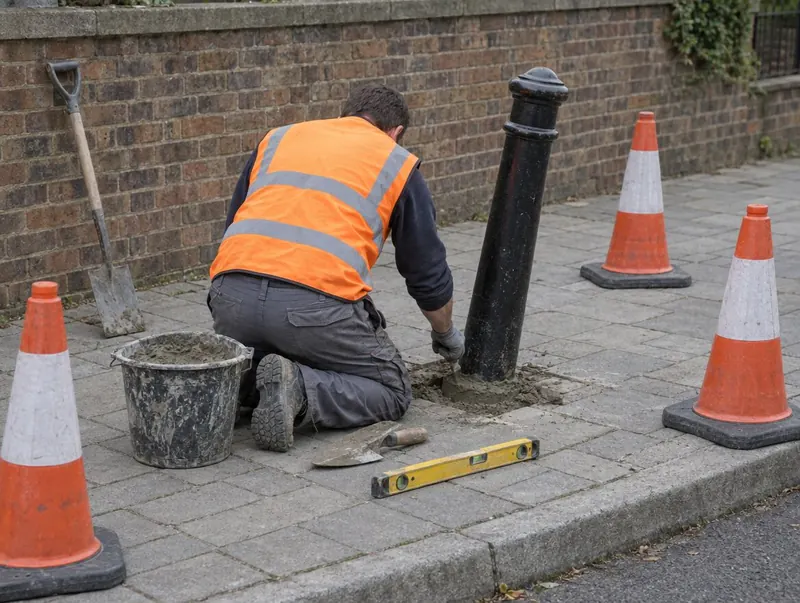
Paid repair visits for loose, leaning and damaged bollards: re-bedding, re-fixing, new sockets, locks, caps and reflective bands.
Learn more →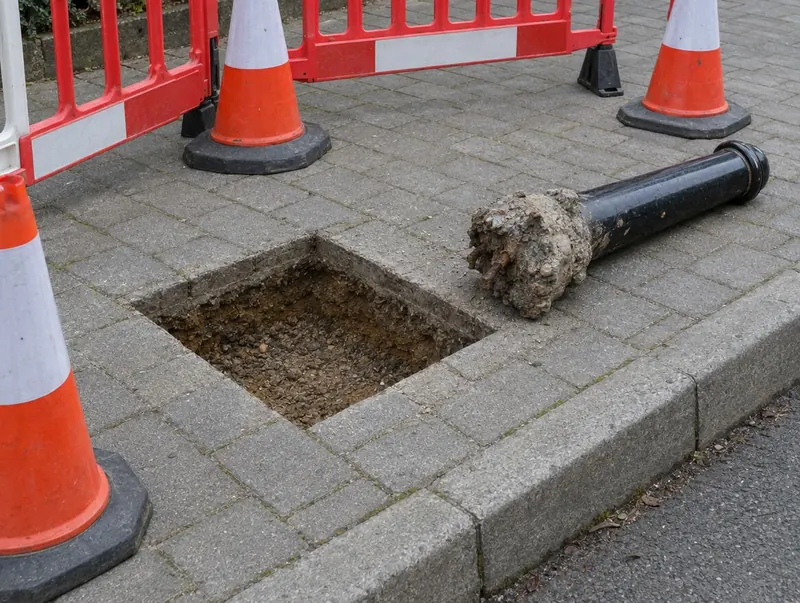
Bollard removal
Removal of fixed, removable, telescopic and automatic bollards, including foundations, with the surface made good to match.
Learn more →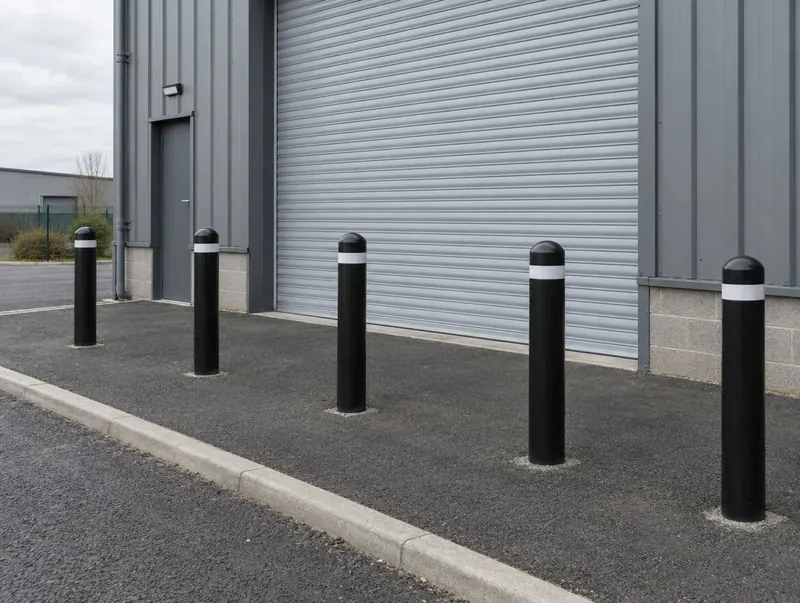
Steel security bollards (unrated)
Concrete-filled steel bollards, root-fixed or base-plated, for car parks, forecourts, boundaries and nuisance vehicle control.
Learn more →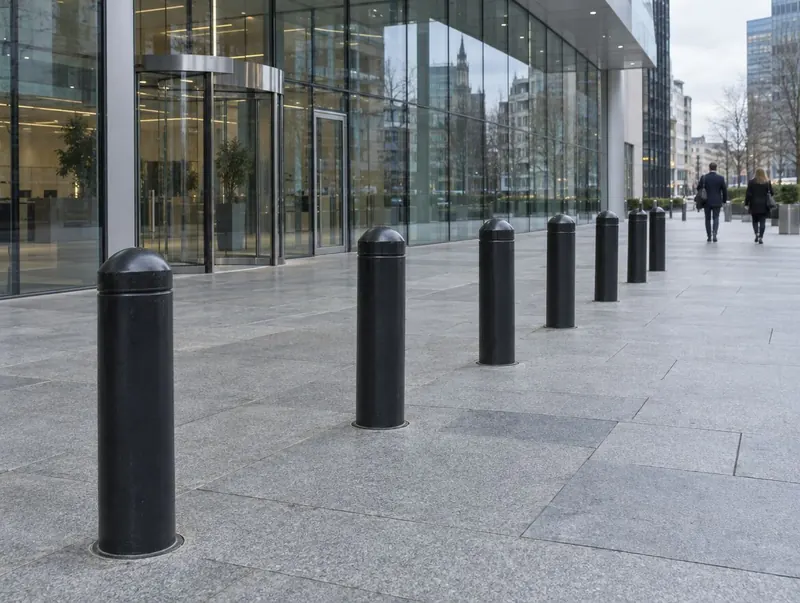
Crash-rated (HVM) bollards
Installation of impact-tested HVM bollards rated to ISO 22343-1 (or the superseded, still-accepted PAS 68 / IWA 14-1) on the tested foundation.
Learn more →Bollard replacement near you
Local pages show the highway authority, postcodes covered and regional prices.
- Bedfordshire
- Berkshire
- Bristol
- Buckinghamshire
- Cambridgeshire
- Cheshire
- Cornwall
- County Durham
- Cumbria
- Derbyshire
- Devon
- Dorset
- East Riding of Yorkshire
- East Sussex
- Essex
- Gloucestershire
- Greater Manchester
- Hampshire
- Herefordshire
- Hertfordshire
- Isle of Wight
- Kent
- Lancashire
- Leicestershire
- Lincolnshire
- London
- Merseyside
- Norfolk
- North Yorkshire
- Northamptonshire
- Northumberland
- Nottinghamshire
- Oxfordshire
- Rutland
- Shropshire
- Somerset
- South Yorkshire
- Staffordshire
- Suffolk
- Surrey
- Tyne and Wear
- Warwickshire
- West Midlands
- West Sussex
- West Yorkshire
- Wiltshire
- Worcestershire
- Blaenau Gwent
- Bridgend
- Caerphilly
- Cardiff
- Carmarthenshire
- Ceredigion
- Conwy
- Denbighshire
- Flintshire
- Gwynedd
- Isle of Anglesey
- Merthyr Tydfil
- Monmouthshire
- Neath Port Talbot
- Newport
- Pembrokeshire
- Powys
- Rhondda Cynon Taf
- Swansea
- Torfaen
- Vale of Glamorgan
- Wrexham
- Aberdeen City
- Aberdeenshire
- Angus
- Argyll and Bute
- City of Edinburgh
- Clackmannanshire
- Dumfries and Galloway
- Dundee City
- East Ayrshire
- East Dunbartonshire
- East Lothian
- East Renfrewshire
- Falkirk
- Fife
- Glasgow City
- Highland
- Inverclyde
- Midlothian
- Moray
- North Ayrshire
- North Lanarkshire
- Perth and Kinross
- Renfrewshire
- Scottish Borders
- South Ayrshire
- South Lanarkshire
- Stirling
- West Dunbartonshire
- West Lothian
- Antrim and Newtownabbey
- Ards and North Down
- Armagh City, Banbridge and Craigavon
- Belfast
- Causeway Coast and Glens
- Derry City and Strabane
- Fermanagh and Omagh
- Lisburn and Castlereagh
- Mid Ulster
- Mid and East Antrim
- Newry, Mourne and Down