Security & anti-ram
Automatic rising bollard installation
Hydraulic and electro-mechanical rising bollards installed with controls, safety loops, signals and power, for managed vehicle access.
- Typically £2,995–£14,995 per bollard + VAT
- Free survey and fixed written quote
- Foundations and reinstatement included
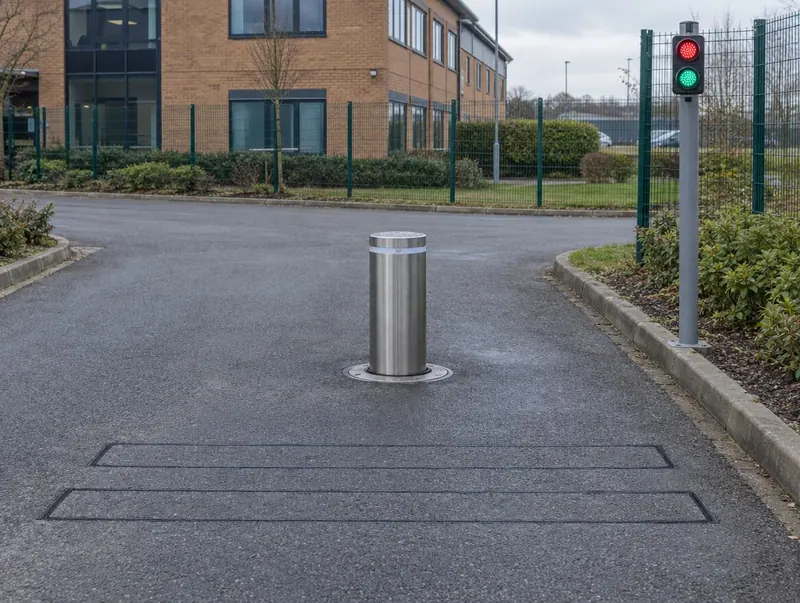 Computer-generated image
What is it?
What are automatic rising bollards?
An automatic rising bollard is a powered post that retracts flush into the ground to let authorised vehicles pass and rises again to close the entrance. It is driven either hydraulically or by an electric motor, and is controlled by a panel linked to access devices, vehicle detection loops and safety equipment. Automatic bollards are available unrated for traffic control or crash-tested for security entrances.
Rising bollards suit entrances that need to stay open to pedestrians and cyclists while vehicles are controlled: business parks, campus roads, pedestrianised town centres, private estates and the service yards of secure buildings. When lowered, the head sits level with the road and vehicles drive straight over; when raised, the entrance is closed without a gate across the footway.
They can also cause harm if they are installed carelessly. A rising post can strike a car that follows another through, or lift under a cyclist. Our installation crews, working under our management, fit the bollards, ducting, drainage and safety equipment as one job, with a qualified electrician for the supply, and commission the system against a written risk assessment before it goes into use.
Where automatic bollards make sense
- Business parks and campus roads with controlled vehicle access
- Pedestrianised streets with permitted delivery windows
- Private estates and gated developments without a full gate
- Bus gates and access-only routes where the highway authority agrees
- Secure loading yards where rated automatic posts are specified
- Emergency access routes that must open on demand
- Entrances where a gate would block pedestrian desire lines
How it works
Each bollard sits in a steel cassette set into a concrete foundation. Hydraulic bollards use a pump and ram, either built into the bollard or driven from a remote power pack in a cabinet, and they cope well with heavy, frequent use. Electro-mechanical bollards use a motor and gearbox within the unit, with no hydraulic fluid to leak, and are often chosen for moderate traffic and simpler maintenance. Duty cycle matters: the number of rise and fall cycles per day, and per hour at peak, should be checked against the manufacturer's figures.
The control panel decides when the bollard may move. Access devices such as ANPR, fobs, keypads or intercoms send the request to lower; an exit loop cut into the road can lower the bollard for vehicles leaving. A safety loop over and around the bollard detects a vehicle above it and stops the post rising while anything is there. Photocells, traffic lights showing red and green, flashing lights in the bollard head and warning signs complete the safety arrangement.
Every installation needs a plan for power failure. Most units can be lowered manually with a release key, and some are set to drop automatically if power is lost; security installations may instead be set to stay raised. Rated automatic bollards can also have an emergency fast-rise function, which needs particularly careful safety planning.
Options and finishes
| Option | Detail |
|---|---|
| Hydraulic drive | Integral or remote power pack. Suits high-frequency entrances and heavier rated units, with periodic checks on fluid, seals and hoses. |
| Electro-mechanical drive | Motor and gearbox inside the bollard with no hydraulic fluid. Often simpler to service, with duty cycles that suit moderate traffic. |
| Unrated or crash-rated | Unrated units control traffic; rated units are tested to IWA 14-1, ISO 22343-1 or PAS 68 for security entrances, with deeper, heavier foundations. |
| Head lighting and finishes | LED rings or lights in the head, reflective bands, and powder-coated or stainless finishes. Lit heads help drivers see the post when it is raised. |
| Fail-safe behaviour | Configured to lower or stay raised on power loss, with a manual release, depending on whether access or security takes priority. |
| Heights and diameters | Raised heights are commonly around 500–800 mm for traffic control and taller for security models, with diameters varying by drive and rating. |
| Paired or multi-bollard lanes | Several bollards can run from one controller to close a wider entrance, with lane-by-lane control where needed. |
Typical specification
| Item | Typical |
|---|---|
| Drive | Hydraulic (integral or remote pack) or electro-mechanical |
| Raised height | Typically 500–800 mm for traffic models, often more for rated units |
| Cycle time | Usually a few seconds to rise or lower, model dependent |
| Safety devices | Safety loop, photocells, traffic lights, head lights, signs |
| Power | Dedicated supply installed by a qualified electrician |
| Drainage | Cassette drain connected to a soakaway or surface water drain |
| Ducting | Ducts and draw pits between bollards, panel and devices |
| Rating (if required) | IWA 14-1, ISO 22343-1 or PAS 68, as specified |
Typical values only — the survey and the product's data sheet set the final specification.
How we install it
Survey and risk assessment
A free site survey covers traffic patterns, who uses the entrance, power, drainage routes and buried services. We draft the safety arrangement from that, and you receive a fixed written quote.
Excavate and set cassettes
Each cassette pit is excavated to the manufacturer's depth, with the base prepared to drain. Cassettes are set to finished road level and fall, then concreted in.
Ducts, drainage and loops
Ducts are laid between the bollards, the controller cabinet and access devices, with draw pits where runs change direction. The drain is connected and the safety and exit loops are cut into the surface and sealed.
Power and controls
A qualified electrician installs the supply and isolation, and the controller, traffic lights, photocells and access devices are mounted and wired.
Commission and test
Rise and fall times, loop detection, photocells, lights and the manual release are tested with vehicles present. Safety settings are recorded against the risk assessment.
Train and hand over
Site staff are shown how to lower the bollard in an emergency and how to recognise faults. You receive keys, the commissioning record and the manufacturer's manuals.
Ground, foundations and buried services
Automatic bollards need a deep pit for the cassette and a reliable way for water to leave it. Without drainage, rainwater and silt collect in the cassette, corrode the mechanism and can freeze around the post in winter. The pit base is usually connected to a surface water drain or a soakaway, and on clay or high water table sites that connection needs particular attention. Duct routes cross the carriageway and often the footway, so buried services along those routes must be traced first. Loops are cut into a sound surface: badly cracked tarmac or block paving may need resurfacing first, because loops in broken surfaces fail early. Reinstatement around each cassette is made flush so vehicles pass smoothly over the lowered head.
Rules and checks before you order
- Prepare a written risk assessment covering pedestrians, cyclists, following vehicles and children, and choose safety devices to match.
- On public highway, rising bollards normally need highway authority approval, with signs and signals to their requirements.
- Have the electrical installation carried out and certified by a qualified electrician to BS 7671.
- Agree emergency access with the fire and ambulance services, including how they will lower the bollards.
- For rated units, keep the test certificate and confirm the foundation matches the tested design.
See rules and standards by nation for highway consent, accessibility and security standards.
Maintenance
Automatic bollards need planned servicing, not just repair when they fail. Typical visits clean and inspect the cassette and drain, check hydraulic fluid or gearbox condition, test loops, photocells, lights and the manual release, and read the controller's fault log. Frequency depends on how often the bollard cycles; a busy entrance needs more visits than a rarely used one. Between visits, site staff should keep the head clear of grit and leaves, report slow or noisy movement early and never override safety devices to keep an entrance open.
What affects the price
- Hydraulic or electro-mechanical drive and the duty cycle needed
- Unrated or crash-rated model and its foundation size
- Number of bollards and lanes controlled
- Length of duct runs, drainage connections and power supply distance
- Access control devices, traffic lights and signage
- Surface condition for loops and the extent of reinstatement
- Traffic management during installation on live roads
Guide prices: automatic bollards
Three typical specifications. The middle one is the specification we usually recommend for durability and visibility.
Standard
per bollard + VAT
- Electro-mechanical or entry hydraulic bollard
- Controls, loops and photocell
- Commissioning and handover
Upgraded
per bollard + VAT
- Heavy-duty hydraulic bollard
- Traffic light, signs and LED head
- Everything in Standard
Premium
per bollard + VAT
- High-cycle or crash-rated automatic bollard
- Extended safety and override options
- Everything in Upgraded
Guide prices for the UK base region; local pages adjust for your area. Per bollard, installed with controls, loops and commissioning. Your fixed price comes in writing after survey.
Automatic bollards: questions answered
How much does automatic rising bollard installation cost?
Typically £2,995–£14,995 per bollard, installed with controls, loops and commissioning, plus VAT. Ground conditions, access, buried services and consents move the figure; the fixed price comes in writing after survey.
Should I choose hydraulic or electro-mechanical bollards?
Choose by how often the bollard will move and how you want it maintained. Hydraulic units suit busy entrances and heavier rated posts but need fluid and seal checks. Electro-mechanical units avoid fluid and are often simpler to look after at moderate traffic levels.
What stops a rising bollard hitting a car?
A safety loop in the road detects a vehicle above or close to the bollard and blocks the rise, backed up by photocells. Traffic lights and head lights tell drivers when to stop. The settings are tested on site with vehicles before handover.
What happens in a power cut?
That depends on how the system is configured. Traffic bollards are often set to lower or can be lowered with a manual release, so vehicles are not trapped. Security bollards may be set to stay raised, with a procedure for staff to follow.
Why do automatic bollards need drainage?
The bollard sits in a pit that collects rain and silt. Without a drain, water corrodes the mechanism, short-circuits electrics and can freeze the post in place. A drain connection is part of every automatic installation we carry out.
How will emergency vehicles get through?
Usually by an agreed method such as a fire service key switch, a code, a remote handset held by the site or a free-exit arrangement. It should be agreed with the emergency services before the bollards go live.
Can rising bollards be installed on a public road?
Only with the highway authority's approval, and they will set requirements for signs, signals and operation. On private land the decision is yours, but the same safety principles apply.
Related bollard services
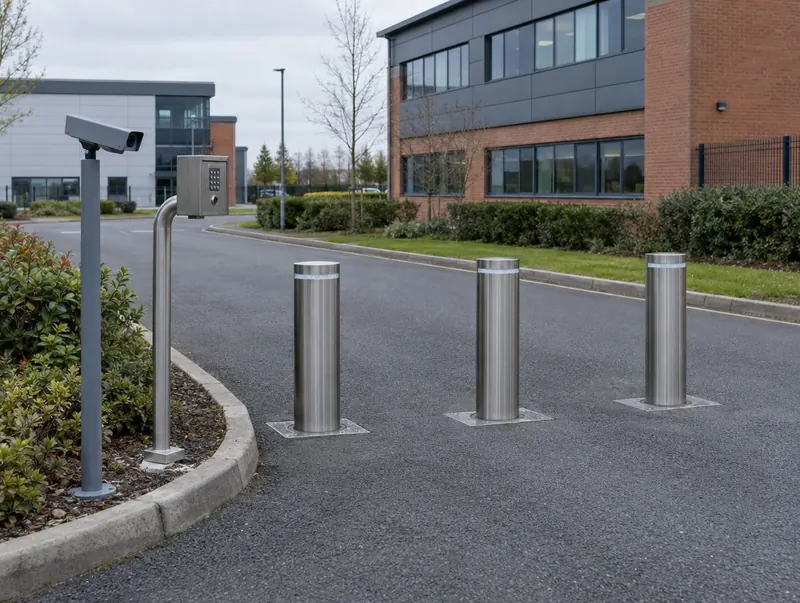
Bollard access control
ANPR, fob, keypad, intercom and remote control systems that decide who can lower an automatic bollard, and when.
Learn more →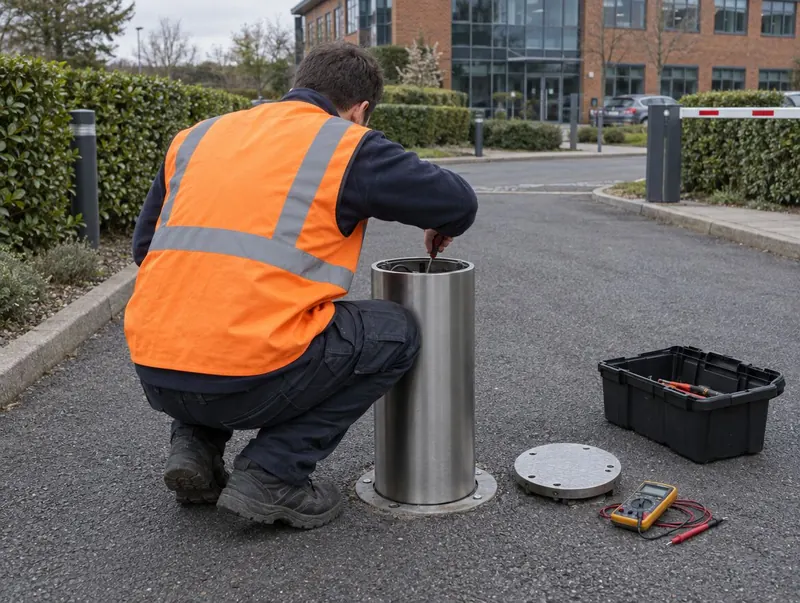
Automatic bollard servicing
Planned servicing visits and maintenance contracts for hydraulic and electro-mechanical rising bollards, priced in writing.
Learn more →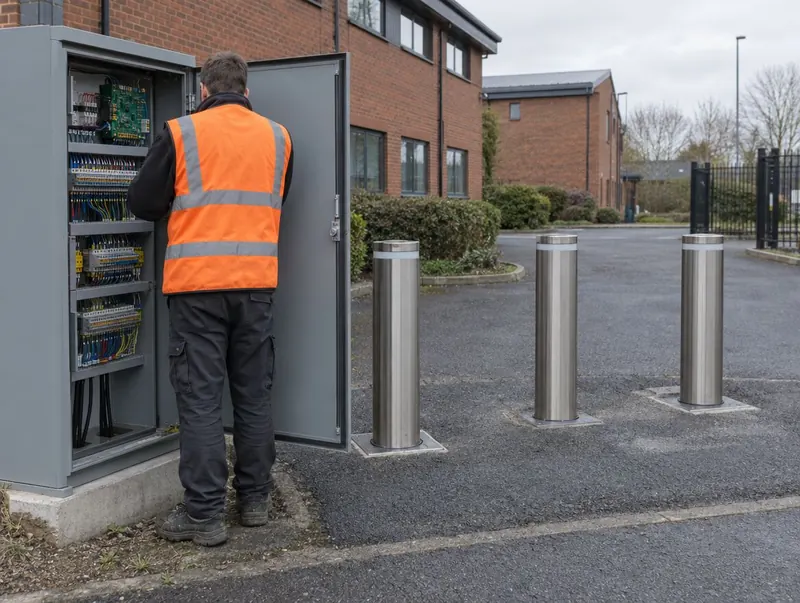
Automatic bollard repairs
Paid repair visits for rising bollards: hydraulics, motors, controllers, loops, flooded pits and heads damaged by vehicles.
Learn more →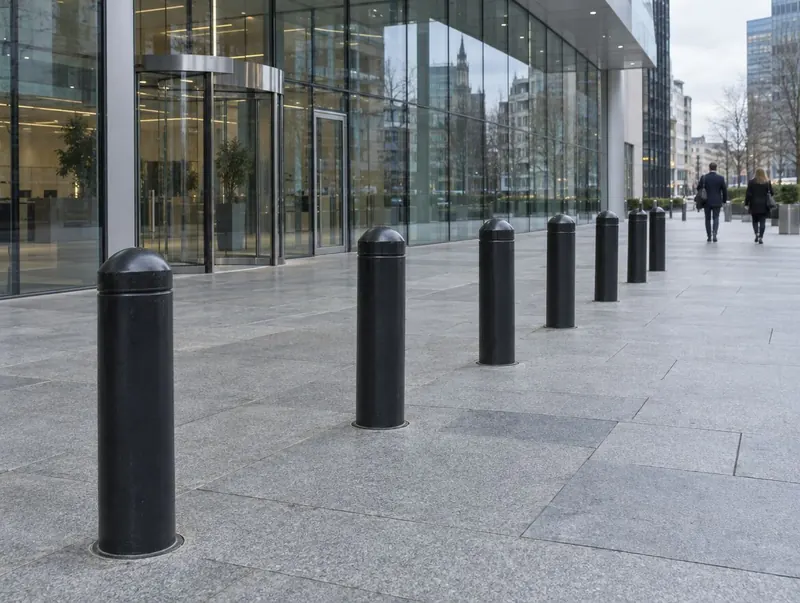
Crash-rated (HVM) bollards
Installation of impact-tested HVM bollards rated to ISO 22343-1 (or the superseded, still-accepted PAS 68 / IWA 14-1) on the tested foundation.
Learn more →Automatic bollards near you
Local pages show the highway authority, postcodes covered and regional prices.
- Bedfordshire
- Berkshire
- Bristol
- Buckinghamshire
- Cambridgeshire
- Cheshire
- Cornwall
- County Durham
- Cumbria
- Derbyshire
- Devon
- Dorset
- East Riding of Yorkshire
- East Sussex
- Essex
- Gloucestershire
- Greater Manchester
- Hampshire
- Herefordshire
- Hertfordshire
- Isle of Wight
- Kent
- Lancashire
- Leicestershire
- Lincolnshire
- London
- Merseyside
- Norfolk
- North Yorkshire
- Northamptonshire
- Northumberland
- Nottinghamshire
- Oxfordshire
- Rutland
- Shropshire
- Somerset
- South Yorkshire
- Staffordshire
- Suffolk
- Surrey
- Tyne and Wear
- Warwickshire
- West Midlands
- West Sussex
- West Yorkshire
- Wiltshire
- Worcestershire
- Blaenau Gwent
- Bridgend
- Caerphilly
- Cardiff
- Carmarthenshire
- Ceredigion
- Conwy
- Denbighshire
- Flintshire
- Gwynedd
- Isle of Anglesey
- Merthyr Tydfil
- Monmouthshire
- Neath Port Talbot
- Newport
- Pembrokeshire
- Powys
- Rhondda Cynon Taf
- Swansea
- Torfaen
- Vale of Glamorgan
- Wrexham
- Aberdeen City
- Aberdeenshire
- Angus
- Argyll and Bute
- City of Edinburgh
- Clackmannanshire
- Dumfries and Galloway
- Dundee City
- East Ayrshire
- East Dunbartonshire
- East Lothian
- East Renfrewshire
- Falkirk
- Fife
- Glasgow City
- Highland
- Inverclyde
- Midlothian
- Moray
- North Ayrshire
- North Lanarkshire
- Perth and Kinross
- Renfrewshire
- Scottish Borders
- South Ayrshire
- South Lanarkshire
- Stirling
- West Dunbartonshire
- West Lothian
- Antrim and Newtownabbey
- Ards and North Down
- Armagh City, Banbridge and Craigavon
- Belfast
- Causeway Coast and Glens
- Derry City and Strabane
- Fermanagh and Omagh
- Lisburn and Castlereagh
- Mid Ulster
- Mid and East Antrim
- Newry, Mourne and Down