Scotland · 6 towns
Automatic rising bollard installation in West Lothian
Automatic bollards for sites across West Lothian: surveyed, quoted in writing and installed by our crews.
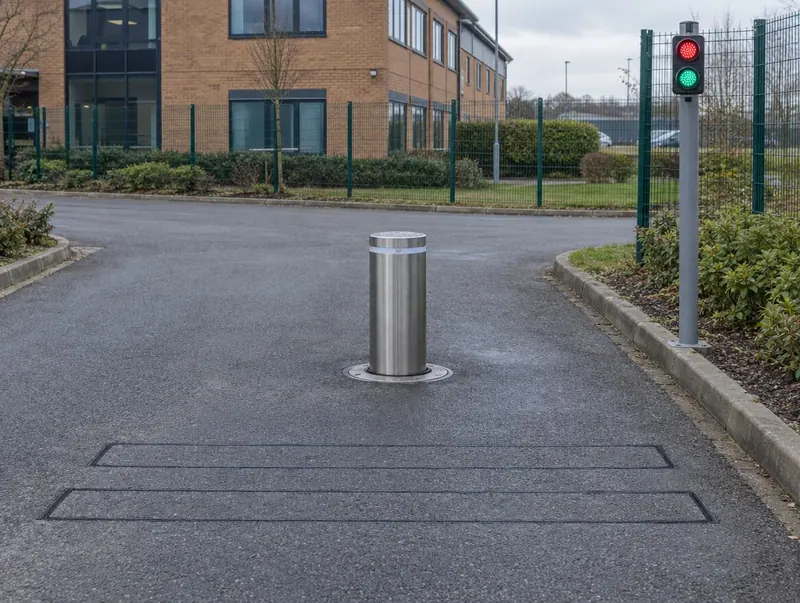 Computer-generated image
Automatic bollards in West Lothian
Across West Lothian, typical sites for automatic bollards include community car parks, filling-station forecourts and schools. Hydraulic and electro-mechanical rising bollards installed with controls, safety loops, signals and power, for managed vehicle access.
Highway and roads authorities for local roads in West Lothian: West Lothian Council.
Choose your town in West Lothian
Guide prices in West Lothian
| Specification | Guide price | Includes |
|---|---|---|
| Standard | £2,995–£8,045 + VAT | Electro-mechanical or entry hydraulic, controls, loops and photocell |
| Upgraded | £6,595–£11,595 + VAT | Heavy-duty hydraulic, traffic light, signs and LED head |
| Premium | £10,195–£14,995 + VAT | High-cycle or crash-rated automatic bollard |
Per bollard, installed with controls, loops and commissioning; no regional adjustment. Guide only — the fixed price follows a survey.
Local authorities across West Lothian
| Town | Highway / roads authority | Planning authority |
|---|---|---|
| Livingston | West Lothian Council | West Lothian Council |
| Bathgate | West Lothian Council | West Lothian Council |
| Broxburn | West Lothian Council | West Lothian Council |
| Linlithgow | West Lothian Council | West Lothian Council |
| Armadale | West Lothian Council | West Lothian Council |
| Whitburn | West Lothian Council | West Lothian Council |
Rules for automatic bollards in Scotland
Works in a public road or footway need the roads authority's written consent under the Roads (Scotland) Act 1984. On private land the owner's agreement is what matters; listed buildings and conservation areas need a word with the planning team first. Rising bollards should fail safe, never rise beneath a vehicle, carry clear signs and give the emergency services an override.
Details and sources: bollard rules in Scotland.
How installation works
Excavate and set cassettes
Each cassette pit is excavated to the manufacturer's depth, with the base prepared to drain. Cassettes are set to finished road level and fall, then concreted in.
Ducts, drainage and loops
Ducts are laid between the bollards, the controller cabinet and access devices, with draw pits where runs change direction. The drain is connected and the safety and exit loops are cut into the surface and sealed.
Power and controls
A qualified electrician installs the supply and isolation, and the controller, traffic lights, photocells and access devices are mounted and wired.
Commission and test
Rise and fall times, loop detection, photocells, lights and the manual release are tested with vehicles present. Safety settings are recorded against the risk assessment.
Automatic bollards in West Lothian: FAQs
Do you cover all of West Lothian for automatic bollards?
Yes — including Livingston, Bathgate, Broxburn, Linlithgow, Armadale and Whitburn. Enter your postcode in the price calculator to confirm.
How much do automatic bollards cost in West Lothian?
In West Lothian, typically £2,995–£14,995 per bollard, installed with controls, loops and commissioning, plus VAT, using our Scotland guide prices. The fixed figure comes in writing after we've seen the site.
Who do I ask about bollards on public land in West Lothian?
The council is the roads authority for local roads (West Lothian Council); Transport Scotland covers trunk roads. Works in a public road need the roads authority's written consent.
How will emergency vehicles get through?
Usually by an agreed method such as a fire service key switch, a code, a remote handset held by the site or a free-exit arrangement. It should be agreed with the emergency services before the bollards go live.
Should I choose hydraulic or electro-mechanical bollards?
Choose by how often the bollard will move and how you want it maintained. Hydraulic units suit busy entrances and heavier rated posts but need fluid and seal checks. Electro-mechanical units avoid fluid and are often simpler to look after at moderate traffic levels.