Traffic & site protection
Timber bollard installation
Oak, hardwood and treated softwood bollards for parks, verges, rural sites, car parks and school frontages.
- Typically £95–£345 per post + VAT (£105–£405 inc VAT for homes); minimum job £445
- Free survey and fixed written quote
- Foundations and reinstatement included
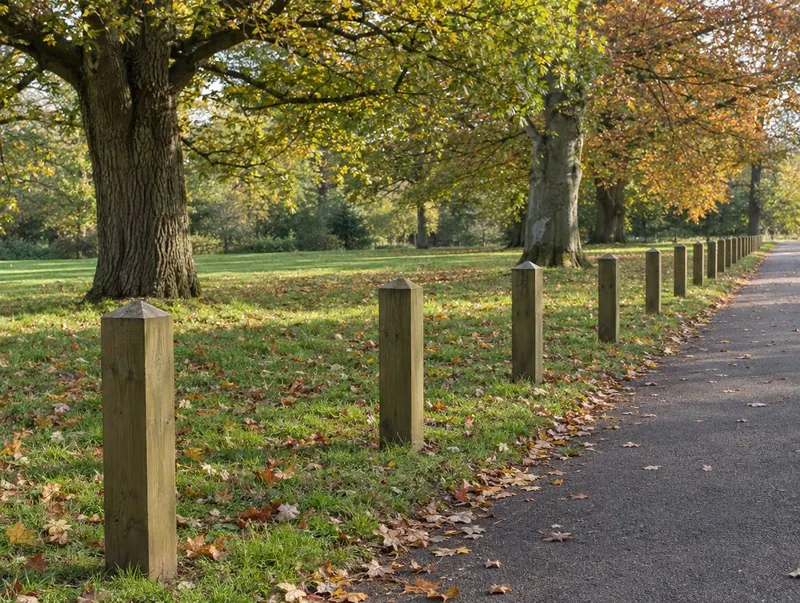 Computer-generated image
What is it?
What are timber bollards?
A timber bollard is a wooden post set in the ground to stop vehicles driving onto verges, grass, paths and open spaces while blending into a natural setting. It is made from durable hardwood such as oak, a dense tropical hardwood, or softwood pressure-treated for ground contact. Timber bollards deter and guide vehicles; they are not tested barriers.
Timber bollards are the usual choice wherever steel or concrete would look hard against grass and trees: country parks, village greens, woodland car parks, recreation grounds, school frontages and the verges of rural lanes and estates. They mark an edge, stop cars mounting the grass and are easy to replace one at a time when one is struck.
How long a timber post lasts depends almost entirely on the species, the treatment and how it is set in the ground. A well-chosen post set to shed water can stand for many years; a poorly treated softwood post set in a cup of concrete can rot at ground level within a few. Our installation crews, working under our management, choose timber and fixing to suit the site and its use.
Where timber bollards make sense
- Country parks, nature reserves and woodland car parks
- Village greens and recreation grounds
- Verges on estates and rural lanes
- School frontages and nursery entrances
- Holiday parks, campsites and farm shops
- Footpath and bridleway entrances
- Landscaped car parks and picnic areas
How it works
Durability is set by species and treatment. European oak heartwood is naturally durable and weathers to a silver-grey. Dense tropical hardwoods are very hard and resist rot and impact well in the ground; they should come from certified sustainable sources. Softwood, usually pine, is cheaper and lighter but must be pressure-treated for ground contact, generally to Use Class 4, and any cut ends must be re-treated on site.
Most timber bollards are set directly in the ground with a portion of their length buried, backfilled with compacted stone or set in concrete. Concrete holds the post firmly but can trap water against the timber at ground level, which is exactly where rot starts. Where concrete is used, the top is shaped to shed water away from the post, and a free-draining base lets water escape. A further option is to mount the post on a galvanised steel shoe or socket so the timber never touches the ground at all, which also makes replacement simple.
Shape matters too. Tops that are chamfered, pyramid-cut or domed shed rain instead of letting it soak into the end grain. Square posts with chamfered edges resist splitting at the corners.
Options and finishes
| Option | Detail |
|---|---|
| Oak | Naturally durable heartwood that weathers to silver-grey. Suits parks, heritage settings and visible frontages. |
| Tropical hardwood | Very dense and long-lasting in ground contact. Specify certified sustainable sources. |
| Treated softwood | Pressure-treated pine for ground contact, economical for long runs on verges and rural sites. |
| Sizes and profiles | Commonly 100–200 mm square or round, with chamfered, pyramid or domed tops to shed water. |
| Fixing methods | Direct burial in compacted stone, set in concrete with a shaped collar, or mounted on a steel shoe or socket. |
| Removable and lockable posts | Timber posts in steel sockets, or hinged timber posts, for maintenance and emergency access. |
| Reflective bands and studs | Reflective bands, white painted tops or inset studs so posts are visible on unlit sites. |
Typical specification
| Item | Typical |
|---|---|
| Species | Oak, certified tropical hardwood or treated softwood |
| Section | Typically 100–200 mm square or round |
| Exposed height | Commonly 600–1,000 mm |
| Buried length | Often around a third of overall length, by ground and use |
| Treatment | Softwood treated for ground contact, generally Use Class 4 |
| Fixing | Compacted stone, concrete with shaped collar, or steel shoe |
| Visibility | Reflective bands or studs on unlit sites |
Typical values only — the survey and the product's data sheet set the final specification.
How we install it
Survey the setting
A free site survey looks at the ground, drainage, tree roots, how vehicles currently get onto the land and how the site looks. You receive a fixed written quote with species, size and fixing.
Set out the line
Posts are set out at spacings that stop cars passing between them while leaving gaps for walkers, buggies and wheelchairs.
Dig the holes
Holes are dug by hand or auger to the required depth, avoiding roots and checking for services along verges and footpaths.
Set the posts
Posts are set plumb and to a consistent height, backfilled with compacted stone or concreted with a shaped top. Cut softwood ends are re-treated.
Finish and tidy
Reflective bands are fitted, turf is reinstated around the posts and spoil is removed or spread as agreed.
Ground, foundations and buried services
Timber bollards usually go into soft landscape, so the ground varies more than with paved sites. Clay holds water against the timber and benefits from a free-draining stone base; sandy ground may need a concrete surround to stop posts loosening. Tree roots are common along verges and parks, and digging close to mature trees can harm them, so positions are adjusted to stay outside root areas where possible. Verges on rural lanes and estates often carry water mains, telecoms cables and drainage, so services are checked before augering. Turf around new posts is reinstated and, on sites used by mowers, posts are spaced so equipment can pass.
Rules and checks before you order
- Leave pedestrian gaps of typically at least 1,000–1,200 mm, and wider at path entrances used by cycles, buggies and mobility scooters, referring to Inclusive Mobility guidance.
- Fit reflective bands or white tops where posts stand beside roads or in unlit car parks.
- Use certified sustainable sources for hardwoods, which many public bodies require.
- Check whether the verge is highway land; posts there usually need the highway authority's agreement.
- Keep emergency vehicle access available, using a removable or hinged post where a route must open.
See rules and standards by nation for highway consent, accessibility and security standards.
Maintenance
Timber naturally moves, checks and splits along its length as it dries; surface cracks in oak and hardwood are normal and rarely affect strength. Inspect posts at ground level, where rot starts, by probing for soft wood. Re-treat cut or damaged softwood, keep grass and soil from building up around the base, and replace posts that are soft at the ground line before they snap. New oak can release tannin that stains nearby paving for the first season; this weathers away. Replacing individual damaged posts is straightforward if the original size and species are recorded.
What affects the price
- Species: treated softwood, oak or tropical hardwood
- Post size and length
- Fixing method: stone, concrete or steel shoe
- Number of posts and length of the line
- Ground conditions, roots and services
- Removable or hinged posts for access
Guide prices: timber bollards
Three typical specifications. The middle one is the specification we usually recommend for durability and visibility.
Standard
per post + VAT · homes £105–£245 inc VAT
- Standard post or product for the type
- Foundation and fixing to manufacturer's details
- Surface reinstated to match
Upgraded
per post + VAT · homes £205–£325 inc VAT
- Upgraded finish (RAL colour, stainless or sleeve)
- Retroreflective band and matched keys
- Everything in Standard
Premium
per post + VAT · homes £285–£405 inc VAT
- Heavy-duty or architectural specification
- Premium finish and fittings
- Everything in Upgraded
Guide prices for the UK base region; local pages adjust for your area. Per post, supplied and installed. Minimum job £445 + VAT. Your fixed price comes in writing after survey.
Timber bollards: questions answered
How much does timber bollard installation cost?
Typically £95–£345 per post, supplied and installed, plus VAT. For homeowners that's £105–£405 including VAT. Small jobs carry a minimum charge of £445 plus VAT. Ground conditions, access, buried services and consents move the figure; the fixed price comes in writing after survey.
How long will a timber bollard last in the ground?
It depends on species, treatment and how the post is set. Dense hardwoods and oak heartwood last much longer than softwood, and posts that are kept out of standing water last longer than those sitting in wet concrete. A steel shoe that keeps timber off the ground extends life considerably.
Should timber posts be set in concrete?
Only with care. Concrete holds the post firmly but can trap water around it at ground level, where rot starts. A free-draining base and a concrete collar shaped to shed water help, and compacted stone backfill is often better in clay.
Why is my new oak bollard cracking?
Oak shrinks as it dries, and surface checks and splits are a normal part of that. They rarely affect the post's strength. Deep splits that run right through, or soft wood at the base, are a different matter.
Can timber bollards be removable?
Yes. Timber posts can be fitted into steel ground sockets with a lock, or mounted on a hinged base. That allows maintenance vehicles or emergency services through without a permanent gap.
Do timber bollards stop vehicles?
They stop most drivers deliberately mounting a verge and resist low-speed knocks, especially in dense hardwood. They are not tested barriers and should not be relied on against a vehicle driven at them deliberately.
Is tropical hardwood a sustainable choice?
It can be, if it comes from certified sustainable sources. Ask for certification with the order. Oak and treated softwood from managed forests are alternatives.
Related bollard services
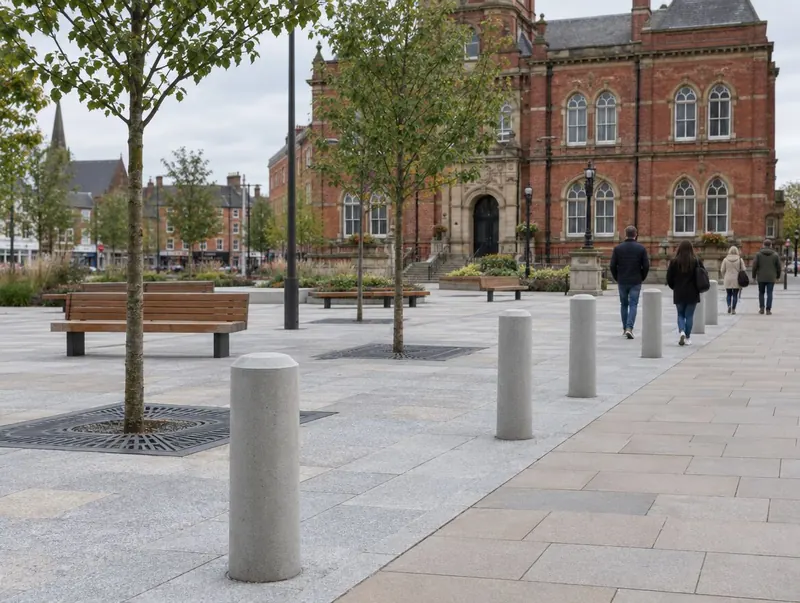
Concrete bollards
Precast concrete and reconstituted stone bollards for public realm, parks, boundaries and estates, dowelled or bedded in place.
Learn more →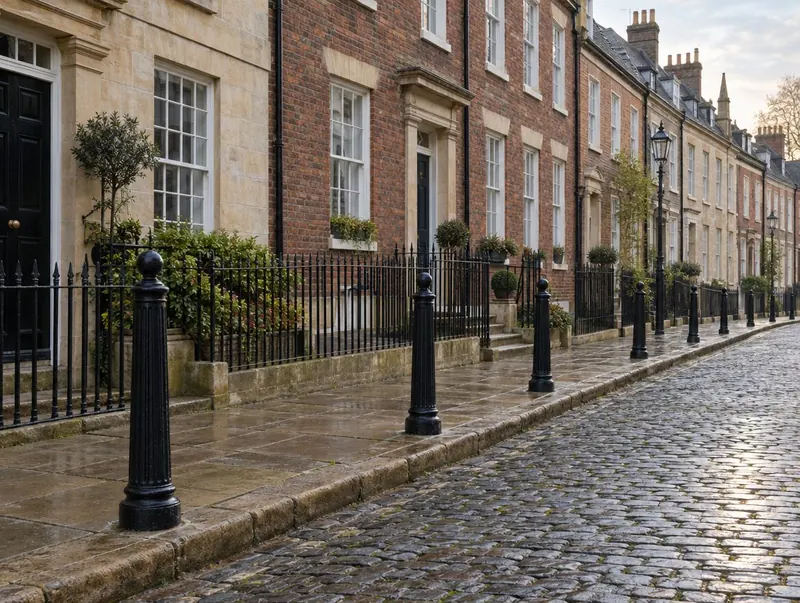
Cast iron and heritage bollards
Traditional cast and ductile iron bollards for conservation areas, period streets and historic estates, installed and reset.
Learn more →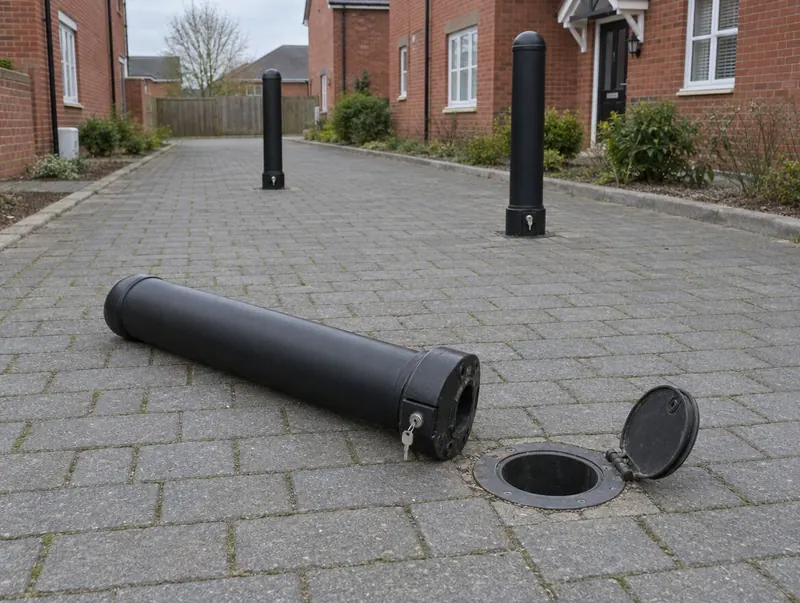
Removable bollards
Lift-out bollards in lockable ground sockets for driveways, delivery routes, access roads and emergency access points.
Learn more →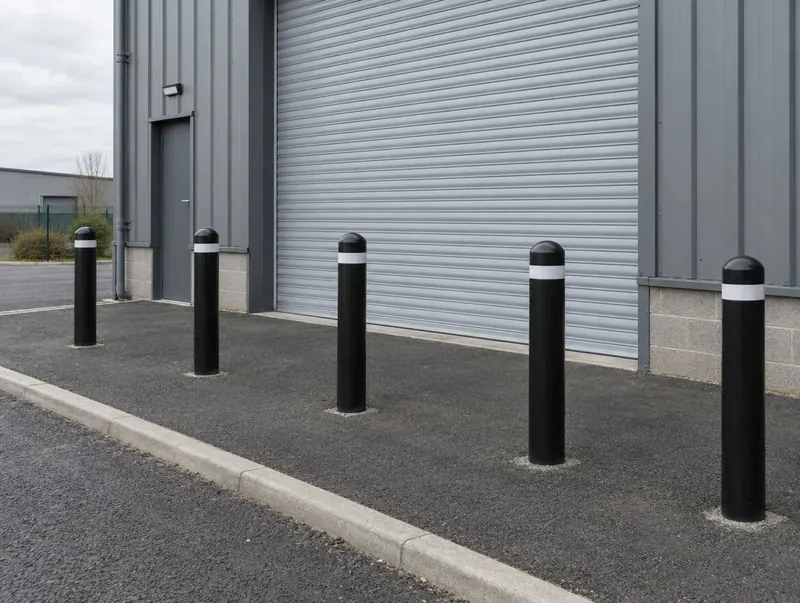
Steel security bollards (unrated)
Concrete-filled steel bollards, root-fixed or base-plated, for car parks, forecourts, boundaries and nuisance vehicle control.
Learn more →Timber bollards near you
Local pages show the highway authority, postcodes covered and regional prices.
- Bedfordshire
- Berkshire
- Bristol
- Buckinghamshire
- Cambridgeshire
- Cheshire
- Cornwall
- County Durham
- Cumbria
- Derbyshire
- Devon
- Dorset
- East Riding of Yorkshire
- East Sussex
- Essex
- Gloucestershire
- Greater Manchester
- Hampshire
- Herefordshire
- Hertfordshire
- Isle of Wight
- Kent
- Lancashire
- Leicestershire
- Lincolnshire
- London
- Merseyside
- Norfolk
- North Yorkshire
- Northamptonshire
- Northumberland
- Nottinghamshire
- Oxfordshire
- Rutland
- Shropshire
- Somerset
- South Yorkshire
- Staffordshire
- Suffolk
- Surrey
- Tyne and Wear
- Warwickshire
- West Midlands
- West Sussex
- West Yorkshire
- Wiltshire
- Worcestershire
- Blaenau Gwent
- Bridgend
- Caerphilly
- Cardiff
- Carmarthenshire
- Ceredigion
- Conwy
- Denbighshire
- Flintshire
- Gwynedd
- Isle of Anglesey
- Merthyr Tydfil
- Monmouthshire
- Neath Port Talbot
- Newport
- Pembrokeshire
- Powys
- Rhondda Cynon Taf
- Swansea
- Torfaen
- Vale of Glamorgan
- Wrexham
- Aberdeen City
- Aberdeenshire
- Angus
- Argyll and Bute
- City of Edinburgh
- Clackmannanshire
- Dumfries and Galloway
- Dundee City
- East Ayrshire
- East Dunbartonshire
- East Lothian
- East Renfrewshire
- Falkirk
- Fife
- Glasgow City
- Highland
- Inverclyde
- Midlothian
- Moray
- North Ayrshire
- North Lanarkshire
- Perth and Kinross
- Renfrewshire
- Scottish Borders
- South Ayrshire
- South Lanarkshire
- Stirling
- West Dunbartonshire
- West Lothian
- Antrim and Newtownabbey
- Ards and North Down
- Armagh City, Banbridge and Craigavon
- Belfast
- Causeway Coast and Glens
- Derry City and Strabane
- Fermanagh and Omagh
- Lisburn and Castlereagh
- Mid Ulster
- Mid and East Antrim
- Newry, Mourne and Down