Security & anti-ram
Crash-rated bollard installation
Installation of impact-tested HVM bollards rated to ISO 22343-1 (or the superseded, still-accepted PAS 68 / IWA 14-1) on the tested foundation.
- Typically £1,995–£9,995 per bollard + VAT; minimum job £3,995
- Free survey and fixed written quote
- Foundations and reinstatement included
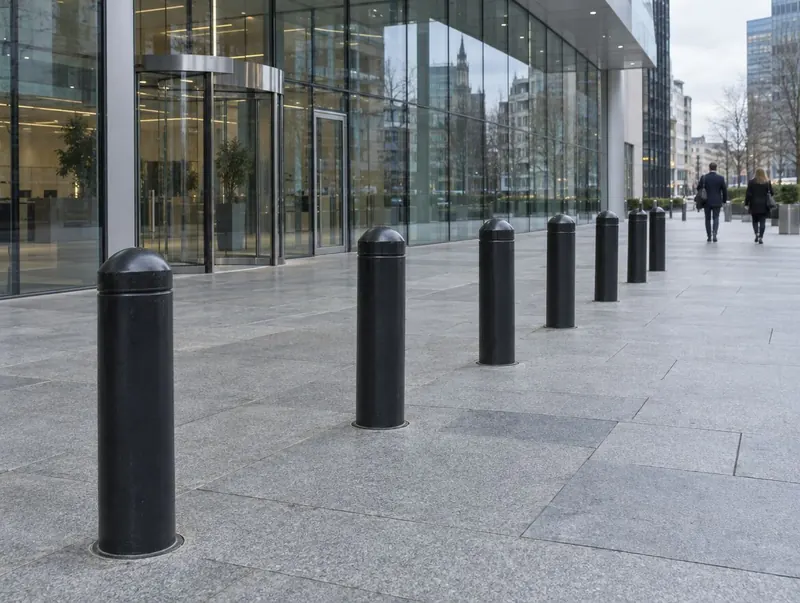 Computer-generated image
What is it?
What are crash-rated (HVM) bollards?
A crash-rated bollard is a vehicle security barrier that has been impact-tested, together with its foundation, against a defined vehicle at a defined speed under ISO 22343-1, or the earlier PAS 68 and IWA 14-1 standards it superseded (products tested to those remain accepted). Its rating records the test vehicle, the impact speed and angle, and how far the vehicle travelled past the bollard line. The rating only holds when the bollard is installed to the same foundation design that was tested.
Crash-rated bollards are used where a vehicle could be driven deliberately at people or at a building: entrances to public and corporate buildings, stadiums, transport hubs, data centres, shopping streets and event spaces. Unlike an ordinary steel post, each model has a published test result, so the product can be matched to the threat a security adviser has identified rather than to how solid a post looks.
We supply and install manufacturer-tested bollards using installation crews working under our management. We do not design hostile vehicle mitigation schemes or decide the threat level. That work sits with the client's security adviser, consultant or the manufacturer's technical team. Our job is to build exactly what has been specified, to the tested foundation detail, and to record what went into the ground so the rating can be relied on later.
Where crash-rated bollards make sense
- Building entrances and forecourts flagged in a security risk assessment
- Pedestrianised streets, plazas and crowded public spaces
- Stadiums, arenas and event venues with predictable crowd flows
- Data centres, utilities and critical infrastructure perimeters
- Glazed frontages on corporate and public buildings
- Transport interchanges, taxi ranks and drop-off zones
- Sites where a vehicle dynamics assessment shows a long straight run-up
How it works
A rated bollard works as a system rather than a post. The visible part is usually a thick-walled steel core, sometimes with an internal insert, set into a reinforced concrete foundation that resists the overturning force when a vehicle strikes it. On impact the post and foundation take the vehicle's energy and pass it into the surrounding ground. The test records whether the vehicle was stopped and how far it travelled past the barrier, known as the penetration distance (measured from the front face under IWA 14-1 and ISO 22343, from the back face under PAS 68).
Ratings are written as a short code. Under IWA 14-1 and ISO 22343-1 the code states the test vehicle class and mass, the impact speed, the angle of approach and the measured penetration; PAS 68 follows a similar pattern. Test vehicles range from a passenger car to heavy goods vehicles, at speeds such as 32, 48, 64 or 80 km/h. A higher rating is not automatically better: the right product matches the speed a vehicle can realistically reach on that approach.
Posts are spaced so that a vehicle cannot squeeze between them, which in practice usually means a clear gap of no more than about 1,200 mm. Some ranges are tested as a row tied together on a continuous beam rather than as individual posts, in which case the rating applies only to that tested arrangement, including any minimum number of posts in the run.
Options and finishes
| Option | Detail |
|---|---|
| Static rated bollards | Fixed posts for permanent lines where vehicles never need to pass. They are a straightforward rated option to install and maintain. |
| Rated removable or automatic posts | Where an entrance must open for deliveries or emergency vehicles, rated removable, retractable or automatic models are available. Check that the rating stated is for the exact model and position you are buying. |
| Deep or standard foundation designs | Deep foundations suit open ground where excavation is unrestricted. Where services or slabs get in the way, shallow-mount tested designs may be a better fit. |
| Decorative covers | Stainless steel, cast or polymer sleeves can be fitted over the steel core to suit a streetscape. Use covers supplied or approved by the manufacturer so the tested product is not altered. |
| Heights and diameters | Exposed heights are commonly around 800 to 1,000 mm, with core diameters varying by model and rating. Larger diameters are not always needed to achieve a given rating. |
| Finishes and visibility bands | Galvanised and powder-coated finishes in RAL colours, with contrasting or reflective bands near the top so the posts are visible to pedestrians and drivers. |
Typical specification
| Item | Typical |
|---|---|
| Test standards | ISO 22343-1 (current); PAS 68 and IWA 14-1 superseded but accepted; ASTM F2656 for some imported products |
| Exposed height | Typically 800–1,000 mm, model dependent |
| Clear gap between posts | Commonly no more than about 1,200 mm |
| Foundation | As per the manufacturer's tested drawing; deep designs often exceed 1 m |
| Concrete and reinforcement | Grade, cover and rebar exactly as the tested specification |
| Curing period | Set by the specification; full design strength is often taken at around 28 days |
| Penetration | Stated in the rating code, measured from the bollard line |
Typical values only — the survey and the product's data sheet set the final specification.
How we install it
Start from the specification
We work from the specification issued by your security adviser or the manufacturer: product, rating, positions and foundation drawing. If no specification exists yet, we can put you in touch with the manufacturer's technical team, but we do not set the threat level ourselves.
Free site survey and ground checks
A free site survey looks at access, surfaces and likely services, followed by utility searches, radar scanning and trial holes where needed. You then receive a fixed written quote based on what the survey found.
Set out and excavate
Positions are set out to the drawing and excavated to the tested depth and width, with shoring where the ground needs it. Spoil is removed as work progresses.
Fix reinforcement and set the posts
The reinforcement cage is built to the drawing and the bollards are held to line and level in templates. Concrete is poured to the specified grade, with samples taken for testing if the specification calls for them.
Cure, protect and reinstate
The posts are protected while the concrete gains strength, and the surface is reinstated to match. The line should not be treated as fully effective until the specified curing period has passed.
Hand over a build record
You receive photographs of the reinforcement and excavation before each pour, concrete delivery tickets, as-built positions and the manufacturer's product certification, ready for your adviser and insurers.
Ground, foundations and buried services
Rated foundations are large, and excavation is often where projects run into trouble. Footways and forecourts in towns are usually crowded with cables, gas mains, water pipes and old drainage, and a single unexpected duct can stop a bollard position. Utility records, radar scanning and hand-dug trial holes come before any machine work, and service diversions can take longer than the bollard installation itself. Made ground, a high water table or soft clay may need an engineer to confirm the tested design suits the site; any change to depth, width or reinforcement must be agreed in writing by the manufacturer, or the rating may no longer apply. Reinstatement matches paving, tactile surfaces and kerbs.
Rules and checks before you order
- Check that the test certificate matches the exact model, configuration and foundation being installed, and keep it with the site records.
- Confirm who owns the land: works on public highway usually need the highway authority's agreement, and permanent street furniture there may need a licence.
- Balance the gaps: narrow enough to stop a vehicle, typically no more than about 1,200 mm, but wide enough for wheelchair users and buggies — check against Inclusive Mobility guidance.
- Ask the local planning authority whether consent is needed, particularly in conservation areas or near listed buildings.
- Agree how emergency vehicles will get through, and refer to guidance on selecting and installing vehicle security barriers such as PAS 69 or ISO 22343-2.
See rules and standards by nation for highway consent, accessibility and security standards.
Maintenance
Static rated bollards need little routine work, but they should be inspected periodically and always after any impact. Look for cracked surfacing at the base, movement, damaged covers and faded bands. A rated bollard that has stopped a vehicle has done its job and should be assessed with the manufacturer; in most cases the post, and sometimes the foundation insert, is replaced rather than straightened. Movable rated bollards need a planned servicing schedule. Keep inspection records with the original test certificate so the line's condition can be shown to insurers or a security adviser.
What affects the price
- The rating required and the product range that achieves it
- Depth and volume of excavation, reinforcement and concrete
- Buried services, diversions and ground investigation
- Number of posts and whether a linked beam system is needed
- Covers, finishes and any integrated lighting
- Traffic management, restricted working hours or night work in occupied sites
- Reinstatement of natural stone, tactile paving or specialist surfaces
Guide prices: crash-rated bollards
Three typical specifications. The middle one is the specification we usually recommend for durability and visibility.
Standard
per bollard + VAT
- Rated for a 7.5 t vehicle at 30 mph (48 km/h)
- Installed to the manufacturer's tested foundation
- Surface reinstated
Upgraded
per bollard + VAT
- Rated for 7.5 t at 40 mph (64 km/h)
- Tested foundation and spacing
- Everything in Standard
Premium
per bollard + VAT
- Rated for 7.5 t at 50 mph (80 km/h) or specialist foundation
- Architectural sleeve or finish
- Everything in Upgraded
Guide prices for the UK base region; local pages adjust for your area. Per bollard, supplied and installed on a standard tested foundation. Minimum job £3,995 + VAT. Your fixed price comes in writing after survey.
Crash-rated bollards: questions answered
How much does crash-rated bollard installation cost?
Typically £1,995–£9,995 per bollard, supplied and installed on a standard tested foundation, plus VAT. Small jobs carry a minimum charge of £3,995 plus VAT. Ground conditions, access, buried services and consents move the figure; the fixed price comes in writing after survey.
What does a crash rating code actually tell me?
It tells you the vehicle used in the test, how fast it was travelling, the angle it hit at and how far it got past the bollard line. Your security adviser compares those figures with the vehicle and speed achievable on your approach. A rating that does not match the site's real risk is either more than you need or not enough.
Is a heavy unrated steel post good enough instead?
Not where the risk is a deliberate vehicle attack. An unrated post may look solid, but nobody can say what it will stop because it has never been tested with its foundation. Unrated steel suits nuisance parking and low-speed knocks, not crowds or buildings flagged in a security assessment.
Why can't the foundation be adjusted to suit our ground?
Because the rating belongs to the bollard and foundation as tested together. Making the hole shallower, narrower or lighter on steel changes how the system behaves on impact. If site conditions force a change, the manufacturer has to approve it in writing, and some changes mean choosing a different product such as a shallow-mount system.
Will you design our HVM layout?
No. Scheme design and threat assessment belong with your security adviser, a specialist consultant or the manufacturer's technical team. We install the products they specify, to the tested foundation, and work alongside them on site so the build matches the design.
When can we rely on the new bollards?
Only once the concrete has reached the strength set in the specification. The posts are physically in place as soon as the pour is finished, but the rated performance depends on the foundation, and full design strength is commonly taken at around 28 days. Your adviser may arrange temporary measures to cover the gap.
What happens if a rated bollard is struck?
Make the area safe and have the post assessed before relying on it again. A rated bollard that has absorbed a serious impact is usually replaced, and the manufacturer may need to check the foundation or insert. We can install the replacement to the original tested detail.
Related bollard services
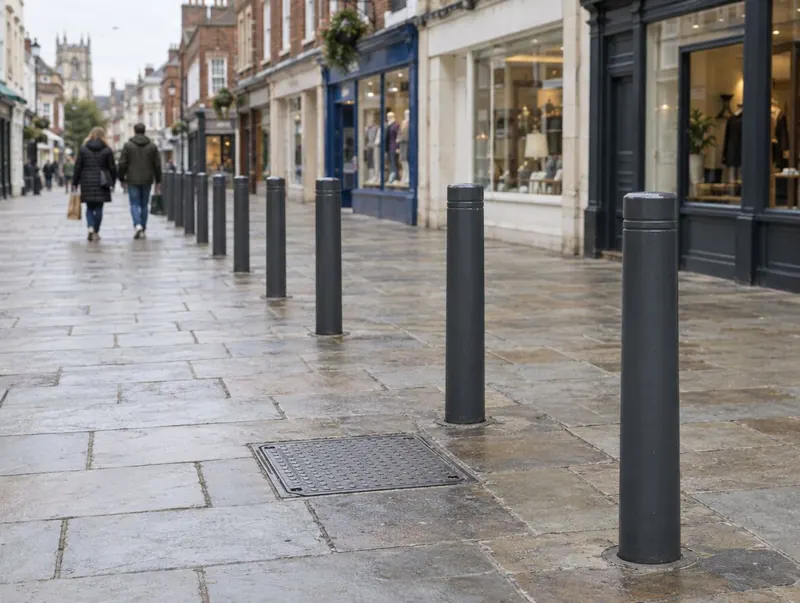
Shallow-mount security bollards
Rated shallow-foundation bollard systems installed where buried services, basements or slabs rule out deep excavation.
Learn more →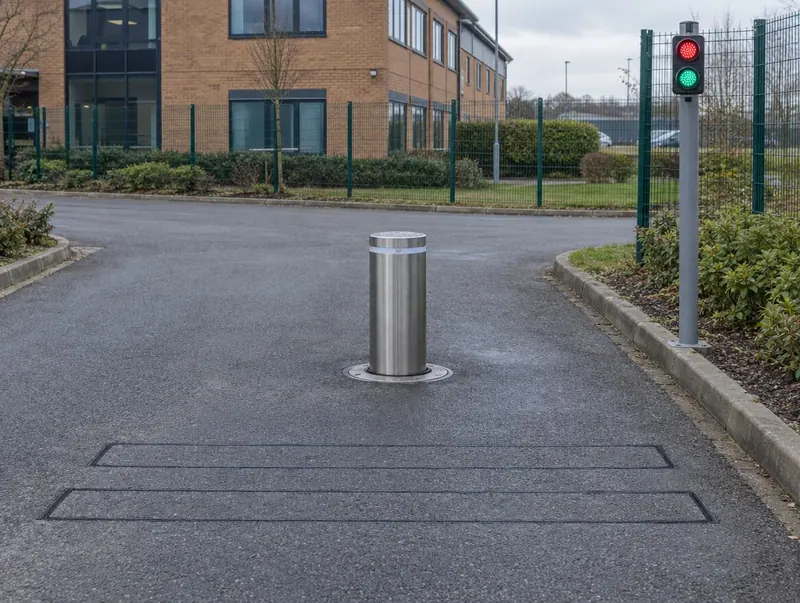
Automatic rising bollards
Hydraulic and electro-mechanical rising bollards installed with controls, safety loops, signals and power, for managed vehicle access.
Learn more →
Ram-raid protection bollards
Bollards fitted in front of shopfronts, ATMs, jewellers and convenience stores to stop vehicles being used to break in.
Learn more →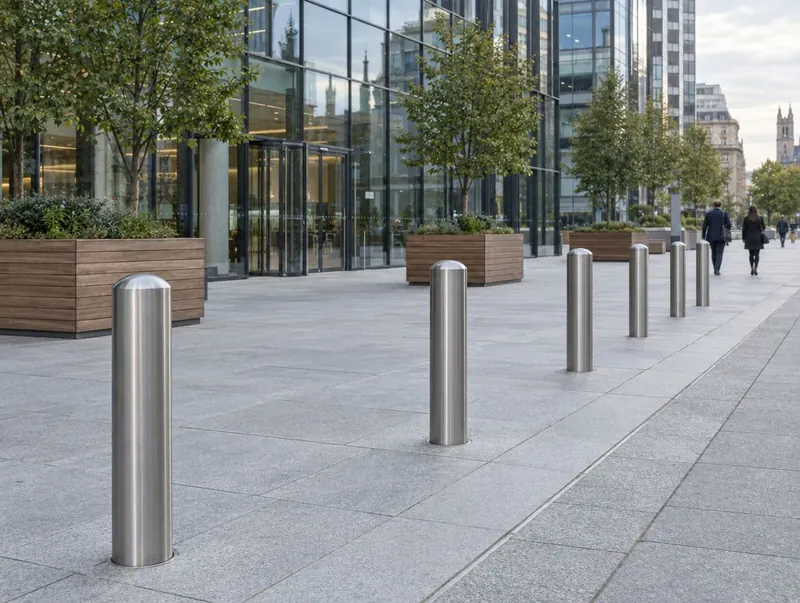
Stainless steel bollards and bollard covers
Stainless steel bollards and sleeve covers in 304 or 316 grade, for building entrances, plazas and upgrading tired steel posts.
Learn more →Crash-rated bollards near you
Local pages show the highway authority, postcodes covered and regional prices.
- Bedfordshire
- Berkshire
- Bristol
- Buckinghamshire
- Cambridgeshire
- Cheshire
- Cornwall
- County Durham
- Cumbria
- Derbyshire
- Devon
- Dorset
- East Riding of Yorkshire
- East Sussex
- Essex
- Gloucestershire
- Greater Manchester
- Hampshire
- Herefordshire
- Hertfordshire
- Isle of Wight
- Kent
- Lancashire
- Leicestershire
- Lincolnshire
- London
- Merseyside
- Norfolk
- North Yorkshire
- Northamptonshire
- Northumberland
- Nottinghamshire
- Oxfordshire
- Rutland
- Shropshire
- Somerset
- South Yorkshire
- Staffordshire
- Suffolk
- Surrey
- Tyne and Wear
- Warwickshire
- West Midlands
- West Sussex
- West Yorkshire
- Wiltshire
- Worcestershire
- Blaenau Gwent
- Bridgend
- Caerphilly
- Cardiff
- Carmarthenshire
- Ceredigion
- Conwy
- Denbighshire
- Flintshire
- Gwynedd
- Isle of Anglesey
- Merthyr Tydfil
- Monmouthshire
- Neath Port Talbot
- Newport
- Pembrokeshire
- Powys
- Rhondda Cynon Taf
- Swansea
- Torfaen
- Vale of Glamorgan
- Wrexham
- Aberdeen City
- Aberdeenshire
- Angus
- Argyll and Bute
- City of Edinburgh
- Clackmannanshire
- Dumfries and Galloway
- Dundee City
- East Ayrshire
- East Dunbartonshire
- East Lothian
- East Renfrewshire
- Falkirk
- Fife
- Glasgow City
- Highland
- Inverclyde
- Midlothian
- Moray
- North Ayrshire
- North Lanarkshire
- Perth and Kinross
- Renfrewshire
- Scottish Borders
- South Ayrshire
- South Lanarkshire
- Stirling
- West Dunbartonshire
- West Lothian
- Antrim and Newtownabbey
- Ards and North Down
- Armagh City, Banbridge and Craigavon
- Belfast
- Causeway Coast and Glens
- Derry City and Strabane
- Fermanagh and Omagh
- Lisburn and Castlereagh
- Mid Ulster
- Mid and East Antrim
- Newry, Mourne and Down