Wales · 3 towns
Crash-rated bollard installation in Monmouthshire
Crash-rated bollards for sites across Monmouthshire: surveyed, quoted in writing and installed by our crews.
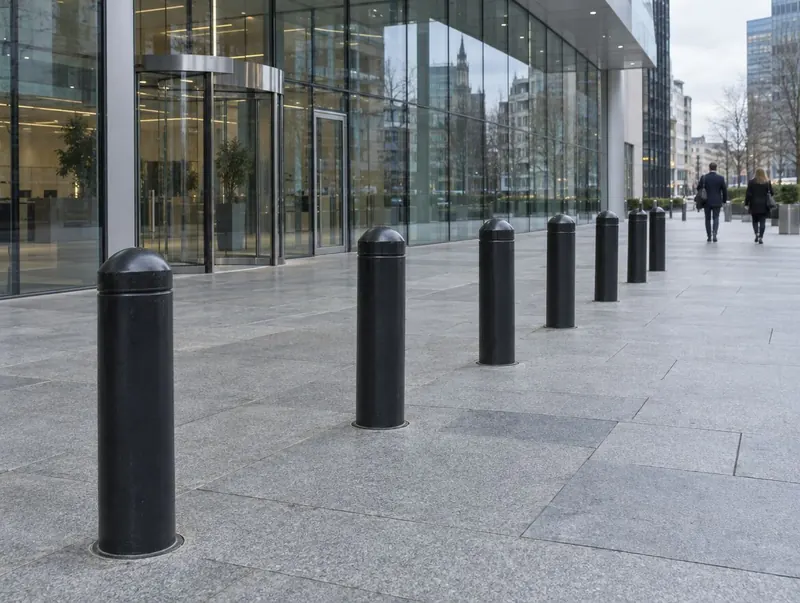 Computer-generated image
Crash-rated bollards in Monmouthshire
Across Monmouthshire, typical sites for crash-rated bollards include town-centre squares, filling-station forecourts and high street shopfronts. Installation of impact-tested HVM bollards rated to ISO 22343-1 (or the superseded, still-accepted PAS 68 / IWA 14-1) on the tested foundation.
Highway authorities for local roads in Monmouthshire: Monmouthshire County Council.
Choose your town in Monmouthshire
Guide prices in Monmouthshire
| Specification | Guide price | Includes |
|---|---|---|
| Standard | £1,945–£5,195 + VAT | Rated for a 7.5 t vehicle at 30 mph (48 km/h), tested foundation |
| Upgraded | £4,245–£7,545 + VAT | Rated for 7.5 t at 40 mph (64 km/h), tested foundation |
| Premium | £6,595–£9,695 + VAT | Rated for 7.5 t at 50 mph (80 km/h), or a specialist foundation |
Per bollard, supplied and installed on a standard tested foundation; -3% for Wales. Guide only — the fixed price follows a survey.
Highway and planning authorities in Monmouthshire
| Town | Highway / roads authority | Planning authority |
|---|---|---|
| Abergavenny | Monmouthshire County Council | Monmouthshire County Council |
| Chepstow | Monmouthshire County Council | Monmouthshire County Council |
| Monmouth | Monmouthshire County Council | Monmouthshire County Council |
Rules for crash-rated bollards in Wales
Bollards on adopted highway are a matter for the highway authority under the Highways Act 1980, so they need its written agreement. On private land the owner's agreement is what matters; listed buildings and conservation areas need a word with the planning team first. Crash ratings (ISO 22343-1, or the superseded but still accepted PAS 68 and IWA 14-1) only hold when the product is installed to its tested foundation.
Details and sources: bollard rules in Wales.
How installation works
Set out and excavate
Positions are set out to the drawing and excavated to the tested depth and width, with shoring where the ground needs it. Spoil is removed as work progresses.
Fix reinforcement and set the posts
The reinforcement cage is built to the drawing and the bollards are held to line and level in templates. Concrete is poured to the specified grade, with samples taken for testing if the specification calls for them.
Cure, protect and reinstate
The posts are protected while the concrete gains strength, and the surface is reinstated to match. The line should not be treated as fully effective until the specified curing period has passed.
Hand over a build record
You receive photographs of the reinforcement and excavation before each pour, concrete delivery tickets, as-built positions and the manufacturer's product certification, ready for your adviser and insurers.
Crash-rated bollards in Monmouthshire: FAQs
Do you cover all of Monmouthshire for crash-rated bollards?
Yes — including Abergavenny, Chepstow and Monmouth. Enter your postcode in the price calculator to confirm.
How much do crash-rated bollards cost in Monmouthshire?
In Monmouthshire, typically £1,945–£9,695 per bollard, supplied and installed on a standard tested foundation, plus VAT, with a minimum job of £3,895 plus VAT, using our Wales guide prices. The fixed figure comes in writing after we've seen the site.
Who do I ask about bollards on public land in Monmouthshire?
For local roads, Monmouthshire County Council; the Welsh Government covers trunk roads. Bollards on adopted highway need the authority's written agreement.
What happens if a rated bollard is struck?
Make the area safe and have the post assessed before relying on it again. A rated bollard that has absorbed a serious impact is usually replaced, and the manufacturer may need to check the foundation or insert. We can install the replacement to the original tested detail.
Why can't the foundation be adjusted to suit our ground?
Because the rating belongs to the bollard and foundation as tested together. Making the hole shallower, narrower or lighter on steel changes how the system behaves on impact. If site conditions force a change, the manufacturer has to approve it in writing, and some changes mean choosing a different product such as a shallow-mount system.