Access & parking control
Fold-down parking post installation
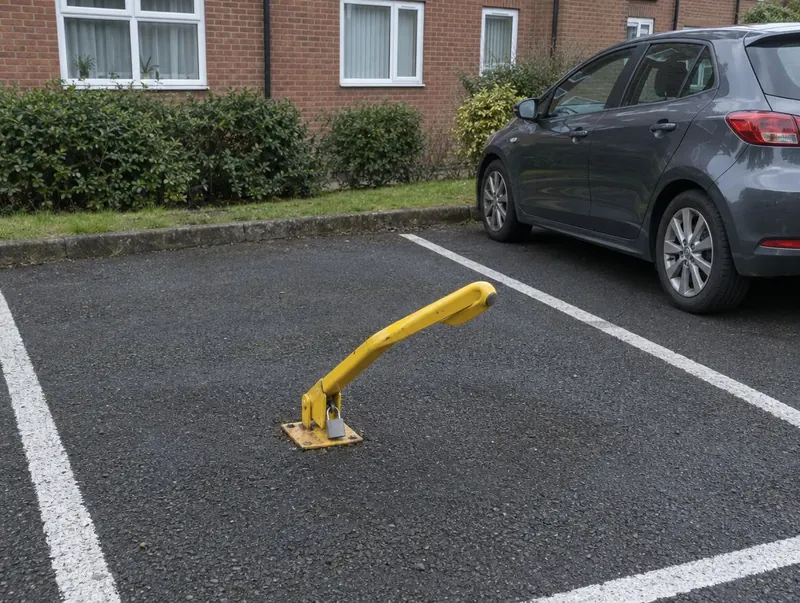
Hinged fold-down parking posts with padlock or integral key locks, bolted down to protect private and allocated bays.
- Typically £145–£445 per post + VAT (£165–£525 inc VAT for homes); minimum job £345
- Free survey and fixed written quote
- Foundations and reinstatement included
 Computer-generated image
What is it?
What are fold-down parking posts?
A fold-down parking post is a hinged post bolted to the ground at the entrance of a parking bay, raised and locked to stop other vehicles using the space and folded flat when the owner wants to park. It is locked with a padlock or an integral key lock. Because it is surface-fixed, it needs no excavation in most cases.
In blocks of flats, shared courtyards, staff car parks and private bays outside homes, a frequent complaint is someone else parking in a space that is yours. A fold-down post is the straightforward answer. It sits upright when you are out and folds flat for you to drive over when you return. It needs no digging, no power and only a few minutes' use each day.
What separates a post that lasts from one that rattles loose within a year is the fixing, the hinge and the lock. Our installation crews, working under our management, check the surface can hold anchors, set the post where wheels will not run over the hinge, and choose a lock that suits who will use it.
Where fold-down parking posts make sense
- Allocated bays in flats and apartment car parks
- Private parking spaces outside terraced homes
- Staff and visitor bays at offices and surgeries
- Disabled bays that keep being taken by other drivers
- Electric vehicle charging bays
- Shared courtyards with marked spaces
- Sites where digging is not allowed or practical
How it works
The post is welded or bolted to a hinge on a steel base plate, and the plate is anchored to the ground. Raised, the post is held upright by a locking pin, padlock or internal lock. Unlocked, it folds forward or backward until it lies almost flat against the surface, low enough for a car to drive over. Some designs fold into a recess in the base so the profile is lower still.
Locking falls into two families. Padlock posts have a hasp or eye through which a padlock passes; they are cheap to rekey because you simply change the padlock, but the padlock can be attacked and needs to be carried. Integral-lock posts have a key cylinder built into the post or base; they look neater, have nothing loose to lose and are usually more resistant to casual tampering.
Shapes vary for different jobs. A single round or square post suits most bays. A T-shaped or hooped barrier gives a wider visual barrier across the front of the bay. Remote-controlled battery parking barriers are a further option where the owner wants to stay in the car.
Options and finishes
| Option | Detail |
|---|---|
| Padlocked posts | Simple and easy to rekey by changing the padlock. Choose a shrouded padlock to resist bolt croppers. |
| Integral key lock | Built-in cylinder lock with no loose parts; can often be supplied keyed alike across a development. |
| Post shapes | Round or square single posts, T-bar, and hoop styles for a wider barrier across the bay entrance. |
| Fixing methods | Resin anchors or through-bolts into concrete, or a small concrete pad where the existing surface is too weak. |
| Finishes and visibility | Yellow, black or grey powder coat, with reflective bands so the raised post is visible at night. |
| Remote-control barriers | Battery-powered barriers raised and lowered by handset, for owners who prefer not to leave the car. |
Typical specification
| Item | Typical |
|---|---|
| Raised height | Typically 500–900 mm |
| Folded height | Usually low enough to drive over, model dependent |
| Base plate | Steel, anchored at several points |
| Fixing | Resin anchors or through-bolts into sound concrete |
| Locking | Padlock, integral cylinder lock or remote control |
| Finish | Galvanised and powder-coated, often yellow or black |
| Excavation | None, unless a new concrete pad is needed |
Typical values only — the survey and the product's data sheet set the final specification.
How we install it
Survey the bay
A free site survey looks at the surface, the bay layout and where wheels run. You receive a fixed written quote for the posts, locks and any concrete pad.
Position the post
The post is placed where your car can straddle it when folded, usually central to the bay entrance, so tyres do not run over the hinge every day.
Drill and anchor
Holes are drilled into sound concrete, cleaned, and resin anchors or through-bolts set. On weak tarmac or block paving, a small concrete pad is formed first.
Fit and torque
The base plate is fixed down and bolts tightened to the anchor maker's figure once the resin has cured. Anti-tamper bolt heads or caps can be fitted.
Check operation
The post is raised, locked, unlocked and folded several times, and the folded height is checked against your car's clearance.
Ground, foundations and buried services
Surface-fixed posts depend entirely on what they are fixed to. Concrete of reasonable thickness holds resin anchors well. Tarmac on its own does not, because the bitumen creeps and the anchors loosen; on tarmac drives a small concrete pad is cut in beneath the post. Block paving needs the same approach, as anchors into individual blocks simply pull them out. Underground car park decks and podium slabs may contain reinforcement, post-tensioned tendons or waterproofing, and drilling must not damage them, so scanning and confirmation from the building manager come first. Where the car park has heating cables or a membrane, the fixing method is agreed before drilling. Surface drainage matters too: a post fixed in a low spot where water ponds will sit in standing water and grit, so positions are nudged to the drier side of the bay where the layout allows.
Rules and checks before you order
- Get the landlord's or management company's agreement before fixing posts in a shared car park.
- Do not fit posts that block emergency access routes or reduce the usable width of a fire lane.
- Check drilling into car park decks or podium slabs with the building owner, as they may contain tendons or membranes.
- Fit reflective bands so raised posts are visible to drivers at night.
See rules and standards by nation for highway consent, accessibility and security standards.
Maintenance
Fold-down posts are simple, but hinges and locks are exposed to grit and weather. Oil the hinge pin and lubricate the lock a few times a year, and check the anchor bolts are still tight, especially in the first months. Replace padlocks that have become stiff or rusty before they seize. If the post has been driven over while upright, check the hinge and base for bending; a bent hinge can stop the post locking upright. Keep the area around the base swept, because grit packed under a folded post stops it lying flat and lets it rattle. Where several residents share keys or padlock combinations, keep a simple record of who holds what, so a lost key does not end with the post being cut off.
What affects the price
- Padlocked, integral-lock or remote-control post
- Number of bays and keyed-alike locks
- Surface type and whether a concrete pad is needed
- Post style: single, T-bar or hoop
- Car park decks needing scanning before drilling
Guide prices: fold-down parking posts
Three typical specifications. The middle one is the specification we usually recommend for durability and visibility.
Standard
per post + VAT · homes £165–£325 inc VAT
- Standard post or product for the type
- Foundation and fixing to manufacturer's details
- Surface reinstated to match
Upgraded
per post + VAT · homes £275–£435 inc VAT
- Upgraded finish (RAL colour, stainless or sleeve)
- Retroreflective band and matched keys
- Everything in Standard
Premium
per post + VAT · homes £385–£525 inc VAT
- Heavy-duty or architectural specification
- Premium finish and fittings
- Everything in Upgraded
Guide prices for the UK base region; local pages adjust for your area. Per post, supplied and installed. Minimum job £345 + VAT. Your fixed price comes in writing after survey.
Fold-down parking posts: questions answered
How much does fold-down parking post installation cost?
Typically £145–£445 per post, supplied and installed, plus VAT. For homeowners that's £165–£525 including VAT. Small jobs carry a minimum charge of £345 plus VAT. Ground conditions, access, buried services and consents move the figure; the fixed price comes in writing after survey.
Can a fold-down parking post go on a tarmac drive?
Yes, but not by bolting straight into the tarmac. Tarmac is too soft to hold anchors for long, so we cut in a small concrete pad and fix the post to that. The pad sits flush with the surface.
Padlock or integral lock: which is better for a parking post?
An integral lock is neater and has nothing loose to carry or lose, and is harder to tamper with. A padlock is easy to replace if keys go missing. Many residents prefer integral locks for daily use.
Will I damage my car driving over a folded post?
Not if the post is positioned to sit between your wheels and folds low enough for your car's clearance. We check the folded height at installation. Very low cars may need a lower-profile design.
Do I need permission to fit a parking post in my bay?
If the car park is shared or managed, you normally need agreement from the landlord or management company. Leases often control alterations to common parts. On your own freehold drive, permission is not usually needed.
Can someone simply unbolt the post?
Anti-tamper bolt heads or caps make it much harder, and the bolts are covered by the post when it is upright on many designs. Resin anchors set into concrete are also hard to remove without tools and time.
Are fold-down posts suitable for EV charging bays?
Yes, they are a common way to keep a charging bay free for the vehicle that needs it. Position the post so it does not interfere with the charging cable route or the charger itself.
Related bollard services
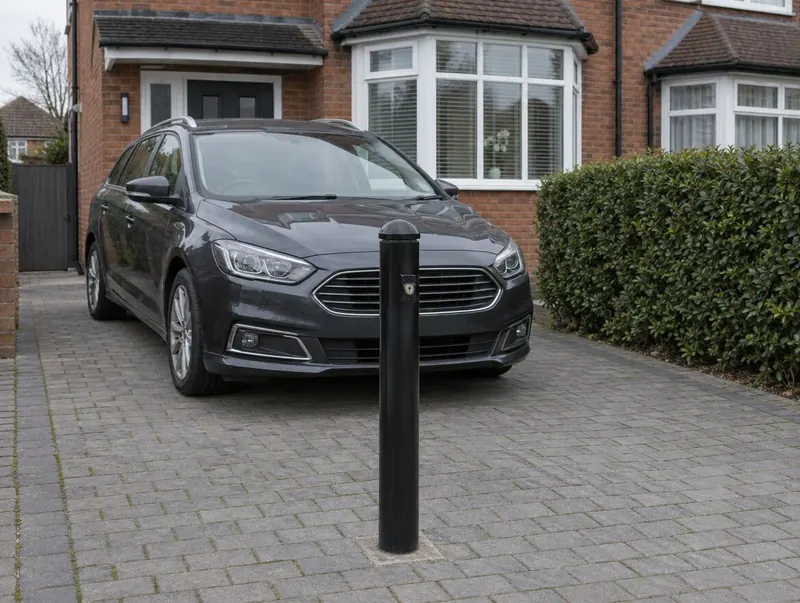
Driveway security posts
Telescopic, fold-down and removable security posts for home driveways, to deter car theft and stop unwanted parking.
Learn more →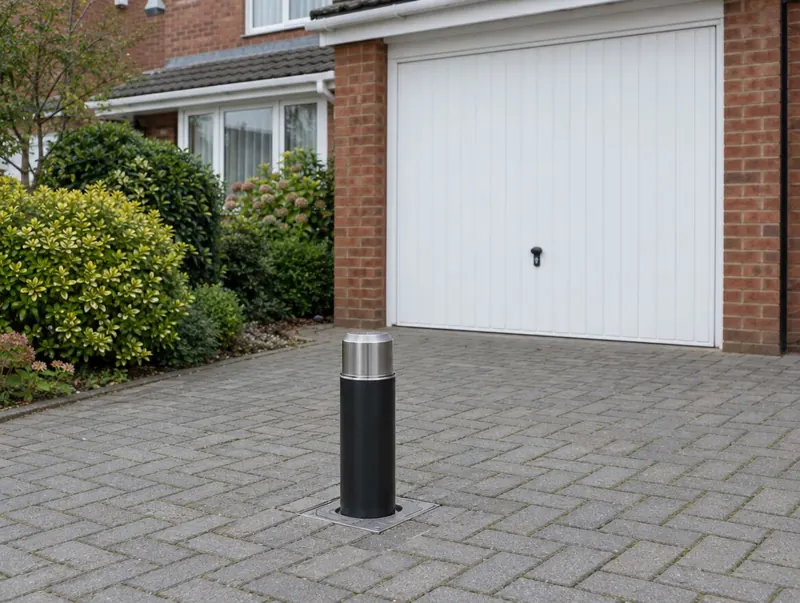
Telescopic bollards
Key-locked telescopic bollards that retract into a ground cassette, for driveways, private bays and access roads.
Learn more →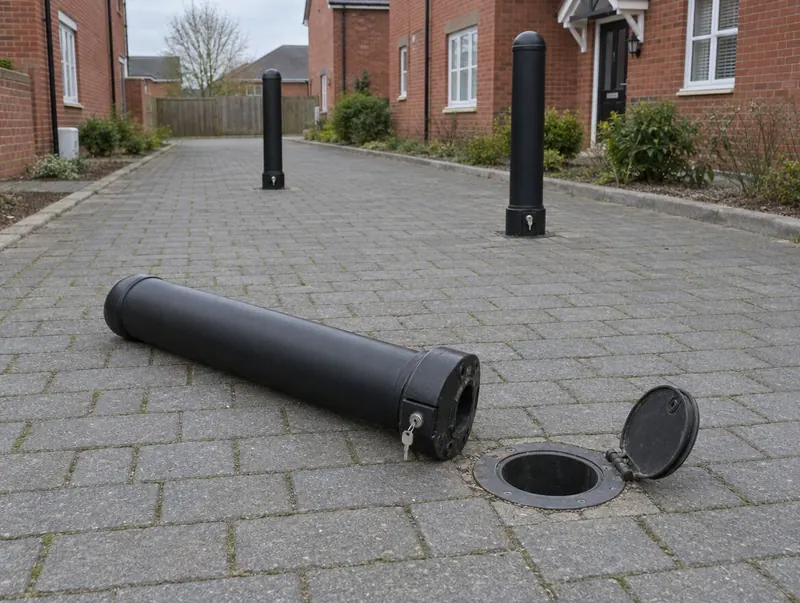
Removable bollards
Lift-out bollards in lockable ground sockets for driveways, delivery routes, access roads and emergency access points.
Learn more →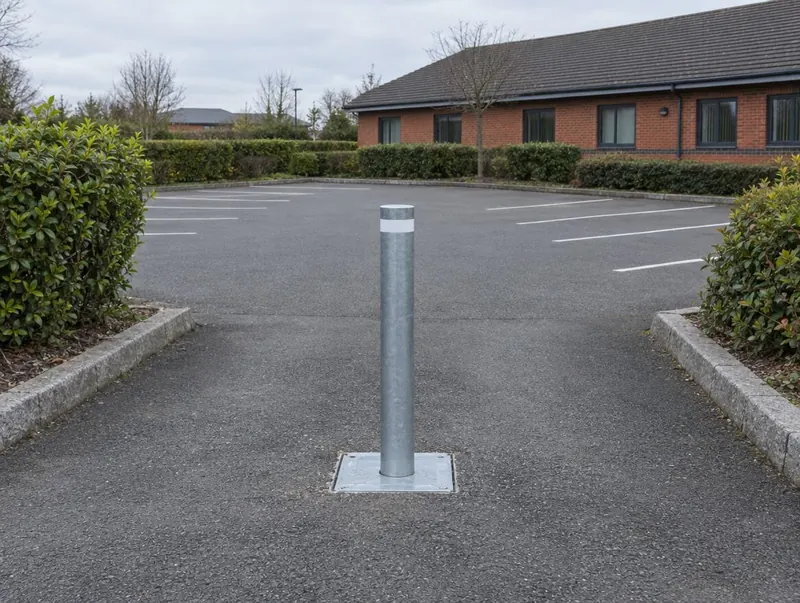
Semi-automatic bollards
Gas-strut assisted bollards that rise on their own when unlocked and lower by hand, with no mains power needed.
Learn more →Fold-down parking posts near you
Local pages show the highway authority, postcodes covered and regional prices.
- Bedfordshire
- Berkshire
- Bristol
- Buckinghamshire
- Cambridgeshire
- Cheshire
- Cornwall
- County Durham
- Cumbria
- Derbyshire
- Devon
- Dorset
- East Riding of Yorkshire
- East Sussex
- Essex
- Gloucestershire
- Greater Manchester
- Hampshire
- Herefordshire
- Hertfordshire
- Isle of Wight
- Kent
- Lancashire
- Leicestershire
- Lincolnshire
- London
- Merseyside
- Norfolk
- North Yorkshire
- Northamptonshire
- Northumberland
- Nottinghamshire
- Oxfordshire
- Rutland
- Shropshire
- Somerset
- South Yorkshire
- Staffordshire
- Suffolk
- Surrey
- Tyne and Wear
- Warwickshire
- West Midlands
- West Sussex
- West Yorkshire
- Wiltshire
- Worcestershire
- Blaenau Gwent
- Bridgend
- Caerphilly
- Cardiff
- Carmarthenshire
- Ceredigion
- Conwy
- Denbighshire
- Flintshire
- Gwynedd
- Isle of Anglesey
- Merthyr Tydfil
- Monmouthshire
- Neath Port Talbot
- Newport
- Pembrokeshire
- Powys
- Rhondda Cynon Taf
- Swansea
- Torfaen
- Vale of Glamorgan
- Wrexham
- Aberdeen City
- Aberdeenshire
- Angus
- Argyll and Bute
- City of Edinburgh
- Clackmannanshire
- Dumfries and Galloway
- Dundee City
- East Ayrshire
- East Dunbartonshire
- East Lothian
- East Renfrewshire
- Falkirk
- Fife
- Glasgow City
- Highland
- Inverclyde
- Midlothian
- Moray
- North Ayrshire
- North Lanarkshire
- Perth and Kinross
- Renfrewshire
- Scottish Borders
- South Ayrshire
- South Lanarkshire
- Stirling
- West Dunbartonshire
- West Lothian
- Antrim and Newtownabbey
- Ards and North Down
- Armagh City, Banbridge and Craigavon
- Belfast
- Causeway Coast and Glens
- Derry City and Strabane
- Fermanagh and Omagh
- Lisburn and Castlereagh
- Mid Ulster
- Mid and East Antrim
- Newry, Mourne and Down