Traffic & site protection
Warehouse and loading-bay bollards
Yellow steel and polymer impact bollards for forklift zones, loading bays, doors, columns and racking inside warehouses.
- Typically £175–£1,195 per bollard + VAT; minimum job £445
- Free survey and fixed written quote
- Foundations and reinstatement included
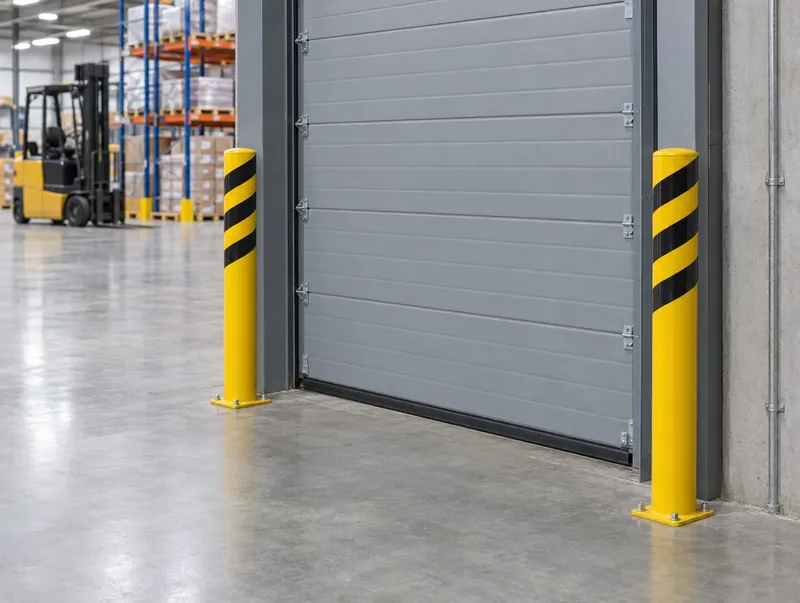 Computer-generated image
What is it?
What are warehouse and loading-bay impact bollards?
Warehouse impact bollards are heavy-duty posts fixed to the floor slab to protect building columns, door frames, racking, plant and walkways from forklifts, pallet trucks and delivery vehicles. They are typically yellow steel posts bolted down with anchors, or energy-absorbing polymer bollards designed to flex and recover. Their size and type are chosen from the weight and speed of the vehicles that could strike them.
Inside warehouses, distribution centres and factories, damage happens daily at walking pace. A reach truck turning too tight catches a column, a counterbalance truck reverses into a fire door frame, a lorry backing onto a dock clips the shutter guides. Each knock is small, but together they damage structure, block fire exits and put people at risk. Bollards placed in the right spots take the impact before the asset does.
Getting it right is a question of matching the bollard to the vehicle and protecting the slab as well as the asset. A rigid steel post that stops a loaded forklift can rip its anchors out of the floor and leave a crater in a slab that is expensive to repair. Our installation crews, working under our management, fit steel and polymer protection with fixings suited to your floor, and plan the work around your operations.
Where warehouse bollards make sense
- Building columns in forklift aisles and turning areas
- Loading dock doors, shutter guides and dock levellers
- Fire exit doors and emergency routes
- Racking ends and corners in busy aisles
- Sprinkler risers, electrical panels and gas meters
- Charging stations for forklifts and pallet trucks
- Pedestrian crossings and the ends of walkways
How it works
Steel warehouse bollards are circular hollow sections, typically 114 to 273 mm in diameter, welded to a base plate and fixed to the slab with four or more anchors. Many are filled with concrete for extra stiffness. They are painted or powder-coated safety yellow, often with black bands. A steel post resists a forklift by being stiff, which means almost all of the impact force passes into the fixings and the slab around them.
Polymer impact bollards work differently. They are made from an engineered plastic that flexes on impact and recovers, absorbing much of the energy over a short distance. That reduces the load on anchors and floor, and the bollard and vehicle are often undamaged. The trade-off is that a polymer bollard needs clearance behind it to deflect into, so it must be set slightly away from the asset it protects.
Choosing between them starts with energy: the mass of the vehicle with its load and the speed it might be travelling. PAS 13 sets out a method for testing workplace safety barriers and stating their impact performance, and many products are tested to it. Matching that tested performance to your fleet, with a margin, is more reliable than choosing by diameter alone.
Options and finishes
| Option | Detail |
|---|---|
| Steel bollards | Yellow-coated steel tube on a base plate, often concrete-filled. Robust and economical, but they pass impact loads straight into the slab. |
| Polymer impact bollards | Flex and recover on impact, reducing damage to anchors, floor and vehicle. Need clearance to deflect. |
| Column and rack end guards | Wrap-around or corner protectors for columns and racking uprights where a single post will not fit. |
| Door frame protection | Bollards or low barriers either side of dock doors and roller shutters to protect frames and guides. |
| Diameters and heights | Commonly 114–273 mm diameter and around 600–1,200 mm high, chosen for vehicle type and mast or fork height. |
| Cast-in or base-plated | Base plates suit existing slabs. External yard posts can be cast into concrete foundations for heavier duty. |
Typical specification
| Item | Typical |
|---|---|
| Diameter | Typically 114–273 mm |
| Height | Commonly 600–1,200 mm, to suit vehicle and asset |
| Fixing | Base plate with chemical or mechanical anchors into the slab |
| Slab | Thickness and condition checked before anchor selection |
| Finish | Safety yellow, often with black bands |
| Testing | Many products tested to PAS 13 with stated impact performance |
| Clearance | Polymer bollards need deflection space behind them |
Typical values only — the survey and the product's data sheet set the final specification.
How we install it
Walk the site with the vehicles running
At the free site survey we watch traffic routes, note the vehicles and loads, and look for existing damage that shows where impacts happen. You receive a fixed written quote with each position and product listed.
Check the slab
Slab thickness, joints, cracks and any underfloor services or heating are checked, and anchors are chosen for the floor rather than taken from a standard list.
Plan around operations
Work is phased by aisle or zone, or done out of hours, with each area barriered off while drilling. Dust is controlled with extraction where products are stored nearby.
Drill and anchor
Holes are drilled, cleaned and anchors installed to the maker's instructions. Chemical anchors are left to cure before the bollard is loaded.
Fix, torque and mark
Bollards and guards are fixed and torqued, then any associated floor markings are applied so drivers can see protected zones.
Ground, foundations and buried services
The slab is the foundation, and it decides what can be fixed where. Warehouse floors vary from thick reinforced slabs to thin toppings over older concrete, and some contain underfloor heating, ducting or wire-guidance systems for automated trucks that must not be cut. Anchors need enough edge distance from slab joints and cracks or they will split the concrete on first impact. Where a slab is too thin or poor, the options include through-bolting, a larger base plate to spread load, a polymer bollard that reduces anchor forces, or breaking out and casting a new local foundation. External yard bollards can be root-fixed in concrete foundations, with the usual checks for buried drainage and cables.
Rules and checks before you order
- Use your workplace transport risk assessment to decide where protection is needed, in line with HSE guidance on workplace transport.
- Where impact performance matters, ask for products tested to PAS 13 and match the stated performance to your vehicles.
- Keep fire exits, escape routes and fire equipment accessible; bollards must not narrow escape routes below their required width.
- Check with the building owner before drilling into slabs with underfloor heating, guidance wires or post-tensioned reinforcement.
See rules and standards by nation for highway consent, accessibility and security standards.
Maintenance
Inspect warehouse bollards regularly as part of routine site checks, and after any reported impact. On steel bollards look for bending, cracked welds, loose or sheared anchors and cracked concrete around the base plate. Polymer bollards should return to their original shape; one that stays deformed or has split needs replacing. Repaint or recoat steel posts when the yellow is worn, because faded protection is easier to miss. Persistent strikes in one place often mean the route or turning space needs changing rather than heavier protection.
What affects the price
- Steel or polymer bollards and the impact performance needed
- Number of positions and types of guard
- Slab condition and the anchors or foundations it needs
- Out-of-hours or phased working around operations
- Removal of damaged existing protection
- Floor marking and associated signage
Guide prices: warehouse bollards
Three typical specifications. The middle one is the specification we usually recommend for durability and visibility.
Standard
per bollard + VAT
- Standard post or product for the type
- Foundation and fixing to manufacturer's details
- Surface reinstated to match
Upgraded
per bollard + VAT
- Upgraded finish (RAL colour, stainless or sleeve)
- Retroreflective band and matched keys
- Everything in Standard
Premium
per bollard + VAT
- Heavy-duty or architectural specification
- Premium finish and fittings
- Everything in Upgraded
Guide prices for the UK base region; local pages adjust for your area. Per bollard, supplied and fixed. Minimum job £445 + VAT. Your fixed price comes in writing after survey.
Warehouse bollards: questions answered
How much does warehouse and loading-bay bollards cost?
Typically £175–£1,195 per bollard, supplied and fixed, plus VAT. Small jobs carry a minimum charge of £445 plus VAT. Ground conditions, access, buried services and consents move the figure; the fixed price comes in writing after survey.
Should we choose steel or polymer warehouse bollards?
Steel suits lighter traffic and sound, thick slabs where cost matters most. Polymer suits busy forklift areas where repeated impacts would destroy anchors and floors. Polymer often costs more to buy but less to keep in service.
What size bollard do we need for forklifts?
That depends on the forklift's weight with load and how fast it travels near the asset, not just the post diameter. Tested products state their impact performance, which can be compared with your fleet. We size from your vehicles at the survey.
Can bollards be fixed to a thin warehouse floor?
Sometimes, using larger base plates, through-bolts or polymer bollards that reduce anchor loads. If the slab is too thin or damaged, a new local foundation may be needed. We check the slab before recommending a fixing.
How close to a column should a bollard sit?
Close enough that a vehicle cannot reach the column around it, but with enough gap that the bollard does not hit the column when struck. Polymer bollards need more clearance than steel because they deflect. The gap is set from the product data.
What is PAS 13?
PAS 13 is a code of practice for safety barriers used in workplaces, including a method for impact testing them. Products tested to it state how much impact they can take. It helps compare products on performance rather than appearance.
Can you install while the warehouse is operating?
Usually yes, by working zone by zone with each area barriered off, or by working nights or weekends. Drilling dust is controlled near stored goods. We agree the phasing with your site manager.
Related bollard services
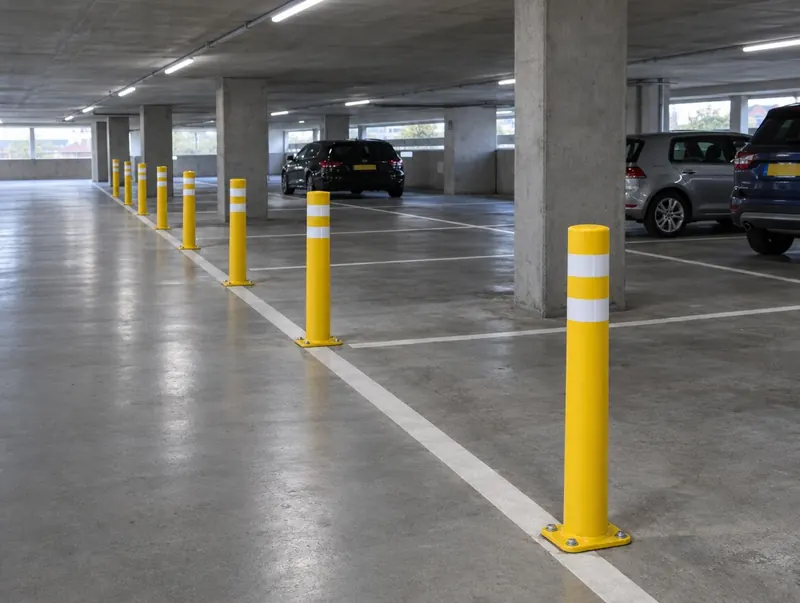
Flexible impact-recoverable bollards
Polyurethane and spring-based bollards that bend when hit and return upright, for car parks, depots and lane separation.
Learn more →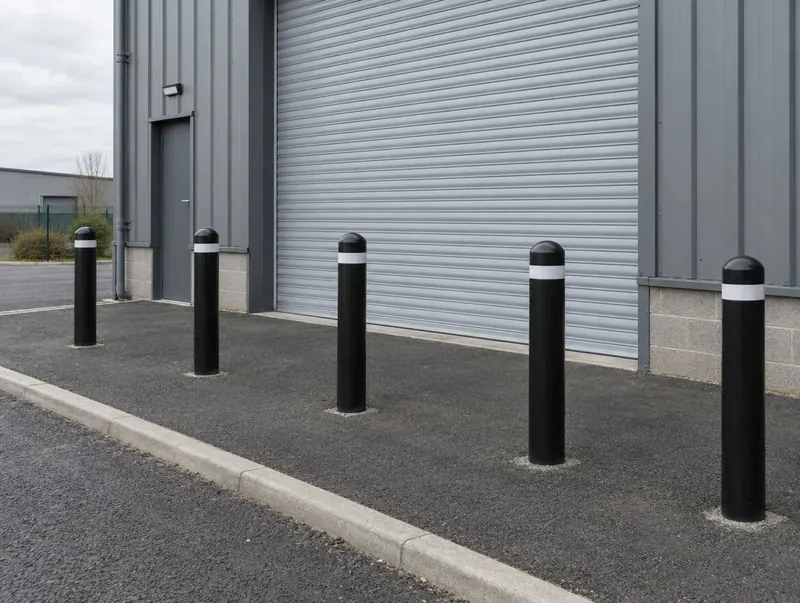
Steel security bollards (unrated)
Concrete-filled steel bollards, root-fixed or base-plated, for car parks, forecourts, boundaries and nuisance vehicle control.
Learn more →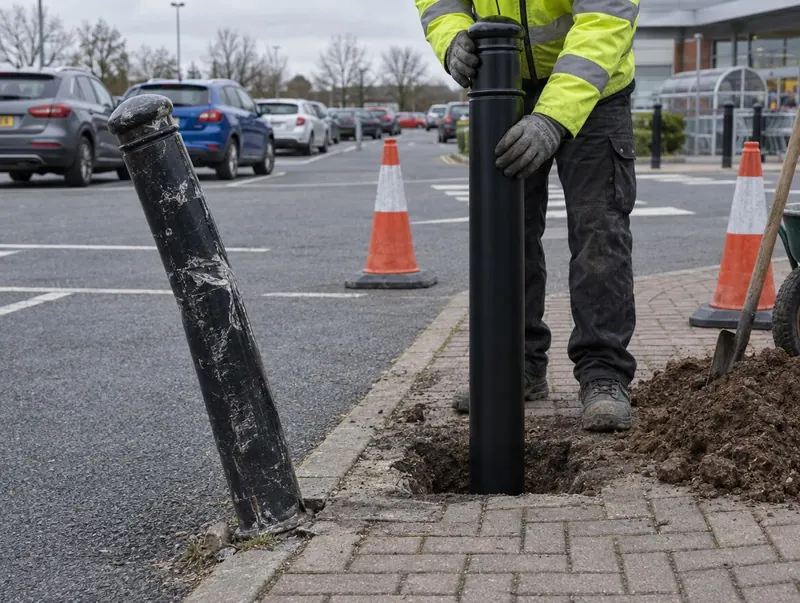
Bollard replacement
Like-for-like or upgraded replacement of bollards damaged by vehicles, corrosion or wear, matched to the existing line.
Learn more →
Pedestrian and shopfront protection bollards
Bollards that separate people from vehicles at car parks, forecourts, walkways, drive-thrus and shop entrances.
Learn more →Warehouse bollards near you
Local pages show the highway authority, postcodes covered and regional prices.
- Bedfordshire
- Berkshire
- Bristol
- Buckinghamshire
- Cambridgeshire
- Cheshire
- Cornwall
- County Durham
- Cumbria
- Derbyshire
- Devon
- Dorset
- East Riding of Yorkshire
- East Sussex
- Essex
- Gloucestershire
- Greater Manchester
- Hampshire
- Herefordshire
- Hertfordshire
- Isle of Wight
- Kent
- Lancashire
- Leicestershire
- Lincolnshire
- London
- Merseyside
- Norfolk
- North Yorkshire
- Northamptonshire
- Northumberland
- Nottinghamshire
- Oxfordshire
- Rutland
- Shropshire
- Somerset
- South Yorkshire
- Staffordshire
- Suffolk
- Surrey
- Tyne and Wear
- Warwickshire
- West Midlands
- West Sussex
- West Yorkshire
- Wiltshire
- Worcestershire
- Blaenau Gwent
- Bridgend
- Caerphilly
- Cardiff
- Carmarthenshire
- Ceredigion
- Conwy
- Denbighshire
- Flintshire
- Gwynedd
- Isle of Anglesey
- Merthyr Tydfil
- Monmouthshire
- Neath Port Talbot
- Newport
- Pembrokeshire
- Powys
- Rhondda Cynon Taf
- Swansea
- Torfaen
- Vale of Glamorgan
- Wrexham
- Aberdeen City
- Aberdeenshire
- Angus
- Argyll and Bute
- City of Edinburgh
- Clackmannanshire
- Dumfries and Galloway
- Dundee City
- East Ayrshire
- East Dunbartonshire
- East Lothian
- East Renfrewshire
- Falkirk
- Fife
- Glasgow City
- Highland
- Inverclyde
- Midlothian
- Moray
- North Ayrshire
- North Lanarkshire
- Perth and Kinross
- Renfrewshire
- Scottish Borders
- South Ayrshire
- South Lanarkshire
- Stirling
- West Dunbartonshire
- West Lothian
- Antrim and Newtownabbey
- Ards and North Down
- Armagh City, Banbridge and Craigavon
- Belfast
- Causeway Coast and Glens
- Derry City and Strabane
- Fermanagh and Omagh
- Lisburn and Castlereagh
- Mid Ulster
- Mid and East Antrim
- Newry, Mourne and Down