England · 8 towns
Warehouse and loading-bay bollards in Buckinghamshire
Warehouse bollards for sites across Buckinghamshire: surveyed, quoted in writing and installed by our crews.
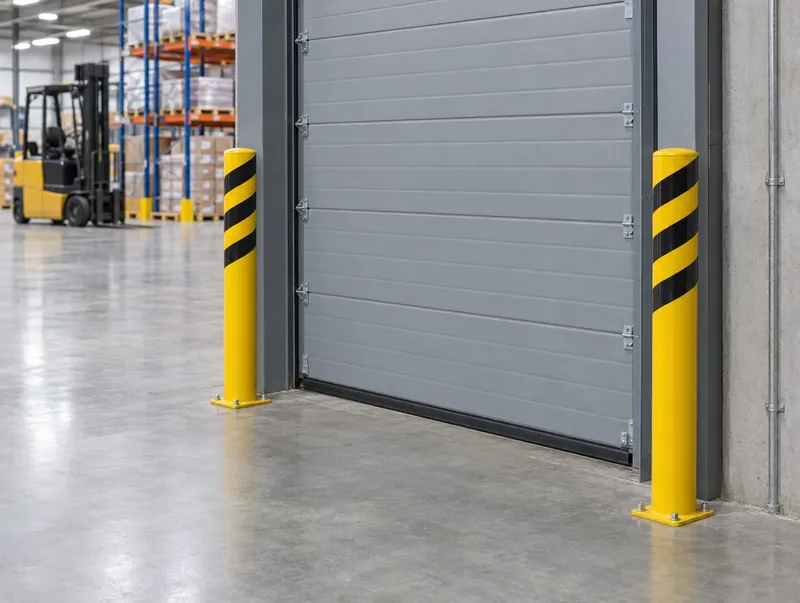 Computer-generated image
Warehouse bollards in Buckinghamshire
Yellow steel and polymer impact bollards for forklift zones, loading bays, doors, columns and racking inside warehouses. We cover Buckinghamshire — Milton Keynes, High Wycombe, Aylesbury, Bletchley and Amersham and more.
Highway authorities for local roads in Buckinghamshire: Buckinghamshire Council and Milton Keynes City Council.
Choose your town in Buckinghamshire
Guide prices in Buckinghamshire
| Specification | Guide price | Includes |
|---|---|---|
| Standard | £185–£635 + VAT | Standard post, foundation, reinstatement |
| Upgraded | £515–£965 + VAT | Upgraded finish or fittings, reflective band, matched keys |
| Premium | £835–£1,245 + VAT | Heavy-duty or architectural spec, premium finish |
Per bollard, supplied and fixed; +6% for South East. Guide only — the fixed price follows a survey.
Local authorities across Buckinghamshire
| Town | Highway / roads authority | Planning authority |
|---|---|---|
| Milton Keynes | Milton Keynes City Council | Milton Keynes City Council |
| High Wycombe | Buckinghamshire Council | Buckinghamshire Council |
| Aylesbury | Buckinghamshire Council | Buckinghamshire Council |
| Bletchley | Milton Keynes City Council | Milton Keynes City Council |
| Amersham | Buckinghamshire Council | Buckinghamshire Council |
| Chesham | Buckinghamshire Council | Buckinghamshire Council |
| Gerrards Cross | Buckinghamshire Council | Buckinghamshire Council |
| Chalfont St Peter | Buckinghamshire Council | Buckinghamshire Council |
Rules for warehouse impact bollards in England
Bollards on adopted highway are a matter for the highway authority under the Highways Act 1980, so they need its written agreement. On private land the owner's agreement is what matters; listed buildings and conservation areas need a word with the planning team first. Accessibility guidance asks for posts at least 1,000 mm high with contrasting tops and no chains between them.
Details and sources: bollard rules in England.
How installation works
Check the slab
Slab thickness, joints, cracks and any underfloor services or heating are checked, and anchors are chosen for the floor rather than taken from a standard list.
Plan around operations
Work is phased by aisle or zone, or done out of hours, with each area barriered off while drilling. Dust is controlled with extraction where products are stored nearby.
Drill and anchor
Holes are drilled, cleaned and anchors installed to the maker's instructions. Chemical anchors are left to cure before the bollard is loaded.
Fix, torque and mark
Bollards and guards are fixed and torqued, then any associated floor markings are applied so drivers can see protected zones.
Warehouse bollards in Buckinghamshire: FAQs
Do you cover all of Buckinghamshire for warehouse impact bollards?
Yes — including Milton Keynes, High Wycombe, Aylesbury, Bletchley, Amersham, Chesham, Gerrards Cross and Chalfont St Peter. Enter your postcode in the price calculator to confirm.
How much do warehouse impact bollards cost in Buckinghamshire?
In Buckinghamshire, typically £185–£1,245 per bollard, supplied and fixed, plus VAT, with a minimum job of £465 plus VAT, using our South East guide prices. The fixed figure comes in writing after we've seen the site.
Who do I ask about bollards on public land in Buckinghamshire?
For local roads, Buckinghamshire Council and Milton Keynes City Council; National Highways covers motorways and trunk roads. Bollards on adopted highway need the highway authority's written agreement.
Should we choose steel or polymer warehouse bollards?
Steel suits lighter traffic and sound, thick slabs where cost matters most. Polymer suits busy forklift areas where repeated impacts would destroy anchors and floors. Polymer often costs more to buy but less to keep in service.
How close to a column should a bollard sit?
Close enough that a vehicle cannot reach the column around it, but with enough gap that the bollard does not hit the column when struck. Polymer bollards need more clearance than steel because they deflect. The gap is set from the product data.