Traffic & site protection
Cast iron and heritage bollards
Traditional cast and ductile iron bollards for conservation areas, period streets and historic estates, installed and reset.
- Typically £445–£1,695 per bollard + VAT (£525–£2,045 inc VAT for homes); minimum job £745
- Free survey and fixed written quote
- Foundations and reinstatement included
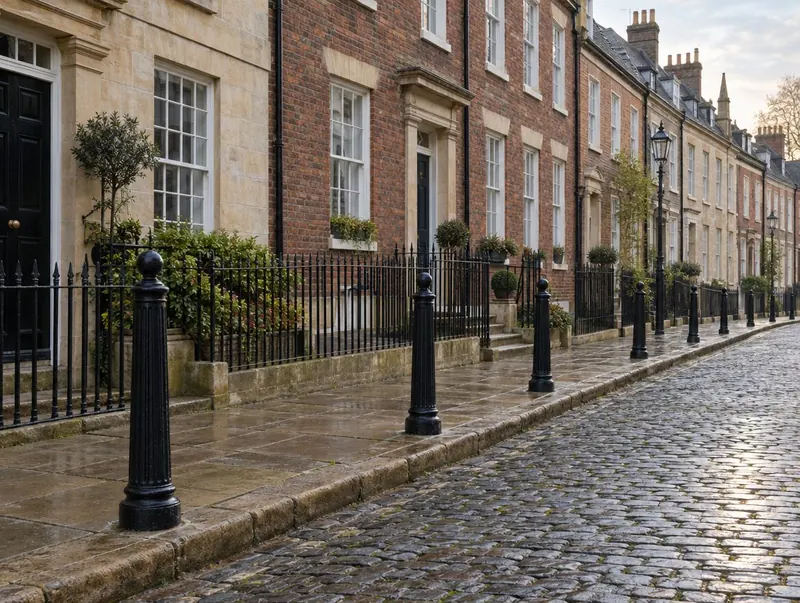 Computer-generated image
What is it?
What are cast iron and heritage bollards?
A cast iron bollard is a post made by pouring molten iron into a patterned mould, giving the traditional shapes seen on period streets, such as cannon, fluted Doric and ball-top designs. Traditional grey cast iron is hard but brittle, while modern ductile iron castings are tougher and bend before they break. Heritage bollards are often fitted over a steel or concrete core to add strength without changing their appearance.
In conservation areas, historic town centres, cathedral closes and around listed buildings, the bollards are part of the street's character. A plain galvanised post looks wrong there, and planning officers and residents notice. Cast iron in a traditional pattern, painted in a suitable colour, fits in and lasts for generations if it is fixed and looked after properly.
Heritage work also means treating what is already there with care. Original cast iron bollards are frequently worth repairing and resetting rather than replacing, and some are of historic interest in their own right. Our installation crews, working under our management, install new castings, reset original ones and match patterns where a street has lost a post, working with the local conservation officer where that is required.
Where cast iron bollards make sense
- Conservation areas and historic town centres
- Streets and squares around listed buildings
- Cathedral closes, college courts and historic estates
- Replacing lost or broken posts in an existing heritage line
- Resetting original bollards that have tilted or worked loose
- Period residential streets and mews
- Heritage-style covers over modern steel or tested cores
How it works
Traditional grey cast iron resists corrosion well and holds fine detail, but it is brittle: a hard blow from a vehicle can crack or shatter it rather than bending it. Ductile iron, sometimes called spheroidal graphite iron, is cast in the same moulds but has a structure that lets it deform before it breaks, so it survives knocks that would destroy a grey iron post. For new bollards on streets where vehicles do hit posts, ductile iron or a cast cover over a steel core is usually the practical choice.
Many heritage bollards are hollow castings. Filling them with concrete, or fitting them over a steel tube root-fixed in the ground, adds stiffness and stops them being snapped off at ground level. Where security is genuinely needed, some manufacturers offer heritage-pattern covers designed to fit over their crash-tested cores, so the street keeps its character while the protection comes from a tested product beneath.
Fixing is by a cast root buried in concrete, a base flange bolted to a foundation, or a sleeve over a steel core. Cast aluminium versions of traditional patterns are also available; they are lighter and cheaper to handle but less robust and sound different when knocked, which some conservation officers dislike.
Options and finishes
| Option | Detail |
|---|---|
| Grey cast iron | Traditional material with crisp detail and good corrosion resistance. Brittle under heavy impact, so suited to low-risk positions. |
| Ductile iron | Same patterns with much greater toughness; bends before it breaks. The usual choice for new posts on trafficked streets. |
| Cast aluminium | Lighter and easier to handle, with traditional patterns, but less robust and not always accepted in sensitive settings. |
| Traditional patterns | Cannon, fluted Doric, ball-top, Victorian and Georgian styles, and crest panels for estates or boroughs. |
| Steel cores and covers | Cast covers over root-fixed steel or crash-tested cores for strength without changing the look. |
| Paint finishes | Primed and painted, commonly black, with traditional highlights in gold or white on bands and crests where appropriate. |
| Contrast details | Painted bands or contrasting caps agreed with the conservation officer so posts are visible to partially sighted people. |
Typical specification
| Item | Typical |
|---|---|
| Materials | Grey cast iron, ductile iron or cast aluminium |
| Exposed height | Typically 750–1,000 mm, pattern dependent |
| Diameter | Commonly 150–300 mm at the widest point |
| Fixing | Cast root in concrete, bolted flange, or cover over a steel core |
| Core | Concrete fill or steel tube for added strength |
| Finish | Primer and paint system, often black with highlights |
| Approvals | Check with the conservation officer in sensitive settings |
Typical values only — the survey and the product's data sheet set the final specification.
How we install it
Record what is there
The free site survey records existing bollards, their pattern, spacing, height and condition, and the paving they sit in. You receive a fixed written quote covering new castings, resets and reinstatement.
Agree pattern and approvals
We source a matching pattern or close equivalent and, where needed, provide details for the conservation officer or planning authority before ordering.
Lift paving carefully
Natural stone flags, setts and kerbs are lifted by hand, numbered where needed and stored for relaying.
Set the post
Each bollard is set plumb in concrete with its root, flange or core, at a height that matches its neighbours. Original posts being reset are cleaned and checked for cracks first.
Relay and finish
Stone is relaid in its original pattern with suitable mortar, and the bollard is painted or touched up after fixing.
Ground, foundations and buried services
Historic streets were built in layers: modern services sit over older drains, coal holes and sometimes vaults, and the paving may be natural stone on a lime or sand bed rather than concrete. Excavation is by hand, positions are checked against service records and scanning, and anything unexpected is recorded rather than broken through. Original stone flags and setts are reused wherever possible, because new stone rarely matches weathered material. Reinstatement follows the original laying pattern and joint style, and on lime-bedded paving uses compatible materials so new work does not crack old stones around it.
Rules and checks before you order
- Ask the local planning authority whether consent is needed for new or replacement bollards in a conservation area or near a listed building.
- Check whether existing bollards are of historic interest or listed before removing them; repair and resetting may be expected.
- Agree contrasting paint details with the conservation officer so posts remain visible to partially sighted people, in line with Inclusive Mobility guidance.
- Avoid chains between posts on pedestrian routes, which can trip blind and partially sighted people.
- On public highway, agree positions and specification with the highway authority.
See rules and standards by nation for highway consent, accessibility and security standards.
Maintenance
Cast iron lasts well if its paint is kept intact. Inspect annually for chips, rust spots and cracks, particularly at the base where water and grit collect. Touch up damaged paint promptly and repaint fully when the finish has dulled or worn through. Grey iron that has been struck should be checked closely for hairline cracks, which can spread with frost. Keep a record of patterns and suppliers so that future replacements match; some patterns are made in small runs and can take time to source.
What affects the price
- Grey iron, ductile iron or cast aluminium
- Pattern complexity and whether a special casting is needed
- Steel cores, concrete fill or tested cores beneath covers
- Lifting and relaying natural stone paving
- Painting, highlights and crest details
- Resetting or repairing original bollards
Guide prices: cast iron bollards
Three typical specifications. The middle one is the specification we usually recommend for durability and visibility.
Standard
per bollard + VAT · homes £525–£1,145 inc VAT
- Standard post or product for the type
- Foundation and fixing to manufacturer's details
- Surface reinstated to match
Upgraded
per bollard + VAT · homes £985–£1,595 inc VAT
- Upgraded finish (RAL colour, stainless or sleeve)
- Retroreflective band and matched keys
- Everything in Standard
Premium
per bollard + VAT · homes £1,445–£2,045 inc VAT
- Heavy-duty or architectural specification
- Premium finish and fittings
- Everything in Upgraded
Guide prices for the UK base region; local pages adjust for your area. Per bollard, supplied and installed. Minimum job £745 + VAT. Your fixed price comes in writing after survey.
Cast iron bollards: questions answered
How much does cast iron and heritage bollards cost?
Typically £445–£1,695 per bollard, supplied and installed, plus VAT. For homeowners that's £525–£2,045 including VAT. Small jobs carry a minimum charge of £745 plus VAT. Ground conditions, access, buried services and consents move the figure; the fixed price comes in writing after survey.
Grey cast iron or ductile iron for new heritage bollards?
Ductile iron for any position that vehicles might strike, because it bends rather than shatters. Grey cast iron suits low-risk positions or matching existing grey iron posts exactly. Both take the same traditional patterns.
Can you match the old bollards on our street?
Often, yes. Many traditional patterns are still cast, and close equivalents exist for others. For rare patterns, a casting can sometimes be made from an existing post, though that takes longer.
Do we need consent for bollards in a conservation area?
Possibly. Consent requirements depend on where the bollards go, who installs them and whether nearby buildings are listed. Ask the local planning authority or conservation officer before ordering.
Can an old cast iron bollard be repaired?
Usually, if it is tilted, loose or has damaged paint: it can be lifted, cleaned, reset on a new foundation and repainted. Cracked grey iron is harder to repair and may need specialist work or a matching replacement.
Can heritage bollards give real vehicle protection?
On their own, untested cast bollards cannot be relied on for security. Where protection is needed, heritage covers designed for crash-tested cores give the traditional look over a tested product.
What colour should cast iron bollards be painted?
Black is the traditional choice in many places, sometimes with gold or white highlights on bands or crests. Some areas have their own historic colours. The conservation officer can confirm what suits the street.
Related bollard services
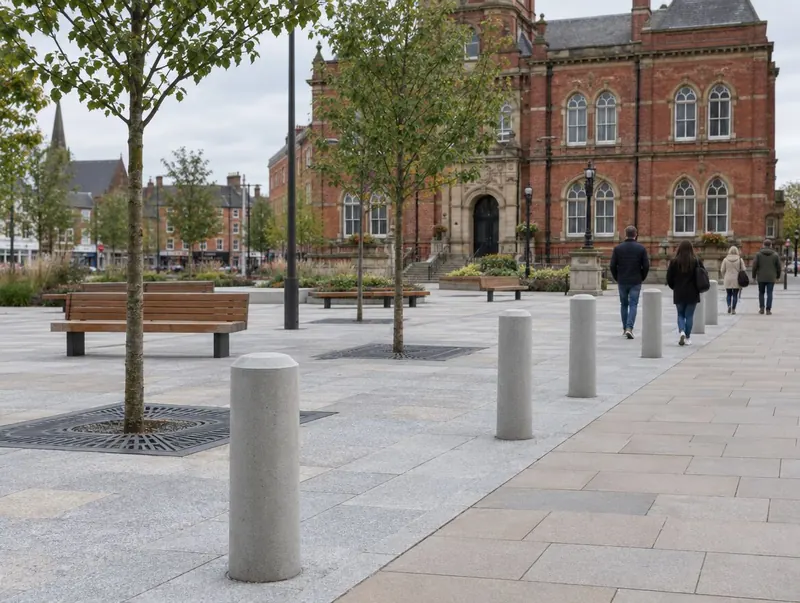
Concrete bollards
Precast concrete and reconstituted stone bollards for public realm, parks, boundaries and estates, dowelled or bedded in place.
Learn more →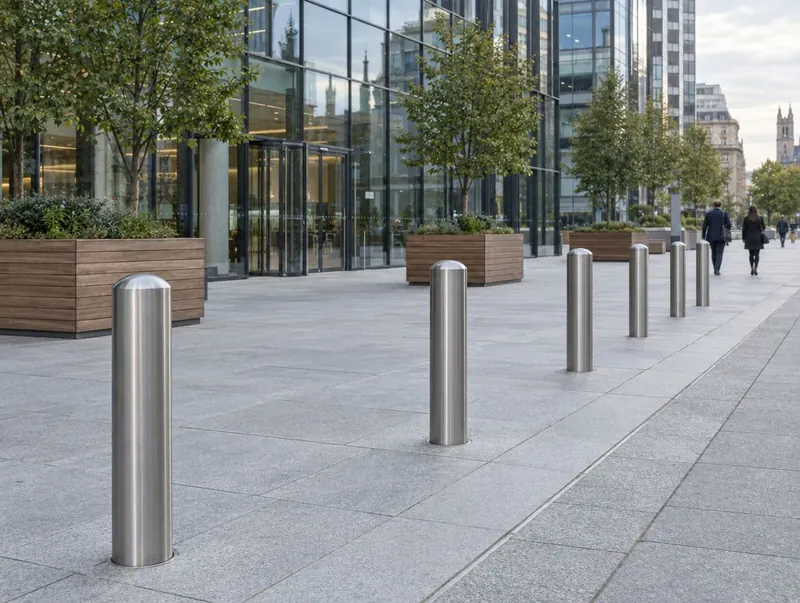
Stainless steel bollards and bollard covers
Stainless steel bollards and sleeve covers in 304 or 316 grade, for building entrances, plazas and upgrading tired steel posts.
Learn more →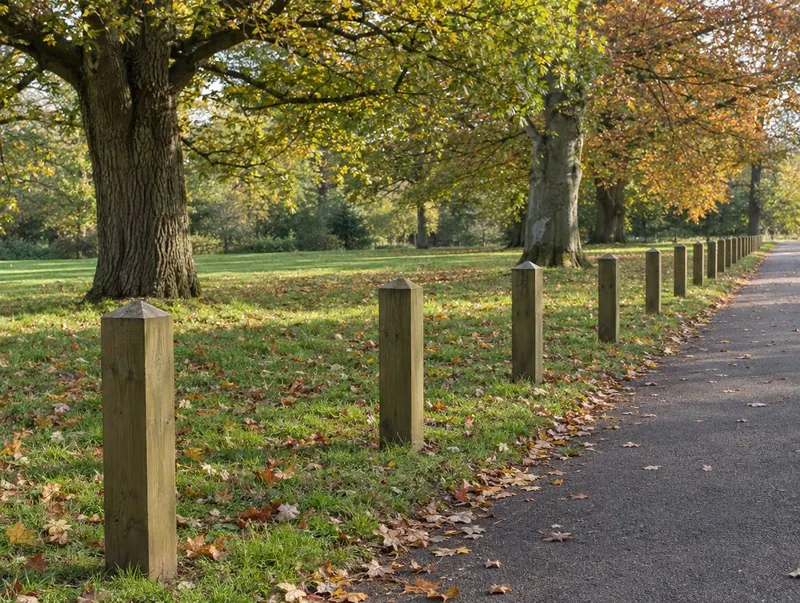
Timber bollards
Oak, hardwood and treated softwood bollards for parks, verges, rural sites, car parks and school frontages.
Learn more →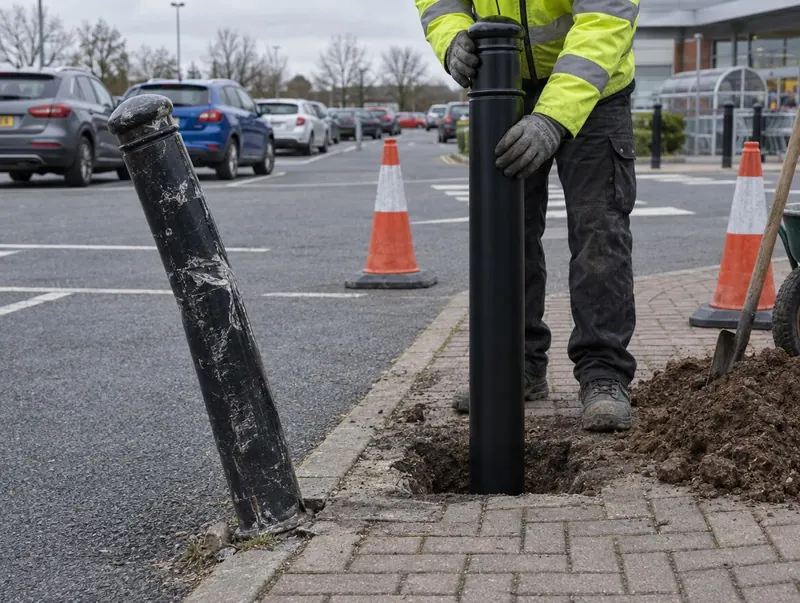
Bollard replacement
Like-for-like or upgraded replacement of bollards damaged by vehicles, corrosion or wear, matched to the existing line.
Learn more →Cast iron bollards near you
Local pages show the highway authority, postcodes covered and regional prices.
- Bedfordshire
- Berkshire
- Bristol
- Buckinghamshire
- Cambridgeshire
- Cheshire
- Cornwall
- County Durham
- Cumbria
- Derbyshire
- Devon
- Dorset
- East Riding of Yorkshire
- East Sussex
- Essex
- Gloucestershire
- Greater Manchester
- Hampshire
- Herefordshire
- Hertfordshire
- Isle of Wight
- Kent
- Lancashire
- Leicestershire
- Lincolnshire
- London
- Merseyside
- Norfolk
- North Yorkshire
- Northamptonshire
- Northumberland
- Nottinghamshire
- Oxfordshire
- Rutland
- Shropshire
- Somerset
- South Yorkshire
- Staffordshire
- Suffolk
- Surrey
- Tyne and Wear
- Warwickshire
- West Midlands
- West Sussex
- West Yorkshire
- Wiltshire
- Worcestershire
- Blaenau Gwent
- Bridgend
- Caerphilly
- Cardiff
- Carmarthenshire
- Ceredigion
- Conwy
- Denbighshire
- Flintshire
- Gwynedd
- Isle of Anglesey
- Merthyr Tydfil
- Monmouthshire
- Neath Port Talbot
- Newport
- Pembrokeshire
- Powys
- Rhondda Cynon Taf
- Swansea
- Torfaen
- Vale of Glamorgan
- Wrexham
- Aberdeen City
- Aberdeenshire
- Angus
- Argyll and Bute
- City of Edinburgh
- Clackmannanshire
- Dumfries and Galloway
- Dundee City
- East Ayrshire
- East Dunbartonshire
- East Lothian
- East Renfrewshire
- Falkirk
- Fife
- Glasgow City
- Highland
- Inverclyde
- Midlothian
- Moray
- North Ayrshire
- North Lanarkshire
- Perth and Kinross
- Renfrewshire
- Scottish Borders
- South Ayrshire
- South Lanarkshire
- Stirling
- West Dunbartonshire
- West Lothian
- Antrim and Newtownabbey
- Ards and North Down
- Armagh City, Banbridge and Craigavon
- Belfast
- Causeway Coast and Glens
- Derry City and Strabane
- Fermanagh and Omagh
- Lisburn and Castlereagh
- Mid Ulster
- Mid and East Antrim
- Newry, Mourne and Down