Northern Ireland · 2 towns
Timber bollard installation in Causeway Coast and Glens
Timber bollards for sites across Causeway Coast and Glens: surveyed, quoted in writing and installed by our crews.
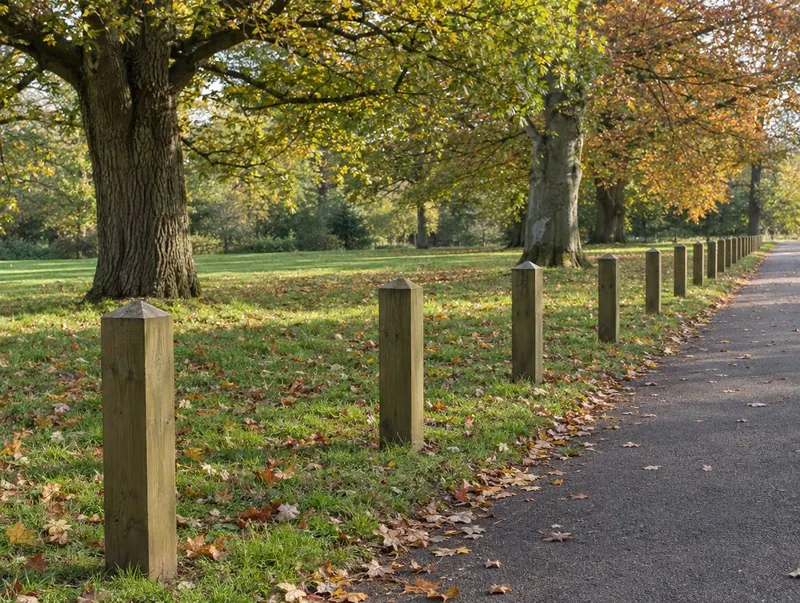 Computer-generated image
Timber bollards in Causeway Coast and Glens
Oak, hardwood and treated softwood bollards for parks, verges, rural sites, car parks and school frontages. We cover Causeway Coast and Glens — Coleraine and Limavady.
Across Northern Ireland, DfI Roads (the Department for Infrastructure) is the roads authority for public roads and footways; councils handle planning.
Choose your town in Causeway Coast and Glens
Guide prices in Causeway Coast and Glens
| Specification | Guide price | Includes |
|---|---|---|
| Standard | £100–£195 + VAT · £115–£225 inc VAT | Standard post, foundation, reinstatement |
| Upgraded | £165–£265 + VAT · £195–£315 inc VAT | Upgraded finish or fittings, reflective band, matched keys |
| Premium | £245–£335 + VAT · £285–£395 inc VAT | Heavy-duty or architectural spec, premium finish |
Per post, supplied and installed; -2% for Northern Ireland. Guide only — the fixed price follows a survey.
Who looks after the roads in Causeway Coast and Glens
| Town | Highway / roads authority | Planning authority |
|---|---|---|
| Coleraine | the Department for Infrastructure (DfI Roads) | Causeway Coast and Glens Borough Council |
| Limavady | the Department for Infrastructure (DfI Roads) | Causeway Coast and Glens Borough Council |
Rules for timber bollards in Northern Ireland
Bollards on public footways and roads need DfI Roads consent under the Roads (NI) Order 1993; councils deal with planning. On private land the owner's agreement is what matters; listed buildings and conservation areas need a word with the planning team first. Accessibility guidance asks for posts at least 1,000 mm high with contrasting tops and no chains between them.
Details and sources: bollard rules in Northern Ireland.
How installation works
Survey the setting
A free site survey looks at the ground, drainage, tree roots, how vehicles currently get onto the land and how the site looks. You receive a fixed written quote with species, size and fixing.
Dig the holes
Holes are dug by hand or auger to the required depth, avoiding roots and checking for services along verges and footpaths.
Set the posts
Posts are set plumb and to a consistent height, backfilled with compacted stone or concreted with a shaped top. Cut softwood ends are re-treated.
Finish and tidy
Reflective bands are fitted, turf is reinstated around the posts and spoil is removed or spread as agreed.
Timber bollards in Causeway Coast and Glens: FAQs
Do you cover all of Causeway Coast and Glens for timber bollards?
Yes — including Coleraine and Limavady. Enter your postcode in the price calculator to confirm.
How much do timber bollards cost in Causeway Coast and Glens?
In Causeway Coast and Glens, typically £100–£335 per post, supplied and installed, plus VAT (£115–£395 including VAT for homeowners), with a minimum job of £435 plus VAT, using our Northern Ireland guide prices. The fixed figure comes in writing after we've seen the site.
Who do I ask about bollards on public land in Causeway Coast and Glens?
DfI Roads (the Department for Infrastructure) is the roads authority for public roads and footways throughout Northern Ireland; councils handle planning.
How long will a timber bollard last in the ground?
It depends on species, treatment and how the post is set. Dense hardwoods and oak heartwood last much longer than softwood, and posts that are kept out of standing water last longer than those sitting in wet concrete. A steel shoe that keeps timber off the ground extends life considerably.
Should timber posts be set in concrete?
Only with care. Concrete holds the post firmly but can trap water around it at ground level, where rot starts. A free-draining base and a concrete collar shaped to shed water help, and compacted stone backfill is often better in clay.