England · 10 towns
Timber bollard installation in Berkshire
Timber bollards for sites across Berkshire: surveyed, quoted in writing and installed by our crews.
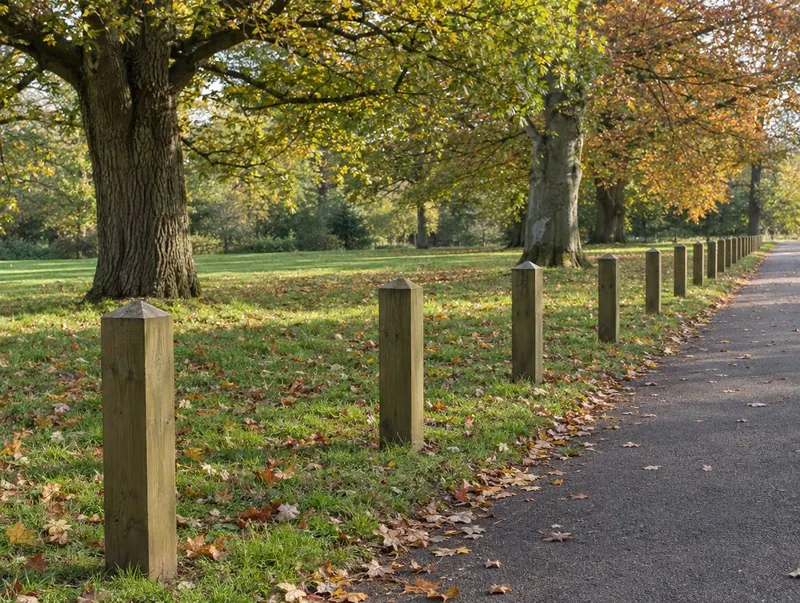 Computer-generated image
Timber bollards in Berkshire
Oak, hardwood and treated softwood bollards for parks, verges, rural sites, car parks and school frontages. We cover Berkshire — Reading, Slough, Bracknell, Maidenhead and Wokingham and more.
Highway authorities for local roads in Berkshire: Bracknell Forest Council, Reading Council, Slough Council, West Berkshire Council, Windsor and Maidenhead Council and Wokingham Council.
Choose your town in Berkshire
Guide prices in Berkshire
| Specification | Guide price | Includes |
|---|---|---|
| Standard | £105–£215 + VAT · £125–£255 inc VAT | Standard post, foundation, reinstatement |
| Upgraded | £185–£295 + VAT · £215–£345 inc VAT | Upgraded finish or fittings, reflective band, matched keys |
| Premium | £265–£365 + VAT · £315–£435 inc VAT | Heavy-duty or architectural spec, premium finish |
Per post, supplied and installed; +6% for South East. Guide only — the fixed price follows a survey.
Local authorities across Berkshire
| Town | Highway / roads authority | Planning authority |
|---|---|---|
| Reading | Reading Council | Reading Council |
| Slough | Slough Council | Slough Council |
| Bracknell | Bracknell Forest Council | Bracknell Forest Council |
| Maidenhead | Windsor and Maidenhead Council | Windsor and Maidenhead Council |
| Wokingham | Wokingham Council | Wokingham Council |
| Newbury | West Berkshire Council | West Berkshire Council |
| Windsor | Windsor and Maidenhead Council | Windsor and Maidenhead Council |
| Crowthorne | Bracknell Forest Council | Bracknell Forest Council |
| Thatcham | West Berkshire Council | West Berkshire Council |
| Sandhurst | Bracknell Forest Council | Bracknell Forest Council |
Rules for timber bollards in England
Bollards on adopted highway are a matter for the highway authority under the Highways Act 1980, so they need its written agreement. On private land the owner's agreement is what matters; listed buildings and conservation areas need a word with the planning team first. Accessibility guidance asks for posts at least 1,000 mm high with contrasting tops and no chains between them.
Details and sources: bollard rules in England.
How installation works
Set out the line
Posts are set out at spacings that stop cars passing between them while leaving gaps for walkers, buggies and wheelchairs.
Dig the holes
Holes are dug by hand or auger to the required depth, avoiding roots and checking for services along verges and footpaths.
Set the posts
Posts are set plumb and to a consistent height, backfilled with compacted stone or concreted with a shaped top. Cut softwood ends are re-treated.
Finish and tidy
Reflective bands are fitted, turf is reinstated around the posts and spoil is removed or spread as agreed.
Timber bollards in Berkshire: FAQs
Do you cover all of Berkshire for timber bollards?
Yes — including Reading, Slough, Bracknell, Maidenhead, Wokingham, Newbury, Windsor and Crowthorne. Enter your postcode in the price calculator to confirm.
How much do timber bollards cost in Berkshire?
In Berkshire, typically £105–£365 per post, supplied and installed, plus VAT (£125–£435 including VAT for homeowners), with a minimum job of £465 plus VAT, using our South East guide prices. The fixed figure comes in writing after we've seen the site.
Who do I ask about bollards on public land in Berkshire?
For local roads, Bracknell Forest Council, Reading Council, Slough Council, West Berkshire Council, Windsor and Maidenhead Council and Wokingham Council; National Highways covers motorways and trunk roads. Bollards on adopted highway need the highway authority's written agreement.
Is tropical hardwood a sustainable choice?
It can be, if it comes from certified sustainable sources. Ask for certification with the order. Oak and treated softwood from managed forests are alternatives.
Do timber bollards stop vehicles?
They stop most drivers deliberately mounting a verge and resist low-speed knocks, especially in dense hardwood. They are not tested barriers and should not be relied on against a vehicle driven at them deliberately.