Devon · England
Stainless steel bollards and covers in Newton Abbot
Planning stainless steel bollards in Newton Abbot? We check ownership, consents and buried services first, then quote a fixed price.
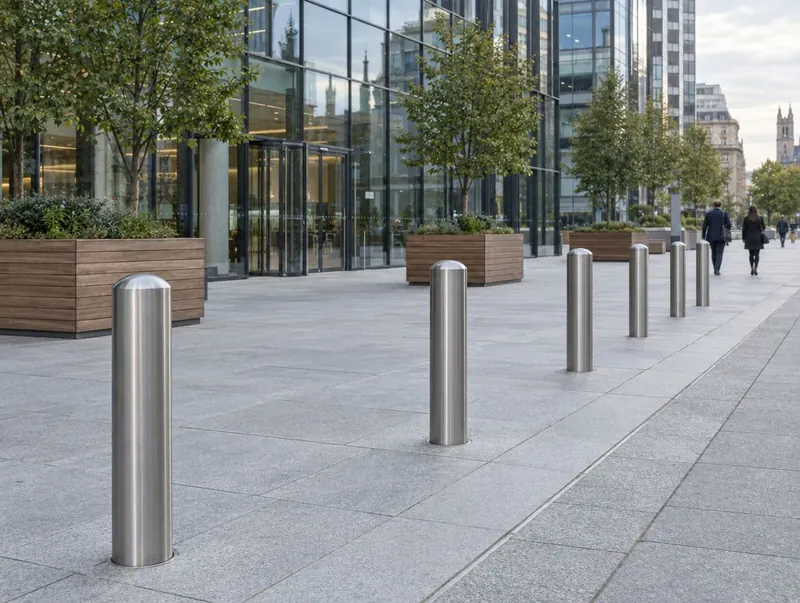 Computer-generated image
Stainless steel bollards in Newton Abbot
Stainless steel bollards suit plenty of Newton Abbot sites, town-centre squares, schools and small industrial units among them. Stainless steel bollards and sleeve covers in 304 or 316 grade, for building entrances, plazas and upgrading tired steel posts.
We cover Newton Abbot's TQ12 and TQ14 postcode districts, including places such as Kingsteignton, Kingskerswell, Ipplepen and Abbotskerswell. Nearby, we also work in Torquay (6 miles), Paignton (6.7 miles), Exmouth (11 miles) and Exeter (14 miles), measured as the crow flies. Newton Abbot is about 26 miles from Plymouth.
Key facts for this area
- Area
- Devon, England
- Highway authority
- Devon County Council (local roads)
- Planning authority
- the council for Teignbridge
- Postcodes
- TQ12 and TQ14
- Guide price
- Typically £295–£1,195 per bollard + VAT (£345–£1,445 inc VAT for homes); minimum job £695
- Survey
- Free, with a fixed written quote
Stainless steel bollards in Newton Abbot: common uses
Common uses in a place like Newton Abbot:
- Sleeving existing painted steel posts that have become tatty
- Disguising crash-rated cores as ordinary street furniture
- Retail parks and shopping centre frontages
What stainless steel bollards cost in Newton Abbot
| Specification | Guide price | Includes |
|---|---|---|
| Standard | £295–£675 + VAT · £345–£805 inc VAT | Standard post, foundation, reinstatement |
| Upgraded | £565–£945 + VAT · £675–£1,145 inc VAT | Upgraded finish or fittings, reflective band, matched keys |
| Premium | £835–£1,195 + VAT · £995–£1,445 inc VAT | Heavy-duty or architectural spec, premium finish |
Per bollard, supplied and installed; no regional adjustment. Guide only — the fixed price follows a survey.
Permissions and groundwork in Newton Abbot
In Newton Abbot, work on adopted pavements and verges needs consent from Devon County Council, the local highway authority. Car parks, forecourts and other private land only need the owner's permission.
Many private-land installations in Newton Abbot need no planning application, but the rules don't clearly cover bollards, so listed buildings, conservation areas and prominent frontages are worth raising with the planning team at the council for Teignbridge before posts go in.
Where covers go over existing posts, there is usually no excavation at all, but the base of the old post often sits in broken surfacing that is worth making good at the same time so the cover finishes neatly against a clean edge. The difference is in handling.
- On crash-rated bollards, confirm with the manufacturer that the cover is approved for the tested product.
- Keep clear gaps of typically at least 1,000–1,200 mm on pedestrian routes, in line with Inclusive Mobility guidance.
What happens on site
Survey and match
A free site survey records existing cores, diameters, heights and the setting, including any salt or coastal exposure that points to 316. You receive a fixed written quote covering grade, finish and fixing.
Prepare the cores
For covers, existing posts are checked for straightness, loose foundations and corrosion. Cores that lean or move are re-bedded first, because a cover will not hide a failing post for long.
Fit covers
Sleeves are slid over the cores, packed so they cannot rattle, and fixed with concealed fixings. A gap or drainage detail at the base stops water being trapped inside.
Specification choices
| Option | Detail |
|---|---|
| Solid stainless posts | Root-fixed, base-plated or removable posts, often concrete-filled or with a steel insert for strength. |
| Contrasting bands | Dark or reflective bands so posts stand out against pale paving, which bare stainless often does not. |
| Grade 304 or 316 | 304 for most inland locations; 316 near the coast, swimming pools, or roads and car parks salted heavily in winter. |
What affects the quote
Two Newton Abbot jobs with the same number of posts can price quite differently. The usual reasons:
- Surface reinstatement and protection of the finish during works
- Grade 304 or 316 and the surface finish
- Manufacturer-approved covers for rated bollards
After installation
Avoid wire wool and steel brushes, which leave particles that rust. Check covers for loose fixings and rattles, and look at the base for trapped water or rust from an old core underneath.
If posts in Newton Abbot are later hit or damaged, we can repair or replace them — see bollard repairs.
Questions about stainless steel bollards in Newton Abbot
Do you install stainless steel bollards in Newton Abbot?
We cover all of Newton Abbot (TQ12 and TQ14) and the rest of Devon. We also work in Torquay, Paignton and Exmouth.
Who gives permission for bollards on the pavement in Newton Abbot?
Devon County Council is the highway authority covering Newton Abbot's local roads. If any post would stand on adopted highway rather than your land, that consent is the first thing we sort out.
What's a typical price for stainless steel bollards in Newton Abbot?
In Newton Abbot, typically £295–£1,195 per bollard, supplied and installed, plus VAT (£345–£1,445 including VAT for homeowners), with a minimum job of £695 plus VAT, using our South West guide prices. The fixed figure comes in writing after we've seen the site.
Are stainless bollards stronger than steel ones?
Not necessarily. Stainless tube is often thinner-walled, so strength depends on wall thickness, infill and fixing. Many stainless posts get their strength from a concrete fill or a steel core inside.
How should stainless bollards be cleaned?
With water and mild detergent, then rinsed and dried, more often in coastal or salty conditions. Use stainless cleaners and non-scratch pads for marks. Never use wire wool or steel brushes.