Devon · England
Flexible bollard installation in Newton Abbot
Planning flexible bollards in Newton Abbot? We check ownership, consents and buried services first, then quote a fixed price.
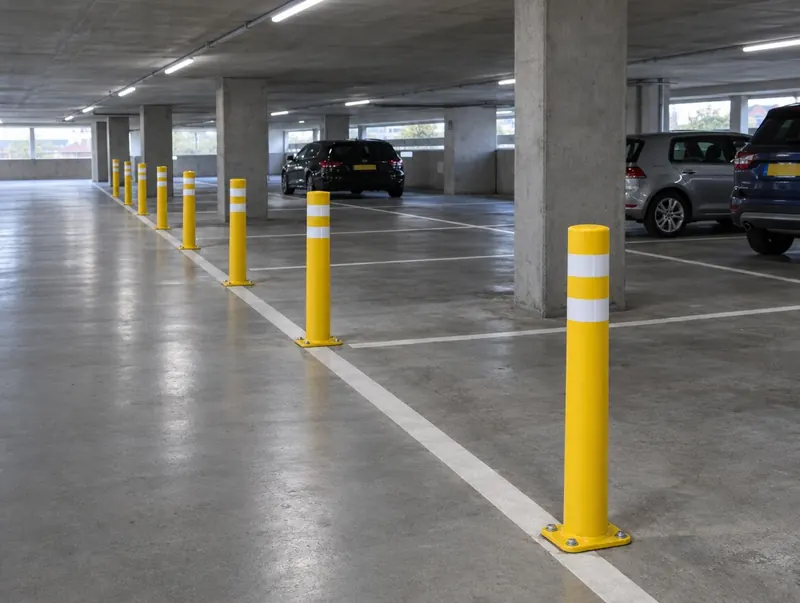 Computer-generated image
Flexible bollards in Newton Abbot
Flexible bollards suit plenty of Newton Abbot sites, community car parks, schools and high street shopfronts among them. Polyurethane and spring-based bollards that bend when hit and return upright, for car parks, depots and lane separation.
We cover Newton Abbot's TQ12 and TQ14 postcode districts, including places such as Kingsteignton, Kingskerswell, Ipplepen and Abbotskerswell. We also cover neighbouring Torquay (6 miles), Paignton (6.7 miles), Exmouth (11 miles) and Exeter (14 miles) — distances are straight-line. Newton Abbot is about 26 miles from Plymouth.
Newton Abbot at a glance
- Area
- Devon, England
- Highway authority
- Devon County Council (local roads)
- Planning authority
- the council for Teignbridge
- Postcodes
- TQ12 and TQ14
- Guide price
- Typically £195–£595 per bollard + VAT; minimum job £445
- Survey
- Free, with a fixed written quote
Flexible bollard prices in Newton Abbot
| Specification | Guide price | Includes |
|---|---|---|
| Standard | £195–£365 + VAT | Standard post, foundation, reinstatement |
| Upgraded | £315–£485 + VAT | Upgraded finish or fittings, reflective band, matched keys |
| Premium | £435–£595 + VAT | Heavy-duty or architectural spec, premium finish |
Per bollard, supplied and fixed; no regional adjustment. Guide only — the fixed price follows a survey.
Where flexible bollards go in around Newton Abbot
Around Newton Abbot, flexible bollards usually solve one of these:
- Approaches to barriers, pay stations and ticket machines
- Depot and yard routes where vehicles knock posts daily
- Bus stations and coach parks
Before we dig in Newton Abbot
The highway authority for local roads in Newton Abbot is Devon County Council; motorways and trunk roads sit with National Highways. Flexible bollards on the adopted footway are a matter for the highway authority, so we only install there with its written agreement.
Bollards on private land often don't need planning permission, but it depends on the council's view, the height and the location; in a conservation area, next to a listed building or under an Article 4 direction, ask the local planning authority (the council for Teignbridge) first — we flag this at survey.
Anchors therefore need sound concrete with enough edge distance; anchoring into thin, cracked or weak surfaces means the base works loose within weeks. Multi-storey and rooftop decks are a special case: slabs may be post-tensioned or carry waterproofing and heating, so drilling depth and positions are agreed with the building owner and scanned first.
- On public highway, including cycle lane segregation, the highway authority's agreement and specification are needed.
- Keep pedestrian gaps and routes clear, referring to Inclusive Mobility guidance where people walk through the line.
Installation, step by step
Survey traffic movements
The free site survey looks at vehicle sizes, turning paths and where drivers currently clip posts or kerbs. You receive a fixed written quote with post type and fixing.
Fit posts and test
Posts are fitted and bent by hand to confirm they return upright, and reflective sleeves are applied.
Hand over spares and records
Post and base details are recorded so replacements match, and spare posts can be left on site for busy locations. Staff are shown how a post is swapped on its base.
Options to consider
| Option | Detail |
|---|---|
| Polyurethane posts | Flex along their length and return to shape. Gentle on vehicles and common in car parks and on forecourts. |
| Heights and diameters | Commonly 750–1,000 mm high and around 80–200 mm diameter, with slimmer wand-style posts for lane lines. |
| Colours and reflective sleeves | Yellow, black, red, white or orange, with reflective sleeves for visibility in low light. |
Pricing flexible bollards in Newton Abbot
Two Newton Abbot jobs with the same number of posts can price quite differently. The usual reasons:
- Number of posts and length of line
- Bolt-down or socket base
- Polymer posts or sprung-base bollards
After installation
After resurfacing or line repainting, check that the bases were not disturbed or painted over, and that posts still line up with the new markings. Keep a few spare posts on site where knocks are frequent, so a damaged one can be swapped before the line develops a gap.
For damaged or loose posts in Newton Abbot, repairs and replacements are priced in writing first.
Flexible bollards in Newton Abbot: FAQs
Which parts of Newton Abbot do you cover for flexible bollards?
We cover all of Newton Abbot (TQ12 and TQ14) and the rest of Devon. We also work in Torquay, Paignton and Exmouth.
Do I need consent for flexible bollards on a public footway in Newton Abbot?
Devon County Council is the highway authority covering Newton Abbot's local roads. If any post would stand on adopted highway rather than your land, that consent is the first thing we sort out.
What's a typical price for flexible bollards in Newton Abbot?
In Newton Abbot, typically £195–£595 per bollard, supplied and fixed, plus VAT, with a minimum job of £445 plus VAT, using our South West guide prices. The fixed figure comes in writing after we've seen the site.
Can flexible bollards go in a multi-storey car park?
Yes, often with low-profile bases. The deck has to be checked first, as some slabs contain tendons or waterproofing that must not be drilled. The building owner usually needs to agree the fixing method.
Do flexible bollards damage vehicles?
Typically very little in a low-speed knock, which is a large part of their appeal. They may leave a scuff on paintwork. A rigid post in the same position would usually dent the vehicle and bend itself.