England · 10 towns
Automatic bollard repairs in Devon
Auto bollard repairs across Devon: visit price confirmed in writing, then a clear report and a fixed price for anything further.
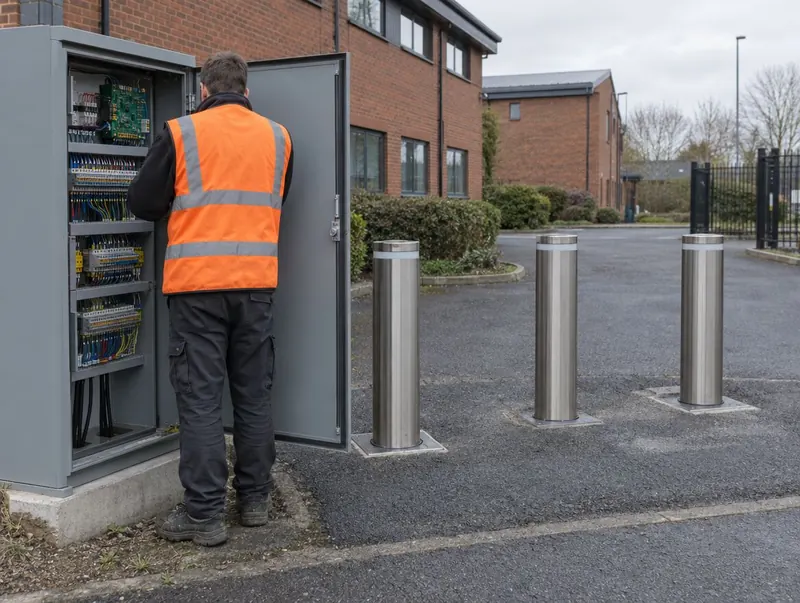 Computer-generated image
Auto bollard repairs in Devon
Paid repair visits for rising bollards: hydraulics, motors, controllers, loops, flooded pits and heads damaged by vehicles. We cover Devon — Plymouth, Exeter, Paignton, Torquay and Newton Abbot and more.
Highway authorities for local roads in Devon: Devon County Council, Plymouth City Council and Torbay Council.
Choose your town in Devon
Guide prices in Devon
| Specification | Guide price | Includes |
|---|---|---|
| Standard | £145–£1,145 + VAT | Diagnostic visit and minor fault fix |
| Upgraded | £855–£1,845 + VAT | Component repair: loop, controller or photocell |
| Premium | £1,545–£2,495 + VAT | Major part: hydraulic unit, ram or bollard head |
Per repair, from a diagnostic visit to a replacement hydraulic unit or head; no regional adjustment. Guide only — the visit price is confirmed in writing first.
Who looks after the roads in Devon
| Town | Highway / roads authority | Planning authority |
|---|---|---|
| Plymouth | Plymouth City Council | Plymouth City Council |
| Exeter | Devon County Council | the council for Exeter |
| Paignton | Torbay Council | Torbay Council |
| Torquay | Torbay Council | Torbay Council |
| Newton Abbot | Devon County Council | the council for Teignbridge |
| Exmouth | Devon County Council | the council for East Devon |
| Barnstaple | Devon County Council | the council for North Devon |
| Bideford | Devon County Council | the council for Torridge |
| Plymstock | Plymouth City Council | Plymouth City Council |
| Tiverton | Devon County Council | the council for Mid Devon |
Rules for auto bollard repairs in England
Bollards on adopted highway are a matter for the highway authority under the Highways Act 1980, so they need its written agreement. On private land the owner's agreement is what matters; listed buildings and conservation areas need a word with the planning team first. Rising bollards should fail safe, never rise beneath a vehicle, carry clear signs and give the emergency services an override.
Details and sources: bollard rules in England.
How installation works
Describe the fault
Tell us what the bollard is doing, any lights or messages on the controller, recent weather or roadworks, and send photographs of the bollard, pit and controller.
Agree the visit price
We confirm the cost of the diagnostic and repair visit in writing. Nothing is done until you have agreed it.
Make the entrance safe
On arrival, the crew makes the bollard and entrance safe, lowering or securing it as agreed with you and coning the area.
Quote and repair
Simple faults within the visit are fixed on the day. Where parts or further work are needed, we quote them in writing and complete the repair once approved.
Auto bollard repairs in Devon: FAQs
Do you cover all of Devon for auto bollard repairs?
Yes — including Plymouth, Exeter, Paignton, Torquay, Newton Abbot, Exmouth, Barnstaple and Bideford. Enter your postcode in the price calculator to confirm.
How much do auto bollard repairs cost in Devon?
In Devon, typically £145–£2,495 per repair, from a diagnostic visit to a replacement hydraulic unit or head, plus VAT, using our South West guide prices. We confirm the visit price in writing before attending.
Who do I ask about bollards on public land in Devon?
For local roads, Devon County Council, Plymouth City Council and Torbay Council; National Highways covers motorways and trunk roads. Bollards on adopted highway need the highway authority's written agreement.
Our automatic bollard is stuck up: what should we do now?
Keep vehicles and people clear and do not try to force it. If you have a manual release key and know the procedure, you can lower it; otherwise cone it off. Then contact us with photographs and a description so we can price the visit.
Our bollard rose under a car: what happens next?
Take it out of service and keep it lowered or secured. The safety loops, photocells and settings are checked to find out why it rose, and the damage is assessed. It should not return to use until the cause is fixed and the risk assessment reviewed.