England · 10 towns
Steel security bollard installation in Lincolnshire
Steel security bollards for sites across Lincolnshire: surveyed, quoted in writing and installed by our crews.
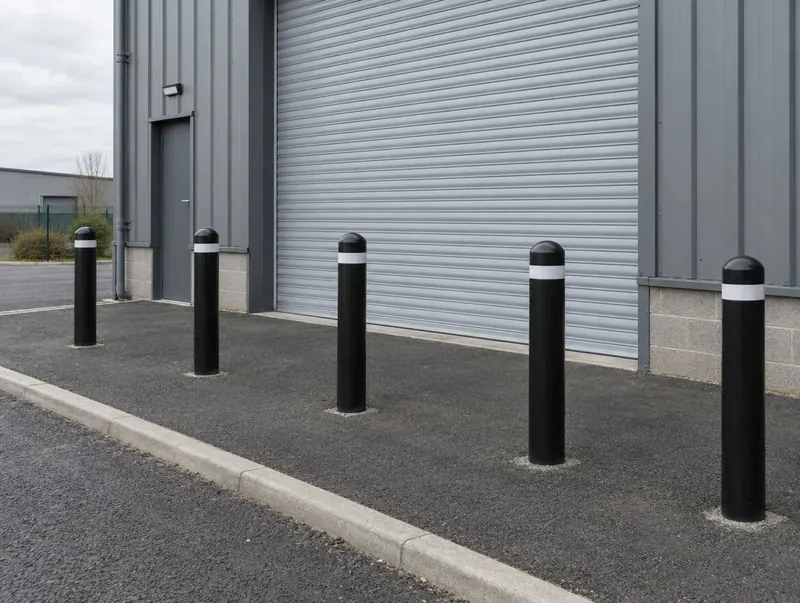 Computer-generated image
Steel security bollards in Lincolnshire
We supply and install steel security bollards across Lincolnshire, with local pages for 10 towns below. Concrete-filled steel bollards, root-fixed or base-plated, for car parks, forecourts, boundaries and nuisance vehicle control.
Highway authorities for local roads in Lincolnshire: Lincolnshire County Council, North East Lincolnshire Council and North Lincolnshire Council.
Choose your town in Lincolnshire
Guide prices in Lincolnshire
| Specification | Guide price | Includes |
|---|---|---|
| Standard | £205–£505 + VAT · £245–£605 inc VAT | Standard post, foundation, reinstatement |
| Upgraded | £415–£725 + VAT · £495–£865 inc VAT | Upgraded finish or fittings, reflective band, matched keys |
| Premium | £635–£925 + VAT · £755–£1,095 inc VAT | Heavy-duty or architectural spec, premium finish |
Per bollard, supplied and installed; +3% for East of England. Guide only — the fixed price follows a survey.
Local authorities across Lincolnshire
| Town | Highway / roads authority | Planning authority |
|---|---|---|
| Lincoln | Lincolnshire County Council | Lincolnshire County Council |
| Grimsby | North East Lincolnshire Council | North East Lincolnshire Council |
| Scunthorpe | North Lincolnshire Council | North Lincolnshire Council |
| Boston | Lincolnshire County Council | the council for Boston |
| Grantham | Lincolnshire County Council | the council for South Kesteven |
| Cleethorpes | North East Lincolnshire Council | North East Lincolnshire Council |
| Spalding | Lincolnshire County Council | the council for South Holland |
| Skegness | Lincolnshire County Council | the council for East Lindsey |
| Stamford | Lincolnshire County Council | the council for South Kesteven |
| Gainsborough | Lincolnshire County Council | the council for West Lindsey |
Rules for steel security bollards in England
Bollards on adopted highway are a matter for the highway authority under the Highways Act 1980, so they need its written agreement. On private land the owner's agreement is what matters; listed buildings and conservation areas need a word with the planning team first.
Details and sources: bollard rules in England.
How installation works
Survey and set out
A free site survey confirms positions, surfaces, buried services and whether root-fixing or base plates suit the ground. You receive a fixed written quote listing post size, finish and fixing.
Break out and excavate
For root-fixed posts, the surface is cut neatly and each hole is dug to depth, by hand near known services. For base plates, the slab is checked for thickness and soundness.
Set the posts
Posts are set plumb and to a consistent height along the line, and concreted in. Base-plated posts are drilled, anchored with resin and torqued once cured.
Fill and cap
Where specified, posts are filled with concrete and capped so water cannot collect inside the tube.
Steel security bollards in Lincolnshire: FAQs
Do you cover all of Lincolnshire for steel security bollards?
Yes — including Lincoln, Grimsby, Scunthorpe, Boston, Grantham, Cleethorpes, Spalding and Skegness. Enter your postcode in the price calculator to confirm.
How much do steel security bollards cost in Lincolnshire?
In Lincolnshire, typically £205–£925 per bollard, supplied and installed, plus VAT (£245–£1,095 including VAT for homeowners), with a minimum job of £605 plus VAT, using our East of England guide prices. The fixed figure comes in writing after we've seen the site.
Who do I ask about bollards on public land in Lincolnshire?
For local roads, Lincolnshire County Council, North East Lincolnshire Council and North Lincolnshire Council; National Highways covers motorways and trunk roads. Bollards on adopted highway need the highway authority's written agreement.
Can new posts match our existing ones?
Usually, if we can measure the existing diameter, height, cap and colour. Galvanised steel in standard sizes is easy to match; older or unusual sections may need a close equivalent.
Why fill a steel bollard with concrete?
Concrete infill adds weight and stiffness, so the post dents less and is harder to cut. It also stops water collecting inside a hollow tube. It is usual for security and impact positions.