England · 9 towns
Ram-raid protection bollards in West Sussex
Ram-raid bollards for sites across West Sussex: surveyed, quoted in writing and installed by our crews.
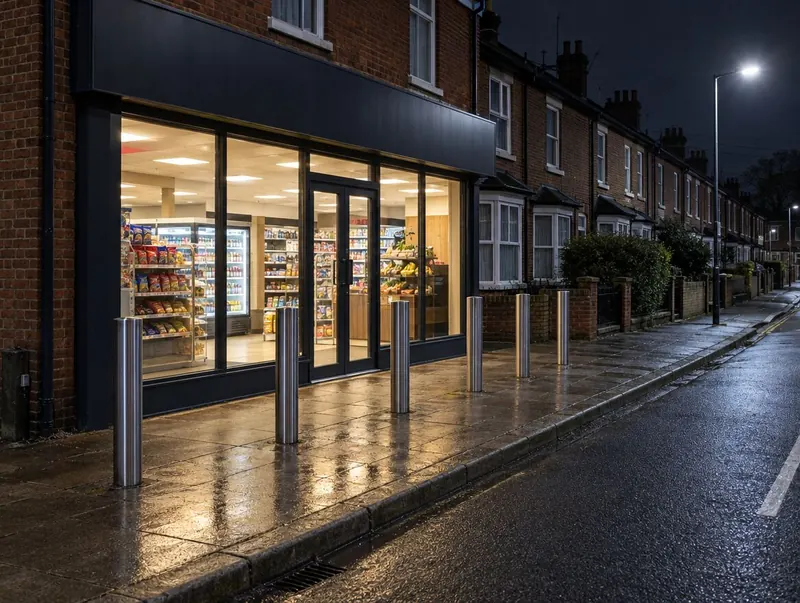 Computer-generated image
Ram-raid bollards in West Sussex
Across West Sussex, typical sites for ram-raid bollards include retail parks, college campuses and industrial estates. Bollards fitted in front of shopfronts, ATMs, jewellers and convenience stores to stop vehicles being used to break in.
Highway authorities for local roads in West Sussex: West Sussex County Council.
Choose your town in West Sussex
Guide prices in West Sussex
| Specification | Guide price | Includes |
|---|---|---|
| Standard | £415–£905 + VAT | Standard post, foundation, reinstatement |
| Upgraded | £765–£1,245 + VAT | Upgraded finish or fittings, reflective band, matched keys |
| Premium | £1,095–£1,595 + VAT | Heavy-duty or architectural spec, premium finish |
Per bollard, supplied and installed; +6% for South East. Guide only — the fixed price follows a survey.
Who looks after the roads in West Sussex
| Town | Highway / roads authority | Planning authority |
|---|---|---|
| Crawley | West Sussex County Council | the council for Crawley |
| Worthing | West Sussex County Council | the council for Worthing |
| Bognor Regis | West Sussex County Council | the council for Arun |
| Littlehampton | West Sussex County Council | the council for Arun |
| Horsham | West Sussex County Council | the council for Horsham |
| Haywards Heath | West Sussex County Council | the council for Mid Sussex |
| Chichester | West Sussex County Council | the council for Chichester |
| Burgess Hill | West Sussex County Council | the council for Mid Sussex |
| East Grinstead | West Sussex County Council | the council for Mid Sussex |
Rules for ram-raid bollards in England
Bollards on adopted highway are a matter for the highway authority under the Highways Act 1980, so they need its written agreement. On private land the owner's agreement is what matters; listed buildings and conservation areas need a word with the planning team first. Crash ratings (ISO 22343-1, or the superseded but still accepted PAS 68 and IWA 14-1) only hold when the product is installed to its tested foundation.
Details and sources: bollard rules in England.
How installation works
Look at how a vehicle would approach
At the free site survey we look at where a vehicle could reverse from, the kerb line, the forecourt and the frontage construction. Ownership of the pavement in front of the shop is checked at the same time.
Agree the post type and positions
We agree unrated or tested posts with you, your landlord and any insurer or security adviser involved. A fixed written quote sets out the positions, foundations and reinstatement.
Excavate and set the posts
Each position is hand-dug near services and taken to depth, then the post is set plumb in a reinforced concrete base. Work is planned around trading hours where possible.
Reinstate the pavement
Paving, tarmac or forecourt concrete is made good flush with the base of each post, leaving no trip edges.
Ram-raid bollards in West Sussex: FAQs
Do you cover all of West Sussex for ram-raid bollards?
Yes — including Crawley, Worthing, Bognor Regis, Littlehampton, Horsham, Haywards Heath, Chichester and Burgess Hill. Enter your postcode in the price calculator to confirm.
How much do ram-raid bollards cost in West Sussex?
In West Sussex, typically £415–£1,595 per bollard, supplied and installed, plus VAT, with a minimum job of £995 plus VAT, using our South East guide prices. The fixed figure comes in writing after we've seen the site.
Who do I ask about bollards on public land in West Sussex?
For local roads, West Sussex County Council; National Highways covers motorways and trunk roads. Bollards on adopted highway need the highway authority's written agreement.
Will bollards stop an ATM being ripped out?
Correctly placed bollards stop a vehicle getting close enough to attach chains or ram the surround. They work alongside the machine's own anchoring and the bank's security measures. Positions need to cover the wall either side of the ATM as well as the front.
What is PAS 170-1 and do I need it?
PAS 170-1 is a standard for testing vehicle security barriers against low-speed impacts. It suits ram-raid risks where someone has asked for tested performance, such as an insurer or security adviser. If nobody has asked for a tested product, a well-founded unrated post is often adequate.