Guide
How far apart should bollards be, and how do you keep them accessible?
Gaps, heights, contrast, cycle clearance and fire access for UK bollard lines, drawn from Inclusive Mobility, TAL 1/11 and Active Travel England.
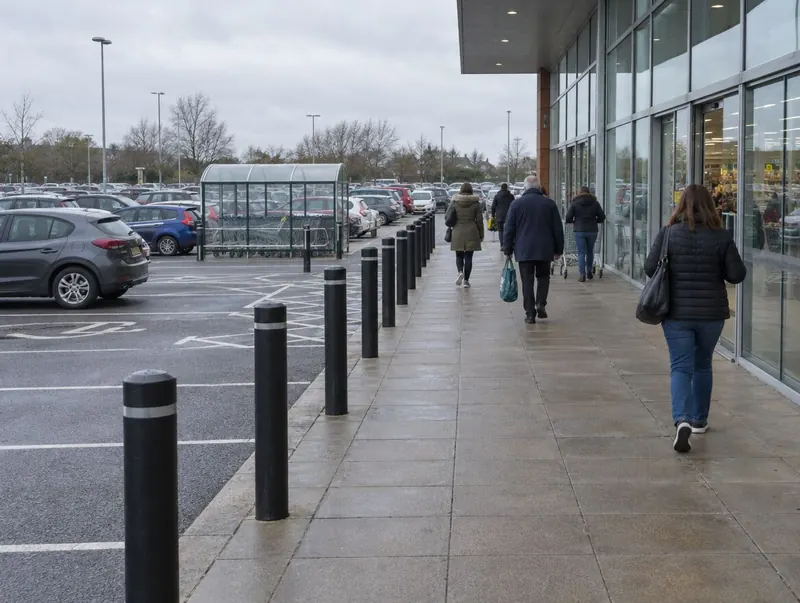 Computer-generated image
Where bollards act as a vehicle security barrier, UK guidance caps the clear gap at 1200 mm, measured 600 mm above finished ground, which still lets wheelchair users and people with prams through. The Department for Transport's Inclusive Mobility guide adds that bollards should be at least 1000 mm high, have tonal and colour contrasted tops and should not be linked by chains or ropes. Cycle routes need at least 1.5 m of clearance, and fire appliance routes need their full clear width or posts the fire service can remove.
What gap should there be between bollards?
Where bollards act as a vehicle security barrier, the clear gap should be no more than 1200 mm. DfT and CPNI guidance, TAL 1/11, sets that maximum measured 600 mm above finished ground level and describes it as enough for wheelchair users and people with prams. DfT's Inclusive Mobility gives the same 1200 mm figure for bollards acting as a security barrier.
For ordinary traffic and parking bollards, these documents don't set a single gap. 1200 mm is a sensible default because it keeps cars out while leaving room for people, but a highway authority may set its own standard on its land, and on a rated security line your security adviser sets the layout. Always measure the clear gap between the faces of the posts, not between their centres.
How tall should bollards be, and do they need contrasting tops?
Inclusive Mobility says bollards should be at least 1000 mm high with tonal and colour contrasted tops, so people with low vision can pick them out. Its separate advice on a contrasting band about 150 mm deep, with its lower edge around 1500 mm above the ground, is written for posts in general rather than bollards.
TAL 1/11 also flags colour contrast and night-time visibility as road safety audit issues. Shorter posts, common on private drives and parking bays, are harder to see, so on any route the public uses we recommend full-height posts with a contrasting top. Reflective bands help at night. We haven't found a regulation that requires them on plain access-control bollards, but where a traffic sign is mounted on a bollard, TSRGD 2016 requires the bollard to be either internally illuminated to BS EN 12899-2 or self-righting and retroreflective to BS 8442.
Can bollards be linked with chains or ropes?
Not on a pedestrian route. Inclusive Mobility says bollards should not be linked with chains or ropes, because they are a trip hazard, particularly for people with impaired vision. If a gap only needs closing some of the time, a removable, telescopic or fold-down post does the job without leaving a low obstacle across the path.
How much space do cyclists need between bollards?
In England, at least 1.5 metres. Active Travel England says bollards and other vertical features on cycle routes should leave at least 1.5 m of horizontal clearance, citing LTN 1/20 section 8.3, and should contrast with their background, with reflectors and lighting where needed.
That is wider than the 1200 mm security gap, so where a vehicle security line crosses a cycle route the two figures pull in different directions. The designer and the highway authority need to agree that layout before anything is ordered.
Will bollards block fire engines and emergency access?
They must not. Bollards across a fire appliance route must keep the required clear width or be removable or retractable by the fire service. In England, Approved Document B sets the access route figures, which Cornwall Fire and Rescue Service summarises as including a minimum gateway width of 3.1 m and a minimum road width between kerbs of 3.7 m.
Fire services set their own requirements. The London Fire Brigade, for example, says bollards must not obstruct hydrants, collapsible posts are acceptable if they project no more than 150 mm when folded, and removable posts should be secured at one point only with a standard fire brigade padlock or GERDA key. That guidance is London-specific, so check with your local fire and rescue service. Wales has its own Approved Document B, Scotland uses its Building Standards Technical Handbooks and Northern Ireland uses Technical Booklet E. For rising bollards, TAL 4/97 says emergency services may need a way to override the controls and lower them.
Which laws sit behind accessible bollard layouts?
Disability discrimination law, which differs by nation. The Equality Act 2010 applies in England, Wales and Scotland but does not apply in Northern Ireland, which still uses the Disability Discrimination Act 1995. The documents above are guidance rather than law, but they are what designers, road safety auditors and highway authorities check layouts against. BS 8300-1:2018, the British Standard for accessible external environments, is worth reading alongside them.
How do we set out a bollard line on site?
We mark every position on the ground before anything is dug, so you can walk it, drive it and change it.
At the free survey we measure clear gaps at the height the guidance uses, check routes for wheelchairs, prams, cycles and fire appliances, look for hydrants, dropped kerbs and doorways, and note anything the highway authority or your security adviser has specified. Positions go on a marked-up plan with the fixed written quote. Our installation crews, working under our management, set out to that plan, and you can check it on the day. National differences are covered on our rules pages.
Prepared by the Bollard Installers team · Last reviewed 01 November 2026 · Prices and rules change; check the rules pages and your written quote.
Questions
Is 1.2 metres the legal maximum gap between bollards?
It is a guidance figure rather than a general law. TAL 1/11 and Inclusive Mobility set 1200 mm as the maximum where bollards act as a vehicle security barrier; for other bollards, the highway authority or designer decides.
Do bollards need reflective bands?
Bollards that carry a traffic sign must be lit or retroreflective under TSRGD 2016. For plain access-control bollards we haven't found a rule that requires bands, but contrast and night-time visibility are road safety audit issues, so bands are worth fitting.
Can fold-down posts be used on a fire route?
Often, if the fire service agrees. The London Fire Brigade accepts collapsible posts that project no more than 150 mm when folded and are secured at one point with a fire brigade padlock or GERDA key; other services set their own rules.
Are the rules different in Wales, Scotland and Northern Ireland?
The spacing figures come from UK government guidance, but highway law, building regulations and disability law differ by nation. Our rules pages for each nation set out the differences.
Related services
Pedestrian and shopfront protection bollards
Bollards that separate people from vehicles at car parks, forecourts, walkways, drive-thrus and shop entrances.
Learn more →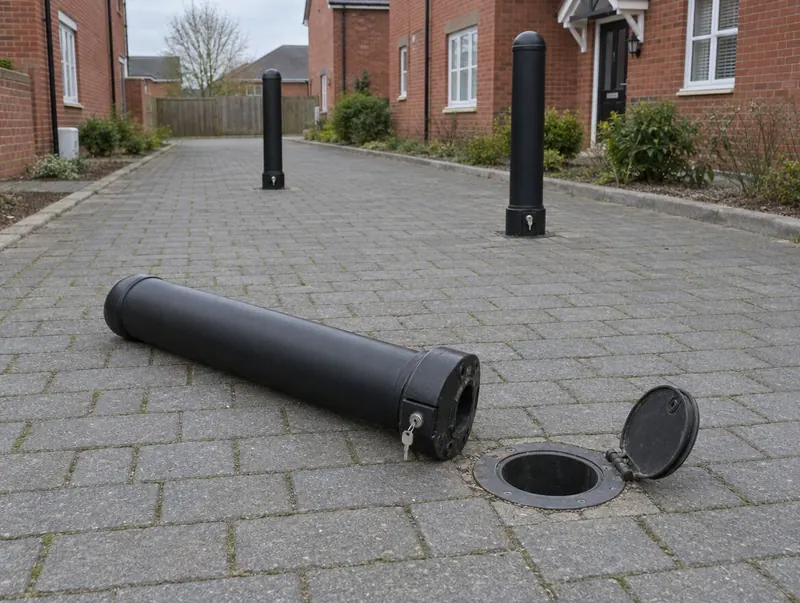
Removable bollards
Lift-out bollards in lockable ground sockets for driveways, delivery routes, access roads and emergency access points.
Learn more →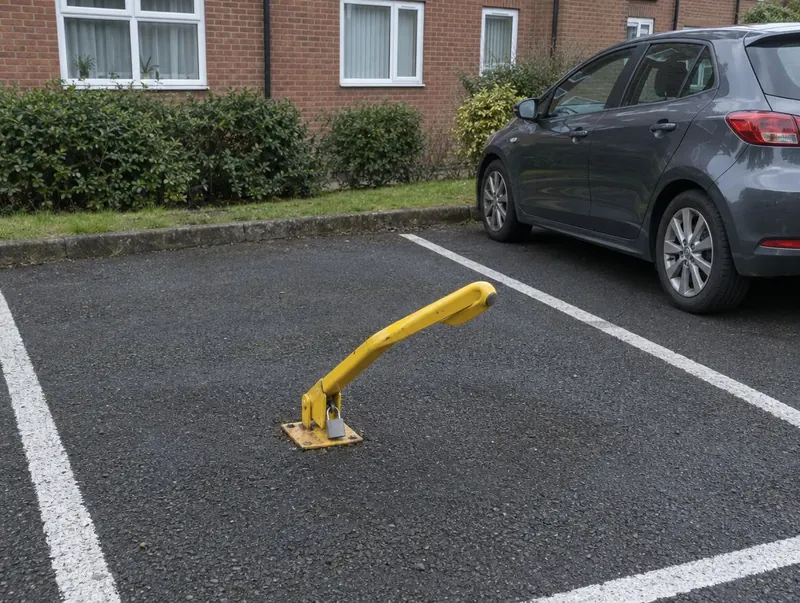
Fold-down parking posts
Hinged fold-down parking posts with padlock or integral key locks, bolted down to protect private and allocated bays.
Learn more →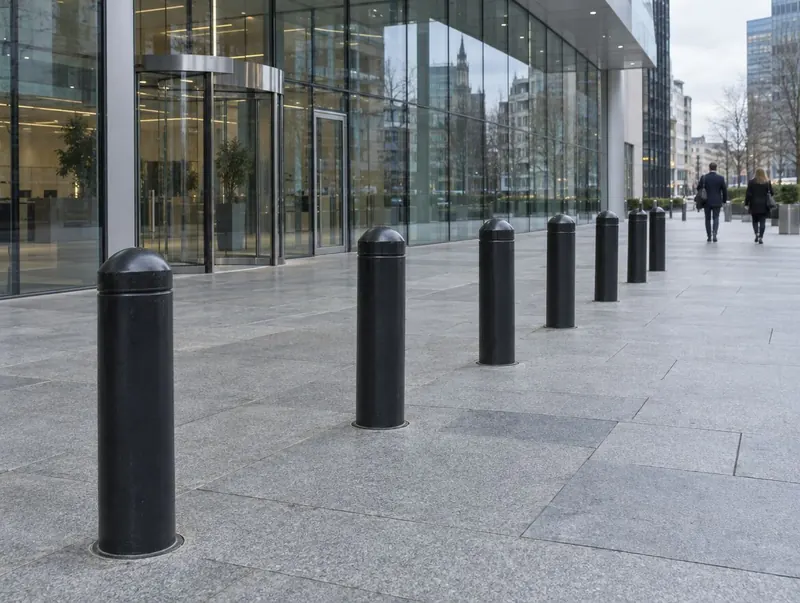
Crash-rated (HVM) bollards
Installation of impact-tested HVM bollards rated to ISO 22343-1 (or the superseded, still-accepted PAS 68 / IWA 14-1) on the tested foundation.
Learn more →