Guide
What are crash-rated bollards and how do the ratings work?
ISO 22343, PAS 68, IWA 14-1 and PAS 170-1 in plain English: reading a rating code, why the tested foundation matters, and how to check a claim.
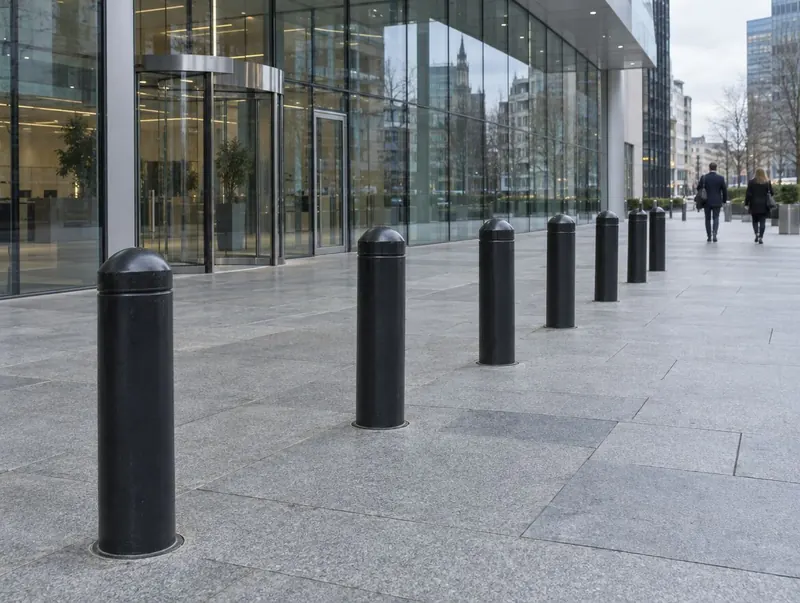 Computer-generated image
A crash-rated bollard is a vehicle security barrier that has passed a full-scale vehicle impact test, so its rating states the vehicle mass, speed and angle it stopped and how far the vehicle travelled past it. The current standard is ISO 22343-1:2023, which superseded PAS 68 and IWA 14-1, although products tested to those standards are still accepted and listed. A crash rating only holds if the bollard is installed to the foundation design it was tested with.
Which crash test standards apply in the UK?
The current standard is ISO 22343, published in 2023 in two parts. ISO 22343-1:2023 sets performance requirements and a vehicle impact test method for rating vehicle security barriers against a single impact from an unmanned test vehicle; BSI publishes it as BS ISO 22343-1. ISO 22343-2:2023 covers selection, installation and use, including how to write an operational requirement.
According to Secured by Design, ISO 22343-1 supersedes PAS 68:2013 and IWA 14-1:2013, and ISO 22343-2 supersedes PAS 69:2013 and IWA 14-2. The same guidance says products tested to PAS 68 or IWA 14-1 remain acceptable, and the NPSA impact-rated product list still includes products rated to PAS 68:2010, IWA 14-1:2013 and ISO 22343-1:2023. In short, PAS 68 and IWA 14-1 have been superseded, but products tested to them are still accepted and listed.
What do PAS 170-1 and ASTM F3016 ratings mean?
They are low-speed tests, not full hostile vehicle mitigation (HVM) ratings. PAS 170-1:2017 tests a single bollard with one impact from a 2,500 kg trolley at 16 or 32 km/h. BSI states it is not equivalent to a full-scale vehicle impact test and does not cover blast, ballistic or manual attack. It is aimed at car parks and retail sites where bollards may be hit at low speed; a penetration of 2.0 m or less earns a rating, written in a form such as IT/2500/32/90:1.4.
ASTM F3016 is a US low-speed bollard test, separate from PAS 68, IWA 14 and ISO 22343. Some UK shops list ASTM F3016 products next to HVM-rated ones. We don't describe a product tested only to ASTM F3016 as HVM rated, and a supplier shouldn't either.
How do you read a crash rating code?
A rating code is a short record of the test the product passed. Take the example PAS 68 V/7500[N2]/80/90:0/25:
| Part of the code | What it means |
|---|---|
| V | Vehicle impact test |
| 7500[N2] | Test vehicle mass in kg and its class: here a 7.5 tonne goods vehicle |
| 80 | Impact speed in km/h (about 50 mph) |
| 90 | Impact angle in degrees, so a square-on hit |
| 0 | Penetration: how far the vehicle got past the barrier, in metres |
| 25 | PAS 68 only: how far major debris (pieces over 25 kg) travelled, in metres |
Penetration figures from different standards are not directly comparable. IWA 14-1 and ISO 22343 measure from the front face of the product, PAS 68 from the back face, and IWA 14-1 drops the debris measurement. Your security adviser should say which vehicle, speed and penetration your site needs, and products are matched to that.
Why does the tested foundation matter so much?
Because the rating belongs to the product as tested, foundation included. The NPSA list records a foundation depth for each entry, and Secured by Design says the listed standards depend on the product being installed correctly in line with the associated standard. A rated post set in a shallower or different foundation is, in effect, an untested product.
ISO 22343-1 groups foundations into classes (Frontier Pitts summary):
- A: freestanding
- Ap: surface mounted and pinned or bolted
- B: less than 0.5 m deep
- C: more than 0.5 m deep
Shallow classes matter where pipes and cables fill the ground, and shallow-mount systems tested that way can avoid diversions. DfT and CPNI guidance, TAL 1/11, notes that later street works can damage a structural foundation and compromise the barrier, so barriers in the highway should be recorded on the highway authority's asset register.
How can I check a supplier's crash rating claim?
Check that the product is listed by the National Protective Security Authority. NPSA, which took over from CPNI in March 2023, has combined its HVM chapters into one Catalogue of Security Equipment chapter covering impact and delay testing. If a barrier is not listed, it has either not been tested, not been submitted, or not met the required performance.
Then ask the supplier for:
- the full rating code and the standard it was tested to
- the foundation drawing used in the test, with depth and reinforcement
- the tested configuration, so the installed layout can match it
- the installation instructions the installer must follow
Who should design a hostile vehicle mitigation scheme?
A qualified security adviser, not the installer. NPSA strongly recommends choosing barriers against a robust security operational requirement, and points to NaCTSO, Counter Terrorism Security Advisers (CTSAs), RSES members and Chartered Security Professionals for advice.
The Register of Security Engineers and Specialists (RSES) is sponsored by NPSA and administered by the ICE. Hostile vehicle mitigation is one of its specialist adviser fields, and members are independently assessed, sign a code of ethics and commit to continuing professional development. The Counter Terrorism Policing-endorsed Security Specialists Register launched on 27 April 2026.
We are not HVM designers and we are not on these registers. We install rated products to the manufacturer's tested foundation details and work to the specification your security adviser sets.
What do crash-rated bollards cost to install?
Static crash-rated bollards typically cost £1,995–£9,995 per bollard position plus VAT on a standard tested foundation, and rated shallow-mount systems £1,995–£8,995.
Those figures exclude HVM design fees, utility diversions, street works licences and traffic management, and rated automatic bollards cost considerably more than static posts. For scale, the University of Kent's 2026 tender for HVM bollards at its University Plaza was estimated at £100,000 excluding VAT, with the number of bollards not stated (Find a Tender). Our part is the survey, locating buried services, excavation, setting posts or cassettes to the manufacturer's drawings, concrete and reinstatement, on a fixed written quote after a free survey. See crash-rated bollard installation.
Prepared by the Bollard Installers team · Last reviewed 01 November 2026 · Prices and rules change; check the rules pages and your written quote.
Questions
Is a PAS 68 bollard still acceptable now ISO 22343 is out?
Yes. Secured by Design says products tested to PAS 68 or IWA 14-1 remain acceptable, and NPSA's list still includes them. Your specifier may still state which standards they will accept for a particular site.
Can a crash-rated bollard go on a shallower foundation to avoid pipes?
Only if that product was tested on the shallower foundation; otherwise the rating no longer applies. Shallow-mount systems tested on foundations less than 0.5 m deep exist for exactly this situation.
Does a crash rating mean a bollard will stop any vehicle?
No. It means the bollard stopped the test vehicle at the stated mass, speed and angle, with the stated penetration. A heavier or faster vehicle, or a different approach, is outside what was tested.
Are automatic rising bollards available crash-rated?
Yes. Rated automatic bollards have heavier cassettes and deeper foundations than unrated units and cost considerably more. Because they move, they also need careful safety planning.
Do crash-rated bollards on the pavement need permission?
Yes. Pavements and verges are usually adopted highway, so bollards there need the highway authority's written agreement whatever their rating. Our guide to bollards on the pavement explains the rules in each nation.
Related services
Crash-rated (HVM) bollards
Installation of impact-tested HVM bollards rated to ISO 22343-1 (or the superseded, still-accepted PAS 68 / IWA 14-1) on the tested foundation.
Learn more →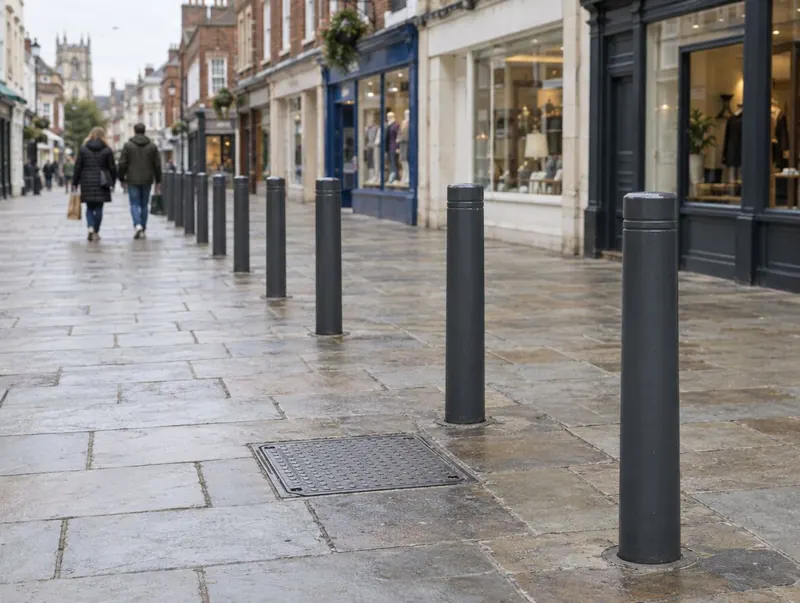
Shallow-mount security bollards
Rated shallow-foundation bollard systems installed where buried services, basements or slabs rule out deep excavation.
Learn more →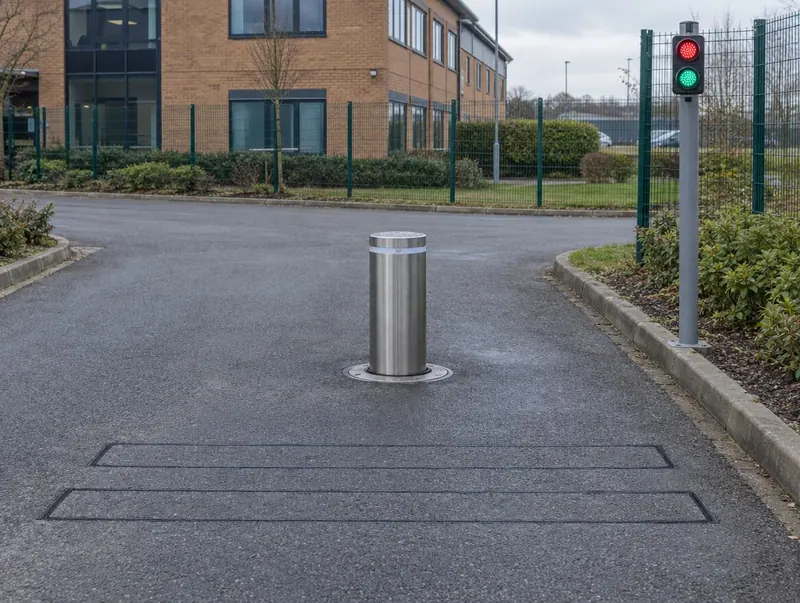
Automatic rising bollards
Hydraulic and electro-mechanical rising bollards installed with controls, safety loops, signals and power, for managed vehicle access.
Learn more →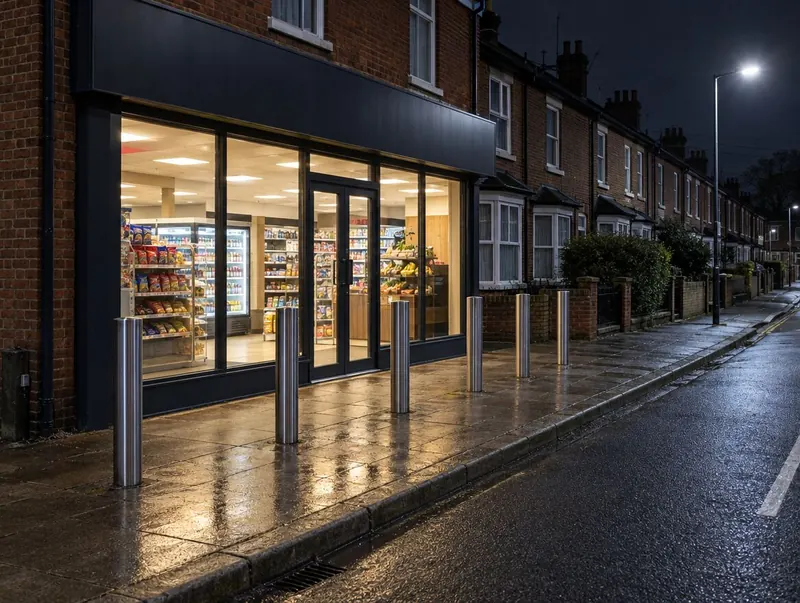
Ram-raid protection bollards
Bollards fitted in front of shopfronts, ATMs, jewellers and convenience stores to stop vehicles being used to break in.
Learn more →