Guide
How do you protect a warehouse from forklift and vehicle impacts?
Choosing and fixing warehouse impact bollards for forklift and HGV areas: slab checks, base-plated or root-fixed posts, colours, walkways and impact logs.
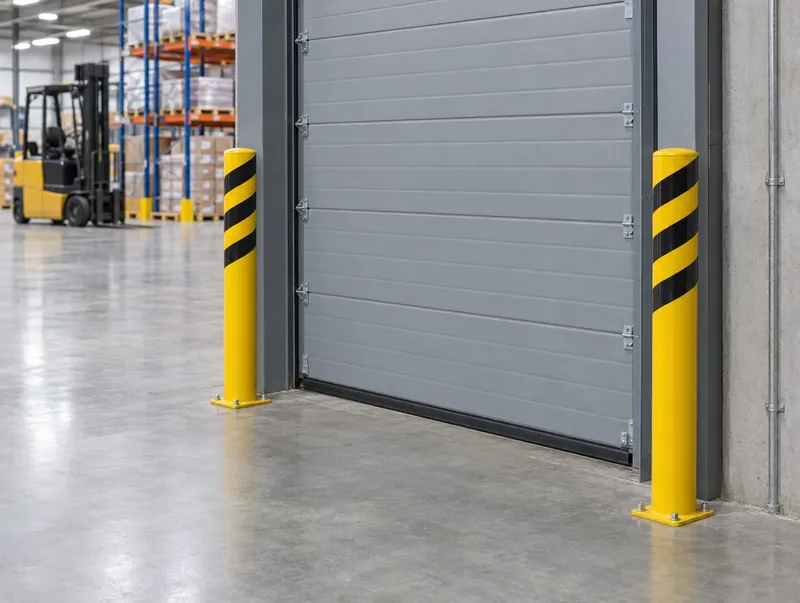 Computer-generated image
Warehouse impact protection uses bollards and barriers to keep forklifts, pallet trucks and HGVs away from people, racking ends, columns, doors and equipment. Inside, most posts are yellow steel or polymer bollards bolted to the slab; in yards, heavier posts are often root-fixed in concrete. The right choice depends on the vehicle, its speed and approach angle, and what the slab can take, and a log of every impact shows where the protection is working and where the layout needs to change.
Where does a warehouse need impact protection?
Wherever a vehicle can reach something that would be dangerous or costly to hit. Your workplace transport risk assessment should set the list, which typically includes:
- racking ends and uprights at aisle entrances
- building columns and steel stanchions
- loading bay doors, fast-action doors and dock levellers
- pedestrian walkways, crossings and doorways from offices and welfare areas
- fire exits, fire equipment and sprinkler valves
- electrical panels, battery charging areas and plant
- gatehouses, fuel points and EV chargers in the yard
Keep escape routes and fire equipment clear: bollards must not narrow an escape route below its required width.
Which bollards suit forklifts, and which suit HGVs?
Match the bollard to the heaviest vehicle at its realistic speed and angle. Inside, steel posts of around 114–273 mm diameter bolted to the slab handle most forklift and pallet truck knocks. Polymer bollards flex and recover from impacts within their stated performance, which reduces the force on the anchors and slab, but they need space behind them to deflect. In yards, where HGVs reverse and turn, heavier concrete-filled steel posts root-fixed in concrete are common, and flexible bollards suit car park and depot aisles where knocks are frequent but light.
BSI's PAS 13 is a code of practice for safety barriers used in workplace traffic management, with impact test methods, and many manufacturers state performance against it. It is guidance rather than law, and we don't summarise its detail here; ask for the test data and compare it with your own vehicles.
Will the floor slab take bolted-down bollards?
Only if it is thick enough, sound and free of anything you can't drill into, so we check before quoting. Warehouse floors range from thick reinforced slabs to thin toppings over older concrete. Anchors need enough edge distance from joints and cracks or they split the concrete on the first hit, and a strong post on a weak slab simply moves the damage into the floor. Some slabs contain underfloor heating, ducts or guidance wires for automated trucks. Where a slab is thin or poor, the options are through-bolting, a larger base plate to spread the load, a polymer bollard that reduces anchor forces, or breaking out and casting a new local foundation.
Should warehouse bollards be base-plated or root-fixed?
As a rule, base-plated inside and root-fixed outside. The trade-off looks like this:
| Base-plated | Root-fixed | |
|---|---|---|
| Installation | Drill and anchor; no break-out | Core drill or excavate, concrete, cure |
| Disruption | Minimal; often fits between shifts | Area kept clear while concrete cures |
| Impact resistance | Limited by the anchors and slab | Higher; load goes into the ground or slab depth |
| After a hit | Unbolt and replace post or anchors | Cut out and re-set |
| Moving later | Easy | Hard |
Root-fixing into an internal slab by core drilling is possible where the slab is thick enough, adding £60–£250 per post plus VAT.
Why are warehouse bollards yellow and black?
Because yellow, or yellow with black bands, is the usual way to mark hazards and obstacles in a workplace, so drivers and pedestrians read them at a glance. Contrast matters most in dim aisles and yards at night, where reflective bands help. Faded coatings are easy to miss, so recoat steel posts when the yellow wears and replace damaged polymer covers. Stainless or black finishes suit customer-facing areas, but in vehicle zones visibility comes first.
How should pedestrian walkways be protected?
With physical separation where people walk beside vehicles, and bollards where they cross. A painted line shows where to walk but stops nothing. Bollards at crossing points, doorways and the ends of walkways stop a vehicle cutting the corner, and continuous barrier is better where a walkway runs alongside a busy aisle. Leave openings wide enough for people, trolleys and anyone using a wheelchair, and line them up with the crossings drivers expect. See pedestrian protection bollards.
What should happen after a bollard is hit?
Record it, inspect it and fix the cause as well as the post. Log the date, place, vehicle and damage; a cluster of strikes in one spot often means the route, turning space or racking layout needs changing rather than heavier protection. Inspect steel posts for bending, cracked welds, loose or sheared anchors and cracked concrete around the plate, and replace polymer posts that stay deformed or have split. Straightening can suit a light traffic post, but where impact protection matters a bent post is better replaced.
Warehouse impact bollards typically cost £175–£1,195 per bollard plus VAT, supplied and fixed, so ten posts on the Standard specification, bolted to a sound slab, come to about £1,745–£6,045 plus VAT. Replacement after damage runs at £215–£1,195 per post plus VAT. We plan work around shifts, with out-of-hours working at £295–£945 per job, and every installation starts with a free survey and a fixed written quote.
Prepared by the Bollard Installers team · Last reviewed 01 November 2026 · Prices and rules change; check the rules pages and your written quote.
Questions
Can impact bollards be fitted while the warehouse is working?
Usually, with the work area fenced off and the programme planned around shifts. Bolt-down posts are quick to fit, while root-fixed posts need the area kept clear while the concrete cures.
Is PAS 13 a legal requirement?
No. PAS 13 is a BSI code of practice for workplace safety barriers, not law. It is useful for comparing products' stated impact performance with your vehicles.
Do flexible polymer bollards need replacing after a hit?
Not if they return to shape and the anchors and slab are undamaged, because they are designed to recover from impacts within their stated performance. Inspect after every impact and replace any that stay deformed or have split.
Can bollards be fixed into a slab with underfloor heating or guidance wires?
Only after the slab has been scanned and the building owner has confirmed where it is safe to drill. If the anchors can't go deep enough, a larger plate, a different product or a new local foundation is needed.
Related services
Warehouse and loading-bay impact bollards
Yellow steel and polymer impact bollards for forklift zones, loading bays, doors, columns and racking inside warehouses.
Learn more →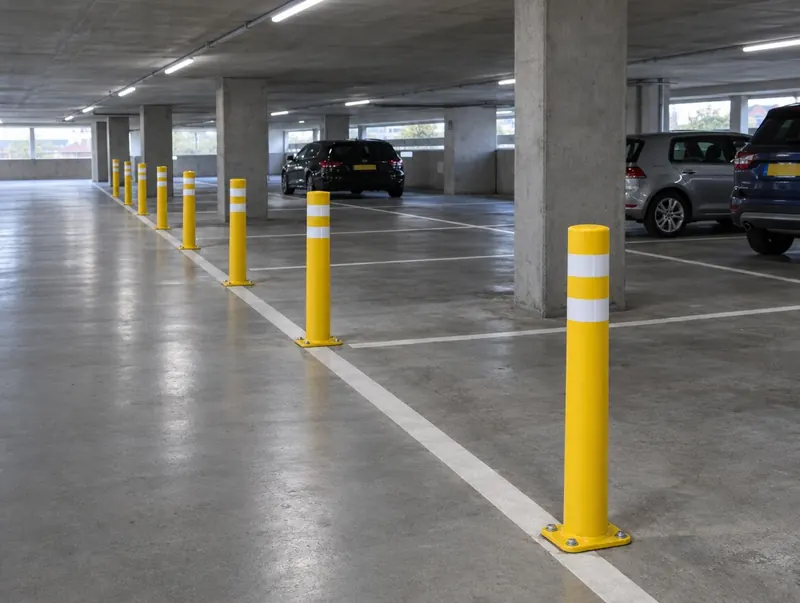
Flexible impact-recoverable bollards
Polyurethane and spring-based bollards that bend when hit and return upright, for car parks, depots and lane separation.
Learn more →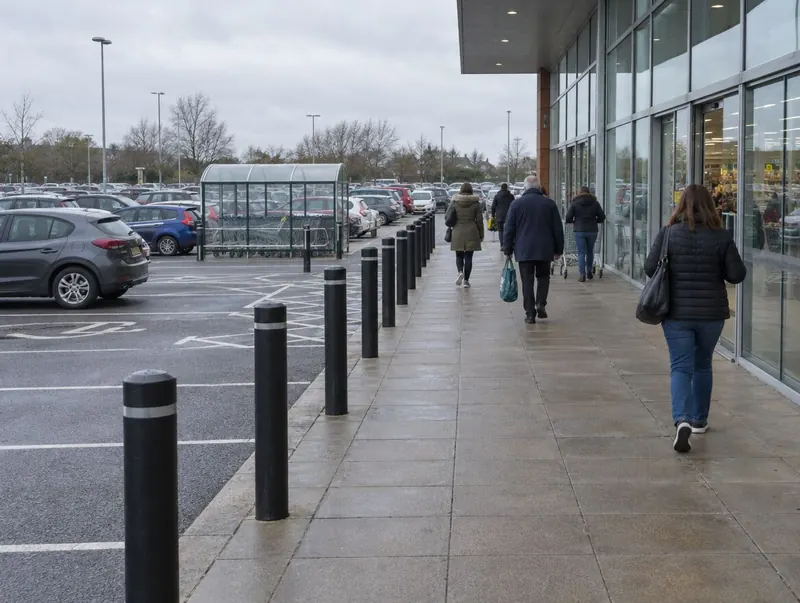
Pedestrian and shopfront protection bollards
Bollards that separate people from vehicles at car parks, forecourts, walkways, drive-thrus and shop entrances.
Learn more →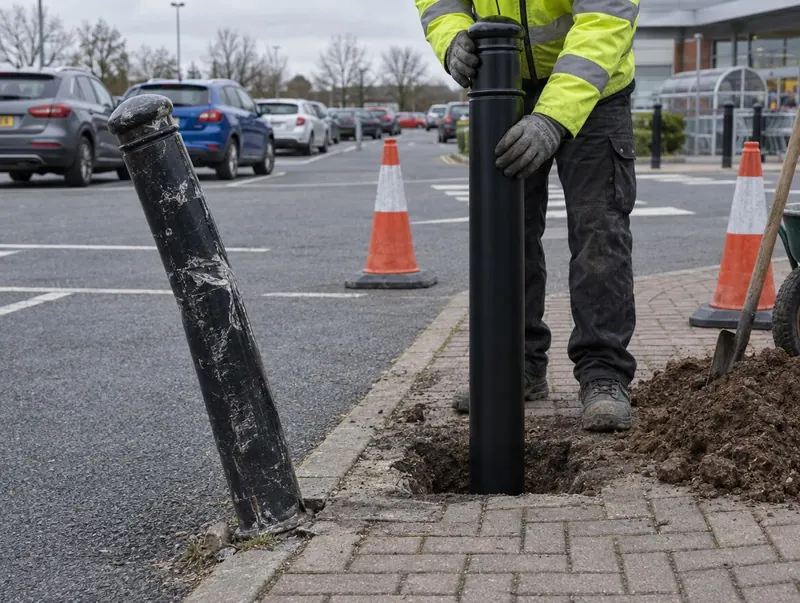
Bollard replacement
Like-for-like or upgraded replacement of bollards damaged by vehicles, corrosion or wear, matched to the existing line.
Learn more →