Cornwall · England
Automatic bollard servicing in Truro
Local automatic bollard service visits across Truro — we diagnose, explain and price in writing before doing more.
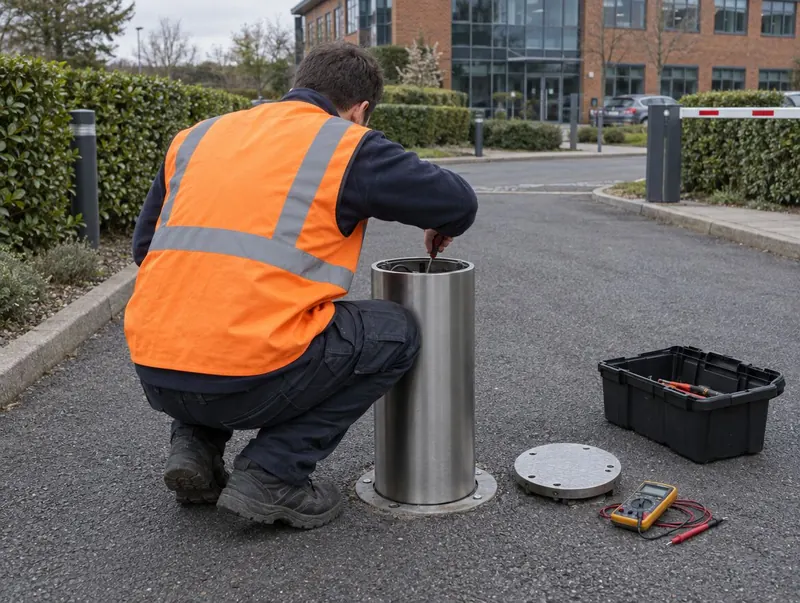 Computer-generated image
Truro automatic bollard service visits
For small industrial units, town-centre squares and filling-station forecourts in Truro, regular attention keeps existing bollards working safely. A service visit cleans and inspects the bollard and cassette, checks the drive, drainage and electrics, and tests every safety device, access control input and emergency function.
We work across TR1, TR4, TR3 and TR2 — Truro itself and places including Goonhavern, Porthtowan, Mount Hawke and Chacewater. Jobs in Truro can be combined with work in Falmouth (7.7 miles), Redruth (7.8 miles), Newquay (10.4 miles) and Camborne (11.3 miles) (straight-line distances).
Local details
- Area
- Cornwall, England
- Highway authority
- Cornwall Council (local roads)
- Planning authority
- Cornwall Council
- Postcodes
- TR1, TR4, TR3 and TR2
- Guide price
- Typically £95–£345 per visit + VAT
- Survey
- Paid visit, price confirmed in writing first
What automatic bollard service visits cost in Truro
| Specification | Guide price | Includes |
|---|---|---|
| Standard | £95–£205 + VAT | One bollard, planned service and safety checks |
| Upgraded | £175–£275 + VAT | Two bollards, full service and written report |
| Premium | £245–£345 + VAT | Larger or rated systems to manufacturer procedures |
Per planned service visit, first bollard; no regional adjustment. Guide only — the visit price is confirmed in writing first.
Common reasons for automatic bollard service visits in Truro
Typical reasons for automatic bollard service visits in Truro:
- Sites needing documented maintenance for insurers or audits
- Residential estates with shared automatic bollards
- Bollards inherited with a building and no service history
Before we dig in Truro
In Truro, work on adopted pavements and verges needs consent from Cornwall Council, the local highway authority. Car parks, forecourts and other private land only need the owner's permission.
Many private-land installations in Truro need no planning application, but the rules don't clearly cover bollards, so listed buildings, conservation areas and prominent frontages are worth raising with the planning team at Cornwall Council before posts go in.
Silt and grit washed in from the surrounding road are a steady source of wear, so where the road drains towards the bollard, a small change such as a channel or gully nearby can reduce how much debris reaches the pit. Drainage outlets are tested by running water into the pit; where they no longer drain, the cause may be a collapsed pipe or a soakaway that has silted up, which may need a separate drainage repair quoted in writing.
- Keep safety devices tested and working; a bollard with disabled or faulty safety loops or photocells should not stay in service.
- Test emergency service access arrangements periodically and after any change to the controls.
From survey to handover
Plan around the entrance
Visits are planned to keep the entrance usable, usually servicing one lane or bollard at a time, with cones and staff on hand while a bollard is out of service.
Service and test
The pit, drainage, drive, electrics, safety devices and access inputs are serviced and tested, and the controller log is read.
Report and recommend
You receive a written report of what was checked and found. Any repair needed is quoted separately in writing for your approval.
Choosing the right spec
| Option | Detail |
|---|---|
| Visit frequency | Set by how often the bollards cycle and the site's risk; busy or security sites usually need more frequent visits. |
| Planned maintenance contract | Scheduled visits at agreed intervals, priced in writing, with a consistent record kept across visits. |
| Safety and access testing | Loops, photocells, lights, manual release, emergency functions and access control inputs tested on every visit. |
What moves the price in Truro
Our South West guide prices are a starting point; the survey in Truro firms them up. What tends to move them:
- Number of bollards and controllers
- Traffic management needed on live roads
- Access control equipment to be tested
After installation
If the site changes how the entrance is used, such as longer opening hours or heavier delivery vehicles, mention it before the next visit so the service frequency and safety settings can be reconsidered. Between service visits, site staff can do a lot to keep bollards reliable: keep the head and surrounding road clear of leaves and grit, report any change in speed, noise or behaviour, keep a note of faults with the date and time, and never bypass or disconnect safety devices to keep an entrance open.
We can also service, repair or replace existing posts anywhere in Truro.
Bollard servicing in Truro: FAQs
Do you carry out automatic bollard service visits in Truro?
We cover all of Truro (TR1, TR4, TR3 and TR2) and the rest of Cornwall. We also work in Falmouth, Redruth and Newquay.
Do I need consent for bollards on a public footway in Truro?
In Truro, work on adopted pavements and verges needs consent from Cornwall Council, the local highway authority. Car parks, forecourts and other private land only need the owner's permission.
How much do automatic bollard service visits cost in Truro?
In Truro, typically £95–£345 per planned service visit, first bollard, plus VAT, using our South West guide prices. We confirm the visit price in writing before attending.
Will the entrance be closed during a service?
Usually only partly. We service one bollard or lane at a time where possible, with cones and staff managing traffic. On single-bollard entrances, a short closure is agreed in advance.
What is checked during a bollard service?
The cassette and drainage, the hydraulic or electro-mechanical drive, electrics, rise and fall times, all safety devices, the manual release, emergency functions and access control inputs. You receive a written report afterwards.