Tyne and Wear · England
Automatic bollard servicing in Washington
Automatic bollard service visits in Washington, Tyne and Wear: the visit price confirmed in writing first, then a clear report and a fixed price for anything further.
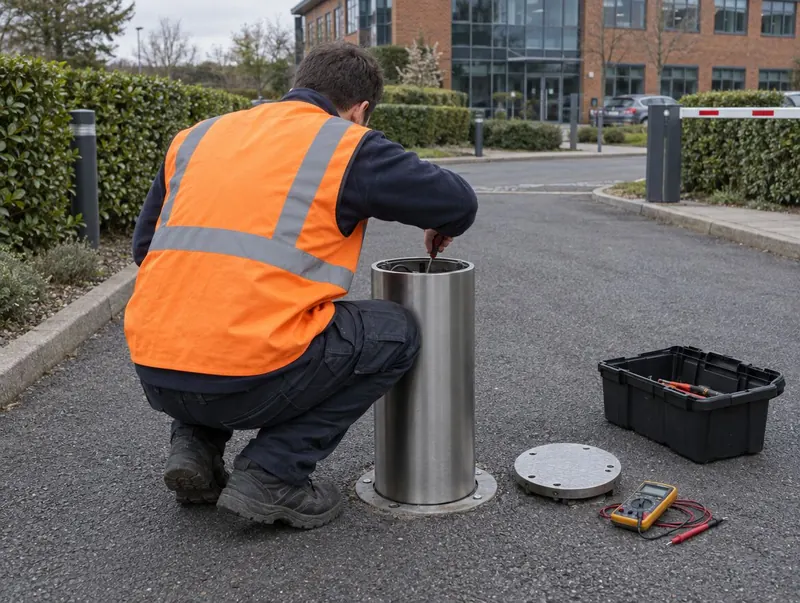 Computer-generated image
Washington automatic bollard service visits
Planned servicing visits and maintenance contracts for hydraulic and electro-mechanical rising bollards, priced in writing. Around Washington, that usually means sites such as small industrial units, schools and town-centre squares.
We cover every part of Washington in the NE38 and NE37 postcode districts. Nearby, we also work in Chester-le-Street (3.7 miles), Felling (4.3 miles), Houghton-le-Spring (4.6 miles) and Hebburn (5 miles), measured as the crow flies. Washington is about 6 miles from Newcastle upon Tyne.
Washington at a glance
- Area
- Tyne and Wear, England
- Highway authority
- Sunderland City Council (local roads)
- Planning authority
- Sunderland City Council
- Postcodes
- NE38 and NE37
- Guide price
- Typically £95–£335 per visit + VAT
- Survey
- Paid visit, price confirmed in writing first
- Nearby
- Chester-le-Street (3.7 mi), Felling (4.3 mi), Houghton-le-Spring (4.6 mi), Hebburn (5 mi)
Typical automatic bollard service visits requests in Washington
What automatic bollard service visits usually sort out in Washington:
- Residential estates with shared automatic bollards
- Secure sites with crash-rated automatic bollards
- Bollards inherited with a building and no service history
Washington: typical servicing prices
| Specification | Guide price | Includes |
|---|---|---|
| Standard | £95–£195 + VAT | One bollard, planned service and safety checks |
| Upgraded | £165–£265 + VAT | Two bollards, full service and written report |
| Premium | £235–£335 + VAT | Larger or rated systems to manufacturer procedures |
Per planned service visit, first bollard; -4% for North East. Guide only — the visit price is confirmed in writing first.
What we check first in Washington
Sunderland City Council is the highway authority covering Washington's local roads. If any post would stand on adopted highway rather than your land, that consent is the first thing we sort out.
Many private-land installations in Washington need no planning application, but the rules don't clearly cover bollards, so listed buildings, conservation areas and prominent frontages are worth raising with the planning team at Sunderland City Council before posts go in.
Silt and grit washed in from the surrounding road are a steady source of wear, so where the road drains towards the bollard, a small change such as a channel or gully nearby can reduce how much debris reaches the pit. Cracked or sunken surfacing around a cassette can indicate a failing foundation or water washing out the sub-base.
- Keep safety devices tested and working; a bollard with disabled or faulty safety loops or photocells should not stay in service.
- For crash-rated automatic bollards, follow the manufacturer's maintenance requirements so the bollard continues to perform as tested.
From survey to handover
Tell us about the installation
Send the make and model if known, the number of bollards, how busy the entrance is and any current problems, with photographs of the bollards and controller.
Service and test
The pit, drainage, drive, electrics, safety devices and access inputs are serviced and tested, and the controller log is read.
Report and recommend
You receive a written report of what was checked and found. Any repair needed is quoted separately in writing for your approval.
Choosing the right spec
| Option | Detail |
|---|---|
| Hydraulic servicing | Fluid, hoses, seals, pump and valve checks, with fluid topped up or changed as needed. |
| Visit frequency | Set by how often the bollards cycle and the site's risk; busy or security sites usually need more frequent visits. |
| Planned maintenance contract | Scheduled visits at agreed intervals, priced in writing, with a consistent record kept across visits. |
What moves the price in Washington
Our North East guide prices are a starting point; the survey in Washington firms them up. What tends to move them:
- Hydraulic or electro-mechanical drive
- Traffic management needed on live roads
- Visit frequency and contract length
After installation
After snow, clear around the head before use. If the site changes how the entrance is used, such as longer opening hours or heavier delivery vehicles, mention it before the next visit so the service frequency and safety settings can be reconsidered.
If posts in Washington are later hit or damaged, we can repair or replace them — see bollard repairs.
Common questions
Which parts of Washington do you cover for automatic bollard service visits?
We cover all of Washington (NE38 and NE37) and the rest of Tyne and Wear. We also work in Chester-le-Street, Felling and Houghton-le-Spring.
Do I need consent for bollards on a public footway in Washington?
The highway authority for local roads in Washington is Sunderland City Council; motorways and trunk roads sit with National Highways. Bollards on the adopted footway are a matter for the highway authority, so we only install there with its written agreement.
How much do automatic bollard service visits cost in Washington?
In Washington, typically £95–£335 per planned service visit, first bollard, plus VAT, using our North East guide prices. We confirm the visit price in writing before attending.
Will the entrance be closed during a service?
Usually only partly. We service one bollard or lane at a time where possible, with cones and staff managing traffic. On single-bollard entrances, a short closure is agreed in advance.
How often should automatic bollards be serviced?
It depends on how often they cycle and the risk at the site. Commonly that means every three to six months, with busier or security entrances at the more frequent end. We suggest a frequency once we know your usage.
Bollard servicing in nearby towns
- Chester-le-Street (3.7 mi)
- Felling (4.3 mi)
- Houghton-le-Spring (4.6 mi)
- Hebburn (5 mi)
- Sunderland (5.4 mi)
- Gateshead (5.5 mi)