West Yorkshire · England
Automatic bollard servicing in Wakefield
Local automatic bollard service visits across Wakefield — we diagnose, explain and price in writing before doing more.
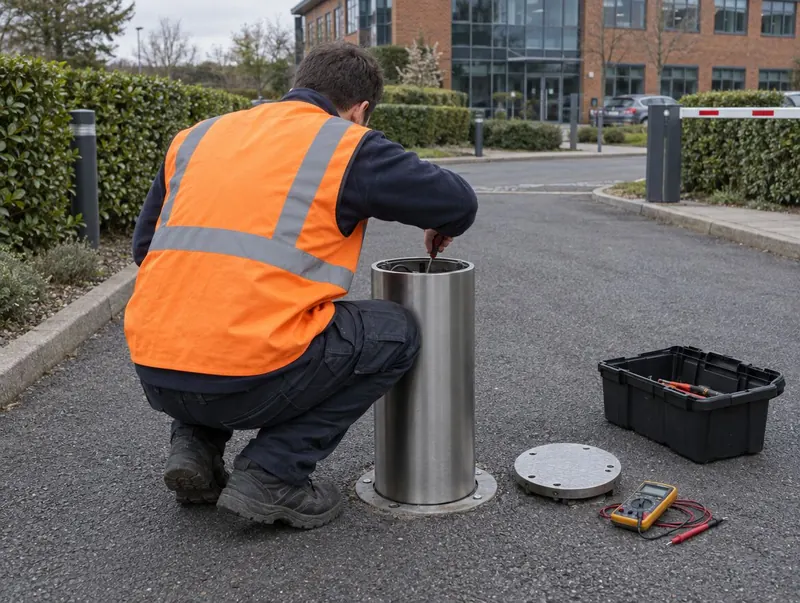 Computer-generated image
Wakefield automatic bollard service visits
Planned servicing visits and maintenance contracts for hydraulic and electro-mechanical rising bollards, priced in writing. Around Wakefield, that usually means sites such as leisure centres, business parks and retail parks.
We work across WF1, WF2, WF3 and WF4 — Wakefield itself and places including Kirkthorpe, Warmfield, Horse Race End and Kirkhamgate. Jobs in Wakefield can be combined with work in Ossett (3.4 miles), Dewsbury (5.4 miles), Batley (5.7 miles) and Morley (5.7 miles) (straight-line distances). Leeds is around 8 miles away.
Local details
- Area
- West Yorkshire, England
- Highway authority
- Wakefield Council (local roads)
- Planning authority
- Wakefield Council
- Postcodes
- WF1, WF2, WF3 and WF4
- Guide price
- Typically £95–£335 per visit + VAT
- Survey
- Paid visit, price confirmed in writing first
What automatic bollard service visits cost in Wakefield
| Specification | Guide price | Includes |
|---|---|---|
| Standard | £95–£195 + VAT | One bollard, planned service and safety checks |
| Upgraded | £165–£265 + VAT | Two bollards, full service and written report |
| Premium | £235–£335 + VAT | Larger or rated systems to manufacturer procedures |
Per planned service visit, first bollard; -3% for Yorkshire and the Humber. Guide only — the visit price is confirmed in writing first.
Common reasons for automatic bollard service visits in Wakefield
Why sites in Wakefield book automatic bollard service visits:
- Systems that have started to run slowly or noisily
- Business parks and campuses with busy automatic entrances
- Sites needing documented maintenance for insurers or audits
Permissions and groundwork in Wakefield
Wakefield Council is the highway authority covering Wakefield's local roads. If any post would stand on adopted highway rather than your land, that consent is the first thing we sort out.
Many private-land installations in Wakefield need no planning application, but the rules don't clearly cover bollards, so listed buildings, conservation areas and prominent frontages are worth raising with the planning team at Wakefield Council before posts go in.
Silt and grit washed in from the surrounding road are a steady source of wear, so where the road drains towards the bollard, a small change such as a channel or gully nearby can reduce how much debris reaches the pit. Drainage outlets are tested by running water into the pit; where they no longer drain, the cause may be a collapsed pipe or a soakaway that has silted up, which may need a separate drainage repair quoted in writing.
- Keep safety devices tested and working; a bollard with disabled or faulty safety loops or photocells should not stay in service.
- For crash-rated automatic bollards, follow the manufacturer's maintenance requirements so the bollard continues to perform as tested.
What happens on site
Agree the visit or contract
We price a one-off visit or a contract in writing, with the visit frequency suggested for your usage. Nothing is booked until you have agreed it.
Plan around the entrance
Visits are planned to keep the entrance usable, usually servicing one lane or bollard at a time, with cones and staff on hand while a bollard is out of service.
Service and test
The pit, drainage, drive, electrics, safety devices and access inputs are serviced and tested, and the controller log is read.
Finishes and options
| Option | Detail |
|---|---|
| Electro-mechanical servicing | Motor, gearbox, couplings and sensor checks, with adjustment of limits and positions. |
| Safety and access testing | Loops, photocells, lights, manual release, emergency functions and access control inputs tested on every visit. |
| Visit frequency | Set by how often the bollards cycle and the site's risk; busy or security sites usually need more frequent visits. |
What affects the quote
When we price automatic bollard service visits in Wakefield, these make the biggest difference:
- Hydraulic or electro-mechanical drive
- Visit frequency and contract length
- Rated bollards with manufacturer-specified procedures
After installation
Between service visits, site staff can do a lot to keep bollards reliable: keep the head and surrounding road clear of leaves and grit, report any change in speed, noise or behaviour, keep a note of faults with the date and time, and never bypass or disconnect safety devices to keep an entrance open. If the site changes how the entrance is used, such as longer opening hours or heavier delivery vehicles, mention it before the next visit so the service frequency and safety settings can be reconsidered.
If posts in Wakefield are later hit or damaged, we can repair or replace them — see bollard repairs.
Questions about automatic bollard service visits in Wakefield
Can you carry out automatic bollard service visits anywhere in Wakefield?
We cover all of Wakefield (WF1, WF2, WF3 and WF4) and the rest of West Yorkshire. We also work in Ossett, Dewsbury and Batley.
Do I need consent for bollards on a public footway in Wakefield?
The highway authority for local roads in Wakefield is Wakefield Council; motorways and trunk roads sit with National Highways. Bollards on the adopted footway are a matter for the highway authority, so we only install there with its written agreement.
What's a typical price for automatic bollard service visits in Wakefield?
In Wakefield, typically £95–£335 per planned service visit, first bollard, plus VAT, using our Yorkshire and the Humber guide prices. We confirm the visit price in writing before attending.
How often should automatic bollards be serviced?
It depends on how often they cycle and the risk at the site. Commonly that means every three to six months, with busier or security entrances at the more frequent end. We suggest a frequency once we know your usage.
Will the entrance be closed during a service?
Usually only partly. We service one bollard or lane at a time where possible, with cones and staff managing traffic. On single-bollard entrances, a short closure is agreed in advance.