Bedfordshire · England
Automatic rising bollard installation in Dunstable
Automatic bollards for sites across Dunstable and the rest of Bedfordshire, from the first measurement to the last relaid paving block.
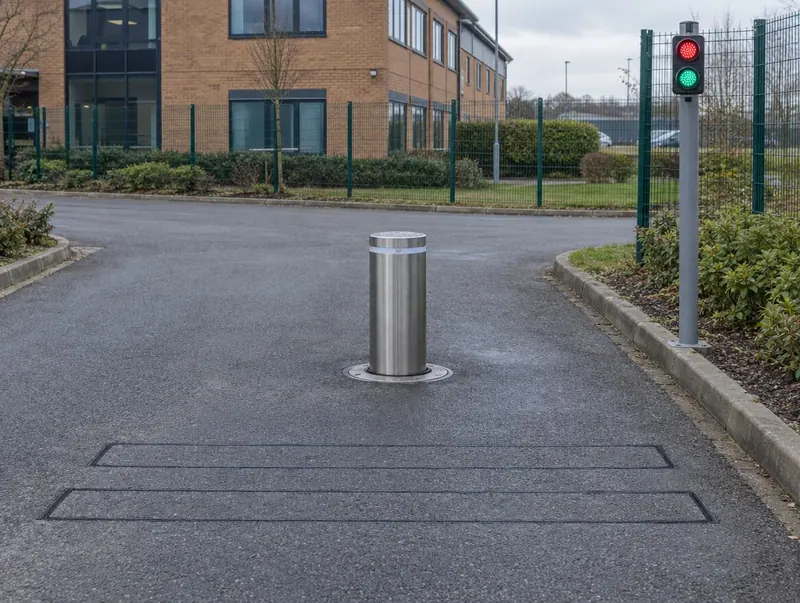 Computer-generated image
Dunstable automatic bollards
Across Dunstable, typical sites for automatic bollards include town-centre squares, small industrial units and filling-station forecourts. Automatic bollards are available unrated for traffic control or crash-tested for security entrances.
We cover Dunstable's LU6 and LU5 postcode districts, including places such as Eaton Bray, Edlesborough, Totternhoe and Kensworth. We also cover neighbouring Luton (4.5 miles), Leighton Buzzard (6.2 miles), Harpenden (8.5 miles) and Berkhamsted (8.8 miles) — distances are straight-line. Dunstable is about 5 miles from Luton.
Key facts for this area
- Area
- Bedfordshire, England
- Highway authority
- Central Bedfordshire Council (local roads)
- Planning authority
- Central Bedfordshire Council
- Postcodes
- LU6 and LU5
- Guide price
- Typically £3,095–£15,495 per bollard + VAT
- Survey
- Free, with a fixed written quote
- Nearby
- Luton (4.5 mi), Leighton Buzzard (6.2 mi), Harpenden (8.5 mi), Berkhamsted (8.8 mi)
Dunstable: typical automatic bollard prices
| Specification | Guide price | Includes |
|---|---|---|
| Standard | £3,095–£8,295 + VAT | Electro-mechanical or entry hydraulic, controls, loops and photocell |
| Upgraded | £6,795–£11,995 + VAT | Heavy-duty hydraulic, traffic light, signs and LED head |
| Premium | £10,495–£15,495 + VAT | High-cycle or crash-rated automatic bollard |
Per bollard, installed with controls, loops and commissioning; +3% for East of England. Guide only — the fixed price follows a survey.
Automatic bollards in Dunstable: common uses
Common uses in a place like Dunstable:
- Secure loading yards where rated automatic posts are specified
- Entrances where a gate would block pedestrian desire lines
- Business parks and campus roads with controlled vehicle access
Before we dig in Dunstable
In Dunstable, work on adopted pavements and verges needs consent from Central Bedfordshire Council, the local highway authority. Car parks, forecourts and other private land only need the owner's permission.
Many private-land installations in Dunstable need no planning application, but the rules don't clearly cover bollards, so listed buildings, conservation areas and prominent frontages are worth raising with the planning team at Central Bedfordshire Council before posts go in.
The pit base is usually connected to a surface water drain or a soakaway, and on clay or high water table sites that connection needs particular attention. Duct routes cross the carriageway and often the footway, so buried services along those routes must be traced first.
- For rated units, keep the test certificate and confirm the foundation matches the tested design.
- On public highway, rising bollards normally need highway authority approval, with signs and signals to their requirements.
How the job runs
Excavate and set cassettes
Each cassette pit is excavated to the manufacturer's depth, with the base prepared to drain. Cassettes are set to finished road level and fall, then concreted in.
Ducts, drainage and loops
Ducts are laid between the bollards, the controller cabinet and access devices, with draw pits where runs change direction. The drain is connected and the safety and exit loops are cut into the surface and sealed.
Power and controls
A qualified electrician installs the supply and isolation, and the controller, traffic lights, photocells and access devices are mounted and wired.
Options to consider
| Option | Detail |
|---|---|
| Fail-safe behaviour | Configured to lower or stay raised on power loss, with a manual release, depending on whether access or security takes priority. |
| Hydraulic drive | Integral or remote power pack. Suits high-frequency entrances and heavier rated units, with periodic checks on fluid, seals and hoses. |
| Electro-mechanical drive | Motor and gearbox inside the bollard with no hydraulic fluid. Often simpler to service, with duty cycles that suit moderate traffic. |
What affects the quote
Two Dunstable jobs with the same number of posts can price quite differently. The usual reasons:
- Surface condition for loops and the extent of reinstatement
- Length of duct runs, drainage connections and power supply distance
- Access control devices, traffic lights and signage
Looking after them
Typical visits clean and inspect the cassette and drain, check hydraulic fluid or gearbox condition, test loops, photocells, lights and the manual release, and read the controller's fault log. Frequency depends on how often the bollard cycles; a busy entrance needs more visits than a rarely used one.
We can also service, repair or replace existing posts anywhere in Dunstable.
Questions about automatic bollards in Dunstable
Can you install automatic bollards anywhere in Dunstable?
We cover all of Dunstable (LU6 and LU5) and the rest of Bedfordshire. We also work in Luton, Leighton Buzzard and Harpenden.
Do I need consent for automatic bollards on a public footway in Dunstable?
The highway authority for local roads in Dunstable is Central Bedfordshire Council; motorways and trunk roads sit with National Highways. Automatic bollards on the adopted footway are a matter for the highway authority, so we only install there with its written agreement.
How much do automatic bollards cost in Dunstable?
In Dunstable, typically £3,095–£15,495 per bollard, installed with controls, loops and commissioning, plus VAT, using our East of England guide prices. The fixed figure comes in writing after we've seen the site.
Should I choose hydraulic or electro-mechanical bollards?
Choose by how often the bollard will move and how you want it maintained. Hydraulic units suit busy entrances and heavier rated posts but need fluid and seal checks. Electro-mechanical units avoid fluid and are often simpler to look after at moderate traffic levels.
Why do automatic bollards need drainage?
The bollard sits in a pit that collects rain and silt. Without a drain, water corrodes the mechanism, short-circuits electrics and can freeze the post in place. A drain connection is part of every automatic installation we carry out.
Automatic bollards near Dunstable
- Luton (4.5 mi)
- Leighton Buzzard (6.2 mi)
- Harpenden (8.5 mi)
- Berkhamsted (8.8 mi)
- Hemel Hempstead (9.6 mi)
- Ampthill (9.8 mi)