Bridgend · Wales
Automatic rising bollard installation in Porthcawl
Automatic bollards supplied and fitted in Porthcawl, Bridgend: surveyed, scanned for services, set in proper foundations and finished to match the ground.
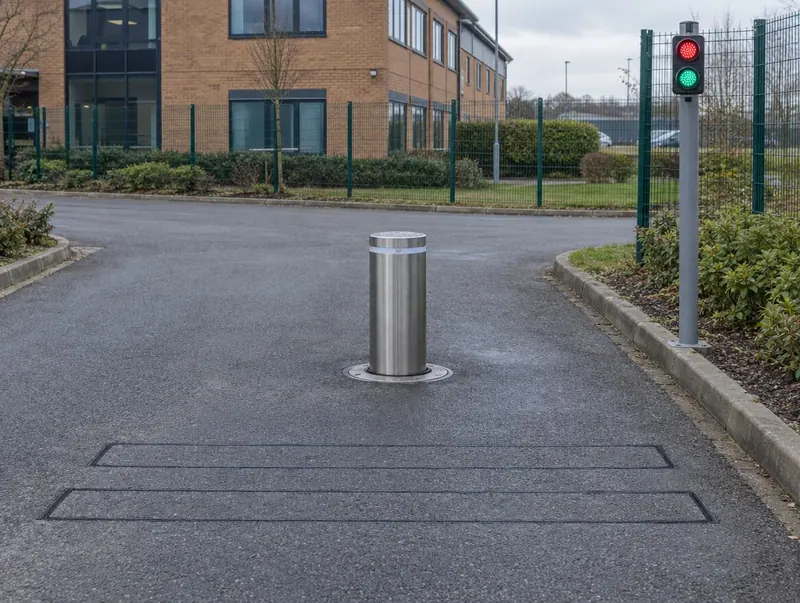 Computer-generated image
About automatic bollards in Porthcawl
We supply and fit automatic bollards throughout Porthcawl, typically for sites such as filling-station forecourts, town-centre squares and community car parks. Automatic bollards are available unrated for traffic control or crash-tested for security entrances.
We cover the CF36 postcode district in Porthcawl. Jobs in Porthcawl can be combined with work in Pyle (2.6 miles), Bridgend (5.7 miles), Port Talbot (8.7 miles) and Maesteg (9.2 miles) (straight-line distances). Porthcawl is about 14 miles from Swansea.
Local details
- Area
- Bridgend, Wales
- Highway authority
- Bridgend County Borough Council (local roads)
- Planning authority
- Bridgend County Borough Council
- Postcodes
- CF36
- Guide price
- Typically £2,895–£14,595 per bollard + VAT
- Survey
- Free, with a fixed written quote
- Nearby
- Pyle (2.6 mi), Bridgend (5.7 mi), Port Talbot (8.7 mi), Maesteg (9.2 mi)
Typical automatic bollards jobs in Porthcawl
Common uses in a place like Porthcawl:
- Bus gates and access-only routes where the highway authority agrees
- Entrances where a gate would block pedestrian desire lines
- Pedestrianised streets with permitted delivery windows
Guide prices for Porthcawl
| Specification | Guide price | Includes |
|---|---|---|
| Standard | £2,895–£7,795 + VAT | Electro-mechanical or entry hydraulic, controls, loops and photocell |
| Upgraded | £6,395–£11,295 + VAT | Heavy-duty hydraulic, traffic light, signs and LED head |
| Premium | £9,895–£14,595 + VAT | High-cycle or crash-rated automatic bollard |
Per bollard, installed with controls, loops and commissioning; -3% for Wales. Guide only — the fixed price follows a survey.
What we check first in Porthcawl
Local roads and pavements in Porthcawl are the responsibility of Bridgend County Borough Council as highway authority, with the Welsh Government's trunk road agents handling trunk roads. Posts on the public highway need that authority's consent; private land does not.
If your site in Porthcawl is listed or inside a conservation area, check with the local planning authority (Bridgend County Borough Council) before choosing a finish — heritage settings often favour cast iron or painted steel over stainless.
Automatic bollards need a deep pit for the cassette and a reliable way for water to leave it. Reinstatement around each cassette is made flush so vehicles pass smoothly over the lowered head.
- On public highway, rising bollards normally need highway authority approval, with signs and signals to their requirements.
- For rated units, keep the test certificate and confirm the foundation matches the tested design.
Installation, step by step
Excavate and set cassettes
Each cassette pit is excavated to the manufacturer's depth, with the base prepared to drain. Cassettes are set to finished road level and fall, then concreted in.
Ducts, drainage and loops
Ducts are laid between the bollards, the controller cabinet and access devices, with draw pits where runs change direction. The drain is connected and the safety and exit loops are cut into the surface and sealed.
Train and hand over
Site staff are shown how to lower the bollard in an emergency and how to recognise faults. You receive keys, the commissioning record and the manufacturer's manuals.
Options to consider
| Option | Detail |
|---|---|
| Unrated or crash-rated | Unrated units control traffic; rated units are tested to IWA 14-1, ISO 22343-1 or PAS 68 for security entrances, with deeper, heavier foundations. |
| Paired or multi-bollard lanes | Several bollards can run from one controller to close a wider entrance, with lane-by-lane control where needed. |
| Heights and diameters | Raised heights are commonly around 500–800 mm for traffic control and taller for security models, with diameters varying by drive and rating. |
Pricing automatic bollards in Porthcawl
When we price automatic bollards in Porthcawl, these make the biggest difference:
- Length of duct runs, drainage connections and power supply distance
- Surface condition for loops and the extent of reinstatement
- Hydraulic or electro-mechanical drive and the duty cycle needed
After installation
Frequency depends on how often the bollard cycles; a busy entrance needs more visits than a rarely used one. Between visits, site staff should keep the head clear of grit and leaves, report slow or noisy movement early and never override safety devices to keep an entrance open.
For damaged or loose posts in Porthcawl, repairs and replacements are priced in writing first.
Automatic bollards in Porthcawl: FAQs
Which parts of Porthcawl do you cover for automatic bollards?
We cover all of Porthcawl (CF36) and the rest of Bridgend. We also work in Pyle, Bridgend and Port Talbot.
Who gives permission for bollards on the pavement in Porthcawl?
In Porthcawl the highway authority for local roads is Bridgend County Borough Council. We confirm whether the ground is adopted highway before quoting, because automatic bollards on a public footway need its agreement first.
How much do automatic bollards cost in Porthcawl?
In Porthcawl, typically £2,895–£14,595 per bollard, installed with controls, loops and commissioning, plus VAT, using our Wales guide prices. The fixed figure comes in writing after we've seen the site.
Why do automatic bollards need drainage?
The bollard sits in a pit that collects rain and silt. Without a drain, water corrodes the mechanism, short-circuits electrics and can freeze the post in place. A drain connection is part of every automatic installation we carry out.
Can rising bollards be installed on a public road?
Only with the highway authority's approval, and they will set requirements for signs, signals and operation. On private land the decision is yours, but the same safety principles apply.
Automatic bollards in nearby towns
- Pyle (2.6 mi)
- Bridgend (5.7 mi)
- Port Talbot (8.7 mi)
- Maesteg (9.2 mi)
- Llantwit Major (10.5 mi)
- Neath (13.4 mi)