Derbyshire · England
Automatic rising bollard installation in Ripley
Automatic bollards supplied and fitted in Ripley, Derbyshire: surveyed, scanned for services, set in proper foundations and finished to match the ground.
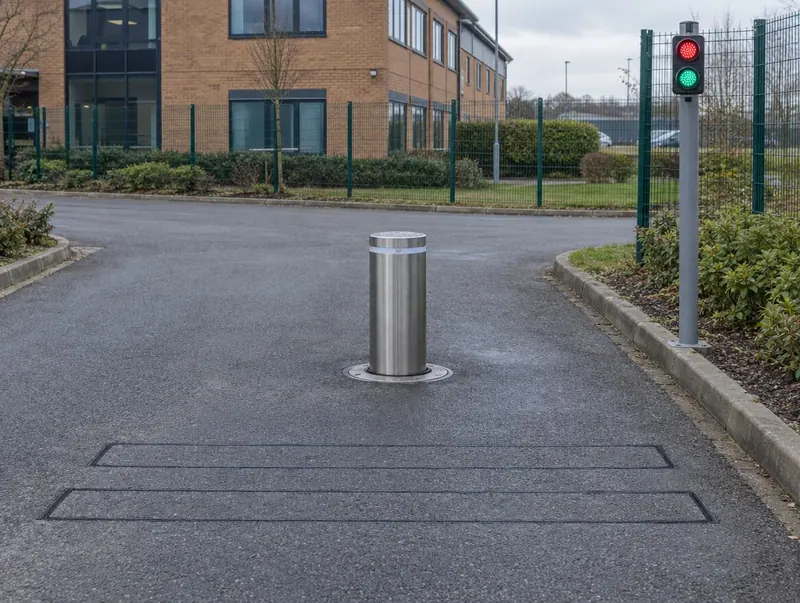 Computer-generated image
About automatic bollards in Ripley
Hydraulic and electro-mechanical rising bollards installed with controls, safety loops, signals and power, for managed vehicle access. In Ripley, that tends to mean sites such as small industrial units, town-centre squares and community car parks.
We work across DE5 — Ripley itself and places including Denby Common, Denby Bottles, Denby Village and Pentrich. Nearby, we also work in Heanor (2.3 miles), Belper (3.4 miles), Alfreton (4.5 miles) and Ilkeston (5.7 miles), measured as the crow flies. Derby is around 8 miles away.
Ripley at a glance
- Area
- Derbyshire, England
- Highway authority
- Derbyshire County Council (local roads)
- Planning authority
- the council for Amber Valley
- Postcodes
- DE5
- Guide price
- Typically £2,945–£14,695 per bollard + VAT
- Survey
- Free, with a fixed written quote
Where automatic bollards go in around Ripley
Typical reasons Ripley sites choose automatic bollards:
- Pedestrianised streets with permitted delivery windows
- Private estates and gated developments without a full gate
- Emergency access routes that must open on demand
Ripley: typical automatic bollard prices
| Specification | Guide price | Includes |
|---|---|---|
| Standard | £2,945–£7,895 + VAT | Electro-mechanical or entry hydraulic, controls, loops and photocell |
| Upgraded | £6,445–£11,395 + VAT | Heavy-duty hydraulic, traffic light, signs and LED head |
| Premium | £9,995–£14,695 + VAT | High-cycle or crash-rated automatic bollard |
Per bollard, installed with controls, loops and commissioning; -2% for East Midlands. Guide only — the fixed price follows a survey.
Consents, ground and services in Ripley
In Ripley, work on adopted pavements and verges needs consent from Derbyshire County Council, the local highway authority. Car parks, forecourts and other private land only need the owner's permission.
Bollards on private land often don't need planning permission, but it depends on the council's view, the height and the location; in a conservation area, next to a listed building or under an Article 4 direction, ask the local planning authority (the council for Amber Valley) first — we flag this at survey.
Automatic bollards need a deep pit for the cassette and a reliable way for water to leave it. Loops are cut into a sound surface: badly cracked tarmac or block paving may need resurfacing first, because loops in broken surfaces fail early.
- On public highway, rising bollards normally need highway authority approval, with signs and signals to their requirements.
- Have the electrical installation carried out and certified by a qualified electrician to BS 7671.
From survey to handover
Power and controls
A qualified electrician installs the supply and isolation, and the controller, traffic lights, photocells and access devices are mounted and wired.
Commission and test
Rise and fall times, loop detection, photocells, lights and the manual release are tested with vehicles present. Safety settings are recorded against the risk assessment.
Train and hand over
Site staff are shown how to lower the bollard in an emergency and how to recognise faults. You receive keys, the commissioning record and the manufacturer's manuals.
Options to consider
| Option | Detail |
|---|---|
| Fail-safe behaviour | Configured to lower or stay raised on power loss, with a manual release, depending on whether access or security takes priority. |
| Paired or multi-bollard lanes | Several bollards can run from one controller to close a wider entrance, with lane-by-lane control where needed. |
| Hydraulic drive | Integral or remote power pack. Suits high-frequency entrances and heavier rated units, with periodic checks on fluid, seals and hoses. |
Pricing automatic bollards in Ripley
When we price automatic bollards in Ripley, these make the biggest difference:
- Traffic management during installation on live roads
- Number of bollards and lanes controlled
- Surface condition for loops and the extent of reinstatement
After installation
Between visits, site staff should keep the head clear of grit and leaves, report slow or noisy movement early and never override safety devices to keep an entrance open. Automatic bollards need planned servicing, not just repair when they fail.
We can also service, repair or replace existing posts anywhere in Ripley.
Common questions
Can you install automatic bollards anywhere in Ripley?
We cover all of Ripley (DE5) and the rest of Derbyshire. We also work in Heanor, Belper and Alfreton.
Who gives permission for bollards on the pavement in Ripley?
The highway authority for local roads in Ripley is Derbyshire County Council; motorways and trunk roads sit with National Highways. Automatic bollards on the adopted footway are a matter for the highway authority, so we only install there with its written agreement.
What's a typical price for automatic bollards in Ripley?
In Ripley, typically £2,945–£14,695 per bollard, installed with controls, loops and commissioning, plus VAT, using our East Midlands guide prices. The fixed figure comes in writing after we've seen the site.
Can rising bollards be installed on a public road?
Only with the highway authority's approval, and they will set requirements for signs, signals and operation. On private land the decision is yours, but the same safety principles apply.
What happens in a power cut?
That depends on how the system is configured. Traffic bollards are often set to lower or can be lowered with a manual release, so vehicles are not trapped. Security bollards may be set to stay raised, with a procedure for staff to follow.
Automatic bollards in nearby towns
- Heanor (2.3 mi)
- Belper (3.4 mi)
- Alfreton (4.5 mi)
- Ilkeston (5.7 mi)
- Kirkby-in-Ashfield (7.9 mi)
- Derby (8.3 mi)