Dorset · England
Automatic rising bollard installation in Bournemouth
Automatic bollards for sites across Bournemouth and the rest of Dorset, from the first measurement to the last relaid paving block.
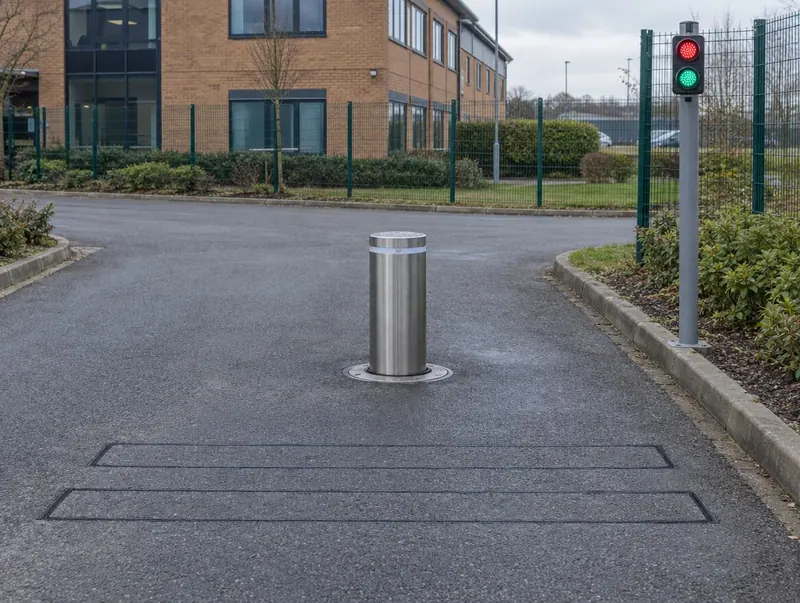 Computer-generated image
Bournemouth automatic bollards
We supply and fit automatic bollards throughout Bournemouth, typically for sites such as leisure centres, town-centre streets and college campuses. Hydraulic and electro-mechanical rising bollards installed with controls, safety loops, signals and power, for managed vehicle access.
Coverage in Bournemouth takes in the BH2, BH4, BH1, BH3, BH8 and BH9 postcode districts. Jobs in Bournemouth can be combined with work in Christchurch (4.4 miles), Poole (4.6 miles), New Milton (9.7 miles) and Totton (21.8 miles) (straight-line distances). Southampton is around 24 miles away.
Bournemouth at a glance
- Area
- Dorset, England
- Highway authority
- Bournemouth, Christchurch and Poole Council (local roads)
- Planning authority
- Bournemouth, Christchurch and Poole Council
- Postcodes
- BH2, BH4, BH1, BH3, BH8, BH9, BH5 and BH7
- Guide price
- Typically £2,995–£14,995 per bollard + VAT
- Survey
- Free, with a fixed written quote
- Nearby
- Christchurch (4.4 mi), Poole (4.6 mi), New Milton (9.7 mi), Totton (21.8 mi)
What Bournemouth sites use automatic bollards for
Typical reasons Bournemouth sites choose automatic bollards:
- Secure loading yards where rated automatic posts are specified
- Business parks and campus roads with controlled vehicle access
- Private estates and gated developments without a full gate
Automatic bollard prices in Bournemouth
| Specification | Guide price | Includes |
|---|---|---|
| Standard | £2,995–£8,045 + VAT | Electro-mechanical or entry hydraulic, controls, loops and photocell |
| Upgraded | £6,595–£11,595 + VAT | Heavy-duty hydraulic, traffic light, signs and LED head |
| Premium | £10,195–£14,995 + VAT | High-cycle or crash-rated automatic bollard |
Per bollard, installed with controls, loops and commissioning; no regional adjustment. Guide only — the fixed price follows a survey.
Consents, ground and services in Bournemouth
Bournemouth, Christchurch and Poole Council is the highway authority covering Bournemouth's local roads. If any post would stand on adopted highway rather than your land, that consent is the first thing we sort out.
Many private-land installations in Bournemouth need no planning application, but the rules don't clearly cover bollards, so listed buildings, conservation areas and prominent frontages are worth raising with the planning team at Bournemouth, Christchurch and Poole Council before posts go in.
Reinstatement around each cassette is made flush so vehicles pass smoothly over the lowered head. Duct routes cross the carriageway and often the footway, so buried services along those routes must be traced first.
- For rated units, keep the test certificate and confirm the foundation matches the tested design.
- Agree emergency access with the fire and ambulance services, including how they will lower the bollards.
Installation, step by step
Survey and risk assessment
A free site survey covers traffic patterns, who uses the entrance, power, drainage routes and buried services. We draft the safety arrangement from that, and you receive a fixed written quote.
Ducts, drainage and loops
Ducts are laid between the bollards, the controller cabinet and access devices, with draw pits where runs change direction. The drain is connected and the safety and exit loops are cut into the surface and sealed.
Power and controls
A qualified electrician installs the supply and isolation, and the controller, traffic lights, photocells and access devices are mounted and wired.
Options to consider
| Option | Detail |
|---|---|
| Electro-mechanical drive | Motor and gearbox inside the bollard with no hydraulic fluid. Often simpler to service, with duty cycles that suit moderate traffic. |
| Paired or multi-bollard lanes | Several bollards can run from one controller to close a wider entrance, with lane-by-lane control where needed. |
| Heights and diameters | Raised heights are commonly around 500–800 mm for traffic control and taller for security models, with diameters varying by drive and rating. |
Pricing automatic bollards in Bournemouth
When we price automatic bollards in Bournemouth, these make the biggest difference:
- Hydraulic or electro-mechanical drive and the duty cycle needed
- Unrated or crash-rated model and its foundation size
- Length of duct runs, drainage connections and power supply distance
Keeping them working
Automatic bollards need planned servicing, not just repair when they fail. Typical visits clean and inspect the cassette and drain, check hydraulic fluid or gearbox condition, test loops, photocells, lights and the manual release, and read the controller's fault log.
If posts in Bournemouth are later hit or damaged, we can repair or replace them — see bollard repairs.
Automatic bollards in Bournemouth: FAQs
Which parts of Bournemouth do you cover for automatic bollards?
We cover all of Bournemouth (BH2, BH4, BH1, BH3, BH8 and BH9) and the rest of Dorset. We also work in Christchurch, Poole and New Milton.
Who gives permission for bollards on the pavement in Bournemouth?
In Bournemouth, work on adopted pavements and verges needs consent from Bournemouth, Christchurch and Poole Council, the local highway authority. Car parks, forecourts and other private land only need the owner's permission.
How much do automatic bollards cost in Bournemouth?
In Bournemouth, typically £2,995–£14,995 per bollard, installed with controls, loops and commissioning, plus VAT, using our South West guide prices. The fixed figure comes in writing after we've seen the site.
Should I choose hydraulic or electro-mechanical bollards?
Choose by how often the bollard will move and how you want it maintained. Hydraulic units suit busy entrances and heavier rated posts but need fluid and seal checks. Electro-mechanical units avoid fluid and are often simpler to look after at moderate traffic levels.
Can rising bollards be installed on a public road?
Only with the highway authority's approval, and they will set requirements for signs, signals and operation. On private land the decision is yours, but the same safety principles apply.