Fife · Scotland
Automatic rising bollard installation in Kirkcaldy
Planning automatic bollards in Kirkcaldy? We check ownership, consents and buried services first, then quote a fixed price.
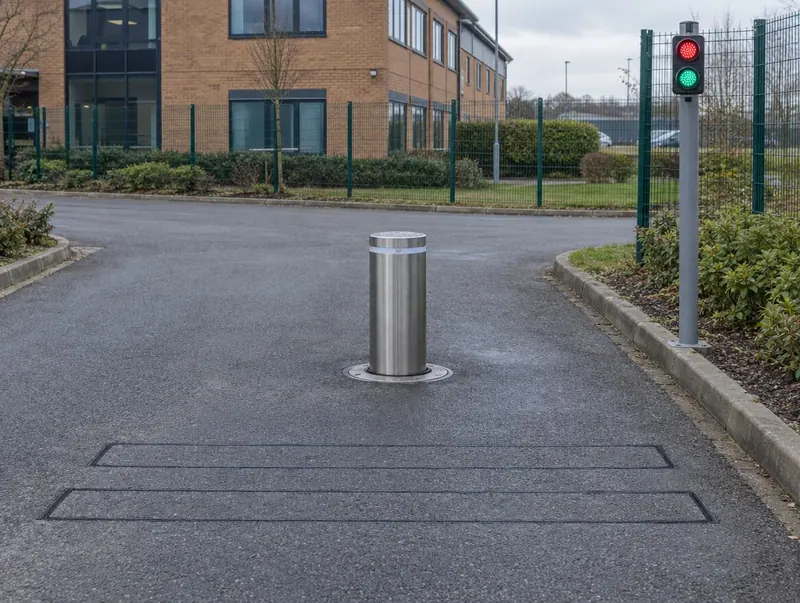 Computer-generated image
Automatic bollards in Kirkcaldy
In the town of Kirkcaldy, automatic bollards tend to go in at schools, small industrial units and filling-station forecourts. Hydraulic and electro-mechanical rising bollards installed with controls, safety loops, signals and power, for managed vehicle access.
We cover Kirkcaldy's KY2, KY1 and KY3 postcode districts, including places such as Auchtertool, Cluny, East Wemyss and Coaltown of Wemyss. We also cover neighbouring Glenrothes (5.4 miles), Cowdenbeath (7.1 miles), Methil (7.1 miles) and Dunfermline (11.9 miles) — distances are straight-line.
Local details
- Area
- Fife, Scotland
- Roads authority
- Fife Council (local roads)
- Planning authority
- Fife Council
- Postcodes
- KY2, KY1 and KY3
- Guide price
- Typically £2,995–£14,995 per bollard + VAT
- Survey
- Free, with a fixed written quote
- Nearby
- Glenrothes (5.4 mi), Cowdenbeath (7.1 mi), Methil (7.1 mi), Dunfermline (11.9 mi)
Guide prices for Kirkcaldy
| Specification | Guide price | Includes |
|---|---|---|
| Standard | £2,995–£8,045 + VAT | Electro-mechanical or entry hydraulic, controls, loops and photocell |
| Upgraded | £6,595–£11,595 + VAT | Heavy-duty hydraulic, traffic light, signs and LED head |
| Premium | £10,195–£14,995 + VAT | High-cycle or crash-rated automatic bollard |
Per bollard, installed with controls, loops and commissioning; no regional adjustment. Guide only — the fixed price follows a survey.
Automatic bollards in Kirkcaldy: common uses
Around Kirkcaldy, automatic bollards usually solve one of these:
- Pedestrianised streets with permitted delivery windows
- Emergency access routes that must open on demand
- Bus gates and access-only routes where the highway authority agrees
What we check first in Kirkcaldy
For anything on the public footway in Kirkcaldy we check with the roads authority first — Fife Council for local roads, Transport Scotland on trunk routes. Private ground such as a car park or forecourt only needs the owner's go-ahead.
Bollards on private land often need no planning application, but listed buildings and conservation areas are different; the planning service at Fife Council can confirm before anything is ordered.
Without drainage, rainwater and silt collect in the cassette, corrode the mechanism and can freeze around the post in winter. Duct routes cross the carriageway and often the footway, so buried services along those routes must be traced first.
- Prepare a written risk assessment covering pedestrians, cyclists, following vehicles and children, and choose safety devices to match.
- Agree emergency access with the fire and ambulance services, including how they will lower the bollards.
Installation, step by step
Survey and risk assessment
A free site survey covers traffic patterns, who uses the entrance, power, drainage routes and buried services. We draft the safety arrangement from that, and you receive a fixed written quote.
Power and controls
A qualified electrician installs the supply and isolation, and the controller, traffic lights, photocells and access devices are mounted and wired.
Commission and test
Rise and fall times, loop detection, photocells, lights and the manual release are tested with vehicles present. Safety settings are recorded against the risk assessment.
Specification choices
| Option | Detail |
|---|---|
| Unrated or crash-rated | Unrated units control traffic; rated units are tested to IWA 14-1, ISO 22343-1 or PAS 68 for security entrances, with deeper, heavier foundations. |
| Paired or multi-bollard lanes | Several bollards can run from one controller to close a wider entrance, with lane-by-lane control where needed. |
| Heights and diameters | Raised heights are commonly around 500–800 mm for traffic control and taller for security models, with diameters varying by drive and rating. |
What affects the quote
Our Scotland guide prices are a starting point; the survey in Kirkcaldy firms them up. What tends to move them:
- Unrated or crash-rated model and its foundation size
- Number of bollards and lanes controlled
- Surface condition for loops and the extent of reinstatement
Looking after them
Frequency depends on how often the bollard cycles; a busy entrance needs more visits than a rarely used one. Between visits, site staff should keep the head clear of grit and leaves, report slow or noisy movement early and never override safety devices to keep an entrance open.
If posts in Kirkcaldy are later hit or damaged, we can repair or replace them — see bollard repairs.
Automatic bollards in Kirkcaldy: FAQs
Which parts of Kirkcaldy do you cover for automatic bollards?
We cover all of Kirkcaldy (KY2, KY1 and KY3) and the rest of Fife. We also work in Glenrothes, Cowdenbeath and Methil.
Who gives permission for bollards on the pavement in Kirkcaldy?
For anything on the public footway in Kirkcaldy we check with the roads authority first — Fife Council for local roads, Transport Scotland on trunk routes. Private ground such as a car park or forecourt only needs the owner's go-ahead.
What's a typical price for automatic bollards in Kirkcaldy?
In Kirkcaldy, typically £2,995–£14,995 per bollard, installed with controls, loops and commissioning, plus VAT, using our Scotland guide prices. The fixed figure comes in writing after we've seen the site.
Why do automatic bollards need drainage?
The bollard sits in a pit that collects rain and silt. Without a drain, water corrodes the mechanism, short-circuits electrics and can freeze the post in place. A drain connection is part of every automatic installation we carry out.
What happens in a power cut?
That depends on how the system is configured. Traffic bollards are often set to lower or can be lowered with a manual release, so vehicles are not trapped. Security bollards may be set to stay raised, with a procedure for staff to follow.
Automatic bollards near Kirkcaldy
- Glenrothes (5.4 mi)
- Cowdenbeath (7.1 mi)
- Methil (7.1 mi)
- Dunfermline (11.9 mi)
- Rosyth (12.1 mi)
- St Andrews (20.7 mi)