Merseyside · England
Automatic rising bollard installation in Litherland
Local installation of automatic bollards in Litherland — free survey, fixed written price, and posts set to the right spacing for people and vehicles.
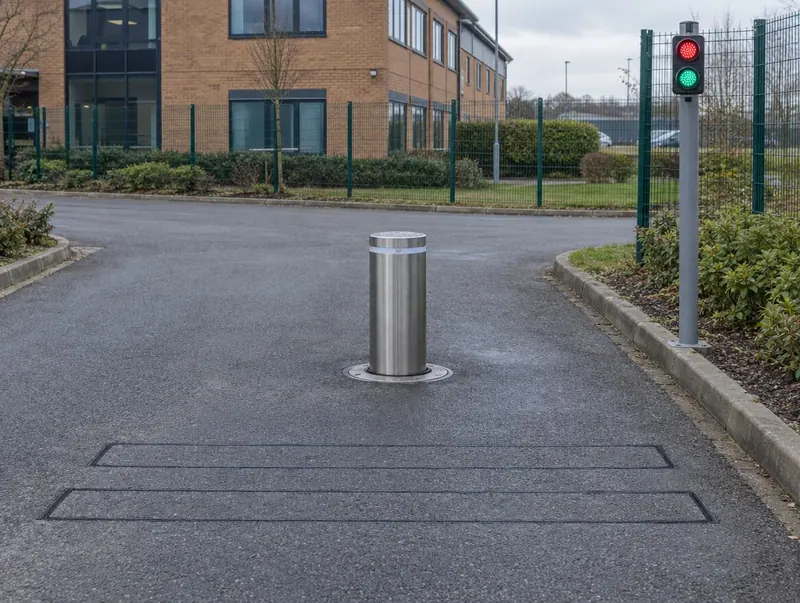 Computer-generated image
Automatic bollards in Litherland
We supply and fit automatic bollards throughout Litherland, typically for sites such as small industrial units, town-centre squares and filling-station forecourts. Hydraulic and electro-mechanical rising bollards installed with controls, safety loops, signals and power, for managed vehicle access.
We work across L21 and L10 — Litherland itself and places including Aintree. We also cover neighbouring Bootle (0.8 miles), Maghull (4 miles), Liverpool (4.2 miles) and Wallasey (4.2 miles) — distances are straight-line. Liverpool is around 4 miles away.
Local details
- Area
- Merseyside, England
- Highway authority
- Sefton Council (local roads)
- Planning authority
- Sefton Council
- Postcodes
- L21 and L10
- Guide price
- Typically £2,945–£14,695 per bollard + VAT
- Survey
- Free, with a fixed written quote
Typical automatic bollards jobs in Litherland
Typical reasons Litherland sites choose automatic bollards:
- Secure loading yards where rated automatic posts are specified
- Private estates and gated developments without a full gate
- Pedestrianised streets with permitted delivery windows
Automatic bollard prices in Litherland
| Specification | Guide price | Includes |
|---|---|---|
| Standard | £2,945–£7,895 + VAT | Electro-mechanical or entry hydraulic, controls, loops and photocell |
| Upgraded | £6,445–£11,395 + VAT | Heavy-duty hydraulic, traffic light, signs and LED head |
| Premium | £9,995–£14,695 + VAT | High-cycle or crash-rated automatic bollard |
Per bollard, installed with controls, loops and commissioning; -2% for North West. Guide only — the fixed price follows a survey.
Before we dig in Litherland
The highway authority for local roads in Litherland is Sefton Council; motorways and trunk roads sit with National Highways. Automatic bollards on the adopted footway are a matter for the highway authority, so we only install there with its written agreement.
Bollards on private land often don't need planning permission, but it depends on the council's view, the height and the location; in a conservation area, next to a listed building or under an Article 4 direction, ask the local planning authority (Sefton Council) first — we flag this at survey.
Without drainage, rainwater and silt collect in the cassette, corrode the mechanism and can freeze around the post in winter. Loops are cut into a sound surface: badly cracked tarmac or block paving may need resurfacing first, because loops in broken surfaces fail early.
- For rated units, keep the test certificate and confirm the foundation matches the tested design.
- Have the electrical installation carried out and certified by a qualified electrician to BS 7671.
What happens on site
Survey and risk assessment
A free site survey covers traffic patterns, who uses the entrance, power, drainage routes and buried services. We draft the safety arrangement from that, and you receive a fixed written quote.
Power and controls
A qualified electrician installs the supply and isolation, and the controller, traffic lights, photocells and access devices are mounted and wired.
Commission and test
Rise and fall times, loop detection, photocells, lights and the manual release are tested with vehicles present. Safety settings are recorded against the risk assessment.
Options to consider
| Option | Detail |
|---|---|
| Heights and diameters | Raised heights are commonly around 500–800 mm for traffic control and taller for security models, with diameters varying by drive and rating. |
| Head lighting and finishes | LED rings or lights in the head, reflective bands, and powder-coated or stainless finishes. Lit heads help drivers see the post when it is raised. |
| Hydraulic drive | Integral or remote power pack. Suits high-frequency entrances and heavier rated units, with periodic checks on fluid, seals and hoses. |
What affects the quote
When we price automatic bollards in Litherland, these make the biggest difference:
- Access control devices, traffic lights and signage
- Hydraulic or electro-mechanical drive and the duty cycle needed
- Traffic management during installation on live roads
After installation
Typical visits clean and inspect the cassette and drain, check hydraulic fluid or gearbox condition, test loops, photocells, lights and the manual release, and read the controller's fault log. Between visits, site staff should keep the head clear of grit and leaves, report slow or noisy movement early and never override safety devices to keep an entrance open.
For damaged or loose posts in Litherland, repairs and replacements are priced in writing first.
Questions about automatic bollards in Litherland
Which parts of Litherland do you cover for automatic bollards?
We cover all of Litherland (L21 and L10) and the rest of Merseyside. We also work in Bootle, Maghull and Liverpool.
Who gives permission for bollards on the pavement in Litherland?
Sefton Council is the highway authority covering Litherland's local roads. If any post would stand on adopted highway rather than your land, that consent is the first thing we sort out.
What's a typical price for automatic bollards in Litherland?
In Litherland, typically £2,945–£14,695 per bollard, installed with controls, loops and commissioning, plus VAT, using our North West guide prices. The fixed figure comes in writing after we've seen the site.
How will emergency vehicles get through?
Usually by an agreed method such as a fire service key switch, a code, a remote handset held by the site or a free-exit arrangement. It should be agreed with the emergency services before the bollards go live.
What happens in a power cut?
That depends on how the system is configured. Traffic bollards are often set to lower or can be lowered with a manual release, so vehicles are not trapped. Security bollards may be set to stay raised, with a procedure for staff to follow.