Merseyside · England
Automatic rising bollard installation in Prescot
Automatic bollards supplied and fitted in Prescot, Merseyside: surveyed, scanned for services, set in proper foundations and finished to match the ground.
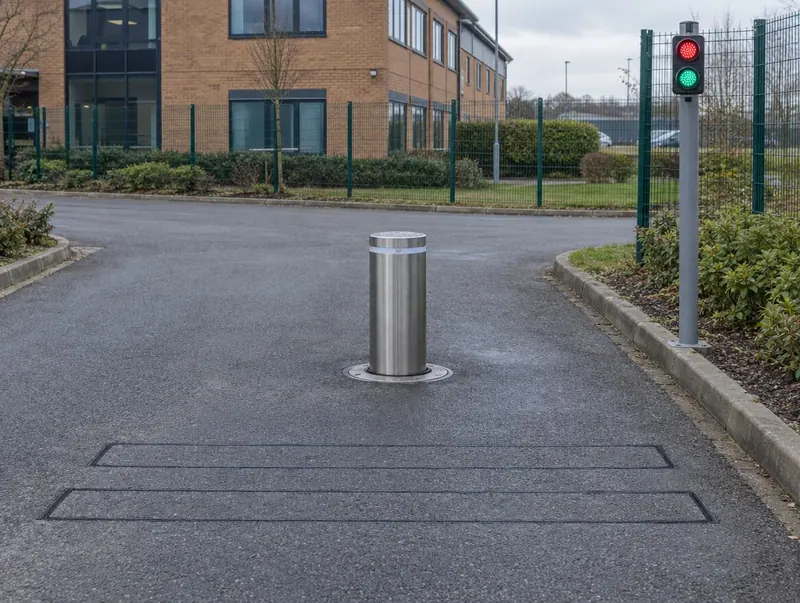 Computer-generated image
Automatic bollards in Prescot
Across Prescot, typical sites for automatic bollards include high street shopfronts, small industrial units and community car parks. Automatic bollards are available unrated for traffic control or crash-tested for security entrances.
We cover Prescot's L34 and L35 postcode districts, including places such as Huyton with Roby and Tarbock Green. Nearby, we also work in Huyton (2 miles), St Helens (3.1 miles), Halewood (5 miles) and Kirkby (5.2 miles), measured as the crow flies. Prescot is about 7 miles from Liverpool.
Prescot at a glance
- Area
- Merseyside, England
- Highway authority
- Knowsley Council (local roads)
- Planning authority
- Knowsley Council
- Postcodes
- L34 and L35
- Guide price
- Typically £2,945–£14,695 per bollard + VAT
- Survey
- Free, with a fixed written quote
Typical automatic bollards jobs in Prescot
Typical reasons Prescot sites choose automatic bollards:
- Business parks and campus roads with controlled vehicle access
- Emergency access routes that must open on demand
- Private estates and gated developments without a full gate
Prescot: typical automatic bollard prices
| Specification | Guide price | Includes |
|---|---|---|
| Standard | £2,945–£7,895 + VAT | Electro-mechanical or entry hydraulic, controls, loops and photocell |
| Upgraded | £6,445–£11,395 + VAT | Heavy-duty hydraulic, traffic light, signs and LED head |
| Premium | £9,995–£14,695 + VAT | High-cycle or crash-rated automatic bollard |
Per bollard, installed with controls, loops and commissioning; -2% for North West. Guide only — the fixed price follows a survey.
Before we dig in Prescot
Knowsley Council is the highway authority covering Prescot's local roads. If any post would stand on adopted highway rather than your land, that consent is the first thing we sort out.
If your site in Prescot is listed or inside a conservation area, check with the local planning authority (Knowsley Council) before choosing a finish — heritage settings often favour cast iron or painted steel over stainless.
Duct routes cross the carriageway and often the footway, so buried services along those routes must be traced first. Automatic bollards need a deep pit for the cassette and a reliable way for water to leave it.
- Agree emergency access with the fire and ambulance services, including how they will lower the bollards.
- On public highway, rising bollards normally need highway authority approval, with signs and signals to their requirements.
From survey to handover
Excavate and set cassettes
Each cassette pit is excavated to the manufacturer's depth, with the base prepared to drain. Cassettes are set to finished road level and fall, then concreted in.
Ducts, drainage and loops
Ducts are laid between the bollards, the controller cabinet and access devices, with draw pits where runs change direction. The drain is connected and the safety and exit loops are cut into the surface and sealed.
Commission and test
Rise and fall times, loop detection, photocells, lights and the manual release are tested with vehicles present. Safety settings are recorded against the risk assessment.
Finishes and options
| Option | Detail |
|---|---|
| Paired or multi-bollard lanes | Several bollards can run from one controller to close a wider entrance, with lane-by-lane control where needed. |
| Electro-mechanical drive | Motor and gearbox inside the bollard with no hydraulic fluid. Often simpler to service, with duty cycles that suit moderate traffic. |
| Head lighting and finishes | LED rings or lights in the head, reflective bands, and powder-coated or stainless finishes. Lit heads help drivers see the post when it is raised. |
What moves the price in Prescot
Our North West guide prices are a starting point; the survey in Prescot firms them up. What tends to move them:
- Hydraulic or electro-mechanical drive and the duty cycle needed
- Length of duct runs, drainage connections and power supply distance
- Traffic management during installation on live roads
Keeping them working
Automatic bollards need planned servicing, not just repair when they fail. Between visits, site staff should keep the head clear of grit and leaves, report slow or noisy movement early and never override safety devices to keep an entrance open.
We can also service, repair or replace existing posts anywhere in Prescot.
Common questions
Which parts of Prescot do you cover for automatic bollards?
We cover all of Prescot (L34 and L35) and the rest of Merseyside. We also work in Huyton, St Helens and Halewood.
Do I need consent for automatic bollards on a public footway in Prescot?
The highway authority for local roads in Prescot is Knowsley Council; motorways and trunk roads sit with National Highways. Automatic bollards on the adopted footway are a matter for the highway authority, so we only install there with its written agreement.
What's a typical price for automatic bollards in Prescot?
In Prescot, typically £2,945–£14,695 per bollard, installed with controls, loops and commissioning, plus VAT, using our North West guide prices. The fixed figure comes in writing after we've seen the site.
Why do automatic bollards need drainage?
The bollard sits in a pit that collects rain and silt. Without a drain, water corrodes the mechanism, short-circuits electrics and can freeze the post in place. A drain connection is part of every automatic installation we carry out.
How will emergency vehicles get through?
Usually by an agreed method such as a fire service key switch, a code, a remote handset held by the site or a free-exit arrangement. It should be agreed with the emergency services before the bollards go live.