Nottinghamshire · England
Automatic rising bollard installation in Worksop
Local installation of automatic bollards in Worksop — free survey, fixed written price, and posts set to the right spacing for people and vehicles.
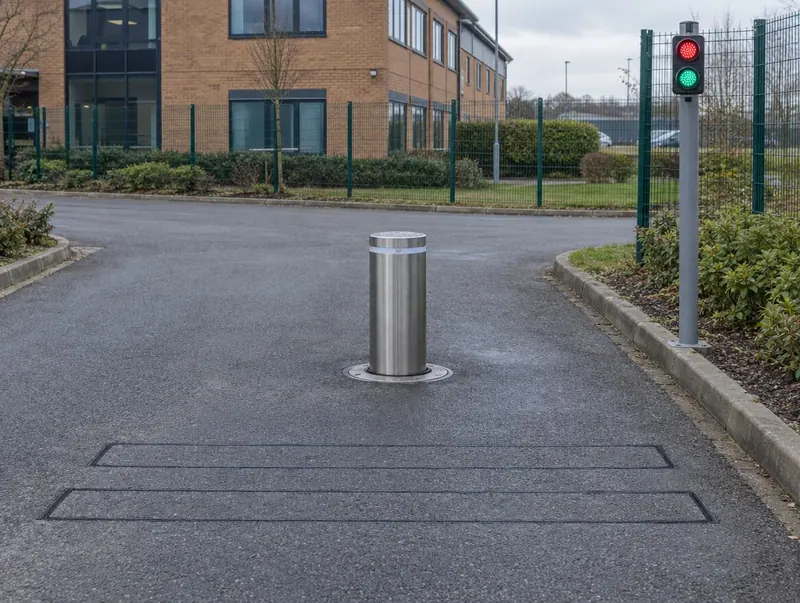 Computer-generated image
Worksop automatic bollards
In the town of Worksop, automatic bollards tend to go in at high street shopfronts, community car parks and schools. Hydraulic and electro-mechanical rising bollards installed with controls, safety loops, signals and power, for managed vehicle access.
We work across S80 and S81 — Worksop itself and places including Rhodesia, Carburton, Carlton in Lindrick and Shireoaks. Nearby, we also work in Retford (7.6 miles), Staveley (9.6 miles), Mansfield (12.1 miles) and Chesterfield (12.6 miles), measured as the crow flies. It sits roughly 15 miles from Sheffield as the crow flies.
Local details
- Area
- Nottinghamshire, England
- Highway authority
- Nottinghamshire County Council (local roads)
- Planning authority
- the council for Bassetlaw
- Postcodes
- S80 and S81
- Guide price
- Typically £2,895–£14,595 per bollard + VAT
- Survey
- Free, with a fixed written quote
- Nearby
- Retford (7.6 mi), Staveley (9.6 mi), Mansfield (12.1 mi), Chesterfield (12.6 mi)
Guide prices for Worksop
| Specification | Guide price | Includes |
|---|---|---|
| Standard | £2,895–£7,795 + VAT | Electro-mechanical or entry hydraulic, controls, loops and photocell |
| Upgraded | £6,395–£11,295 + VAT | Heavy-duty hydraulic, traffic light, signs and LED head |
| Premium | £9,895–£14,595 + VAT | High-cycle or crash-rated automatic bollard |
Per bollard, installed with controls, loops and commissioning; -3% for Yorkshire and the Humber. Guide only — the fixed price follows a survey.
Automatic bollards in Worksop: common uses
Typical reasons Worksop sites choose automatic bollards:
- Business parks and campus roads with controlled vehicle access
- Private estates and gated developments without a full gate
- Bus gates and access-only routes where the highway authority agrees
Consents, ground and services in Worksop
The highway authority for local roads in Worksop is Nottinghamshire County Council; motorways and trunk roads sit with National Highways. Automatic bollards on the adopted footway are a matter for the highway authority, so we only install there with its written agreement.
Bollards on private land often don't need planning permission, but it depends on the council's view, the height and the location; in a conservation area, next to a listed building or under an Article 4 direction, ask the local planning authority (the council for Bassetlaw) first — we flag this at survey.
The pit base is usually connected to a surface water drain or a soakaway, and on clay or high water table sites that connection needs particular attention. Loops are cut into a sound surface: badly cracked tarmac or block paving may need resurfacing first, because loops in broken surfaces fail early.
- On public highway, rising bollards normally need highway authority approval, with signs and signals to their requirements.
- Agree emergency access with the fire and ambulance services, including how they will lower the bollards.
What happens on site
Excavate and set cassettes
Each cassette pit is excavated to the manufacturer's depth, with the base prepared to drain. Cassettes are set to finished road level and fall, then concreted in.
Ducts, drainage and loops
Ducts are laid between the bollards, the controller cabinet and access devices, with draw pits where runs change direction. The drain is connected and the safety and exit loops are cut into the surface and sealed.
Power and controls
A qualified electrician installs the supply and isolation, and the controller, traffic lights, photocells and access devices are mounted and wired.
Specification choices
| Option | Detail |
|---|---|
| Heights and diameters | Raised heights are commonly around 500–800 mm for traffic control and taller for security models, with diameters varying by drive and rating. |
| Unrated or crash-rated | Unrated units control traffic; rated units are tested to IWA 14-1, ISO 22343-1 or PAS 68 for security entrances, with deeper, heavier foundations. |
| Paired or multi-bollard lanes | Several bollards can run from one controller to close a wider entrance, with lane-by-lane control where needed. |
What affects the quote
When we price automatic bollards in Worksop, these make the biggest difference:
- Traffic management during installation on live roads
- Number of bollards and lanes controlled
- Access control devices, traffic lights and signage
Looking after them
Typical visits clean and inspect the cassette and drain, check hydraulic fluid or gearbox condition, test loops, photocells, lights and the manual release, and read the controller's fault log. Automatic bollards need planned servicing, not just repair when they fail.
For damaged or loose posts in Worksop, repairs and replacements are priced in writing first.
Common questions
Which parts of Worksop do you cover for automatic bollards?
We cover all of Worksop (S80 and S81) and the rest of Nottinghamshire. We also work in Retford, Staveley and Mansfield.
Who gives permission for bollards on the pavement in Worksop?
The highway authority for local roads in Worksop is Nottinghamshire County Council; motorways and trunk roads sit with National Highways. Automatic bollards on the adopted footway are a matter for the highway authority, so we only install there with its written agreement.
How much do automatic bollards cost in Worksop?
In Worksop, typically £2,895–£14,595 per bollard, installed with controls, loops and commissioning, plus VAT, using our Yorkshire and the Humber guide prices. The fixed figure comes in writing after we've seen the site.
Why do automatic bollards need drainage?
The bollard sits in a pit that collects rain and silt. Without a drain, water corrodes the mechanism, short-circuits electrics and can freeze the post in place. A drain connection is part of every automatic installation we carry out.
What stops a rising bollard hitting a car?
A safety loop in the road detects a vehicle above or close to the bollard and blocks the rise, backed up by photocells. Traffic lights and head lights tell drivers when to stop. The settings are tested on site with vehicles before handover.
Automatic bollards in nearby towns
- Retford (7.6 mi)
- Staveley (9.6 mi)
- Mansfield (12.1 mi)
- Chesterfield (12.6 mi)
- Rotherham (13.1 mi)
- Sutton-in-Ashfield (13.4 mi)