Angus · Scotland
Access control for automatic bollards in Carnoustie
Bollard access control systems for sites across Carnoustie and the rest of Angus, from the first measurement to the last relaid paving block.
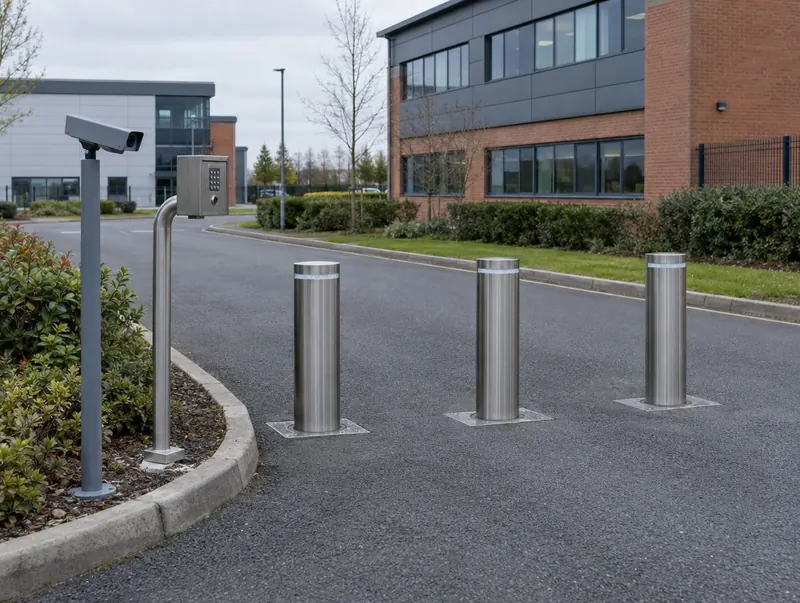 Computer-generated image
Carnoustie bollard access control systems
ANPR, fob, keypad, intercom and remote control systems that decide who can lower an automatic bollard, and when. In Carnoustie, that tends to mean sites such as community car parks, schools and small industrial units.
We work across DD7 — Carnoustie itself and places including East Haven. Nearby, we also work in Arbroath (6.1 miles), Dundee (10.5 miles), St Andrews (11.9 miles) and Forfar (12 miles), measured as the crow flies.
Key facts for this area
- Area
- Angus, Scotland
- Roads authority
- Angus Council (local roads)
- Planning authority
- Angus Council
- Postcodes
- DD7
- Guide price
- Typically £595–£11,995 per entrance + VAT
- Survey
- Free, with a fixed written quote
- Nearby
- Arbroath (6.1 mi), Dundee (10.5 mi), St Andrews (11.9 mi), Forfar (12 mi)
What bollard access control systems cost in Carnoustie
| Specification | Guide price | Includes |
|---|---|---|
| Standard | £595–£5,395 + VAT | Remote fobs or a standalone keypad |
| Upgraded | £3,995–£8,795 + VAT | GSM intercom with keypad on a post |
| Premium | £7,445–£11,995 + VAT | ANPR camera, software and integration |
Per entrance, controls supplied, installed and commissioned; no regional adjustment. Guide only — the fixed price follows a survey.
Bollard access control systems in Carnoustie: common uses
Around Carnoustie, bollard access control systems usually solve one of these:
- Pedestrianised zones with permitted delivery and blue badge access
- Residential estates and mews with controlled vehicle access
- Business parks and campuses with large numbers of staff vehicles
Permissions and groundwork in Carnoustie
Carnoustie falls under Angus Council as roads authority. If the line of posts crosses onto adopted road or pavement, permission comes before excavation; on private land it does not.
Bollards on private land often need no planning application, but listed buildings and conservation areas are different; the planning service at Angus Council can confirm before anything is ordered.
Where existing bollards are being upgraded, old cables and ducts are tested before being reused. Exit and safety loops must be cut into sound tarmac or concrete; cracked or patched surfaces cause loop faults, so poor areas are resurfaced first.
- Agree emergency access with the fire and ambulance services and test the override.
- Have power and data installations certified by a qualified electrician to BS 7671.
Installation, step by step
Understand the users
At the free site survey we ask who uses the entrance, how many, how often they change, and how visitors and deliveries arrive. That decides the entry method, and a fixed written quote follows.
Wire and connect
A qualified electrician installs power, and devices are connected to the bollard controller and to any network or building system.
Programme and test
Users, plates, codes and schedules are entered, and every entry and exit route is tested with vehicles, including what happens when access is refused.
Choosing the right spec
| Option | Detail |
|---|---|
| Exit loops and timers | Loops lower the bollard for vehicles leaving; timers hold it down during set windows. |
| Remote handsets and app control | Handsets for small user groups; app control for sites that want to add and remove users from a phone. |
| GSM and video intercoms | Visitors call a person or phone, who opens remotely. Video models let the person answering see who is at the entrance. |
What moves the price in Carnoustie
Two Carnoustie jobs with the same number of posts can price quite differently. The usual reasons:
- Network or GSM connectivity at the entrance
- Number of users and how they will be managed
- Integration with existing access control or fire systems
Looking after them
Remove users, fobs and plates when people leave, change keypad codes periodically and check that intercom phone numbers are still current. Clean camera lenses and reader faces, check pedestal fixings and look for damage from vehicles.
For damaged or loose posts in Carnoustie, repairs and replacements are priced in writing first.
Bollard access control in Carnoustie: FAQs
Which parts of Carnoustie do you cover for bollard access control systems?
We cover all of Carnoustie (DD7) and the rest of Angus. We also work in Arbroath, Dundee and St Andrews.
Do I need consent for bollards on a public footway in Carnoustie?
In Scotland the council is the roads authority for local roads, which in Carnoustie means Angus Council. Bollards on an adopted footway need its consent; trunk roads sit with Transport Scotland.
What's a typical price for bollard access control systems in Carnoustie?
In Carnoustie, typically £595–£11,995 per entrance, controls supplied, installed and commissioned, plus VAT, using our Scotland guide prices. The fixed figure comes in writing after we've seen the site.
Will vehicles leaving get trapped?
Not if exit detection is fitted. An exit loop in the road lowers the bollard automatically as a vehicle approaches from inside. On some sites a push button or exit reader is used instead.
Is ANPR or fob access better for an automatic bollard?
ANPR suits sites with many regular users who should not have to stop or carry a fob. Fobs suit sites where users change vehicles or where you want each person to have their own credential. Many sites use ANPR for staff and an intercom for visitors.