Essex · England
Bollard removal in South Benfleet
Bollard removal jobs for sites across South Benfleet and the rest of Essex, from the first measurement to the last relaid paving block.
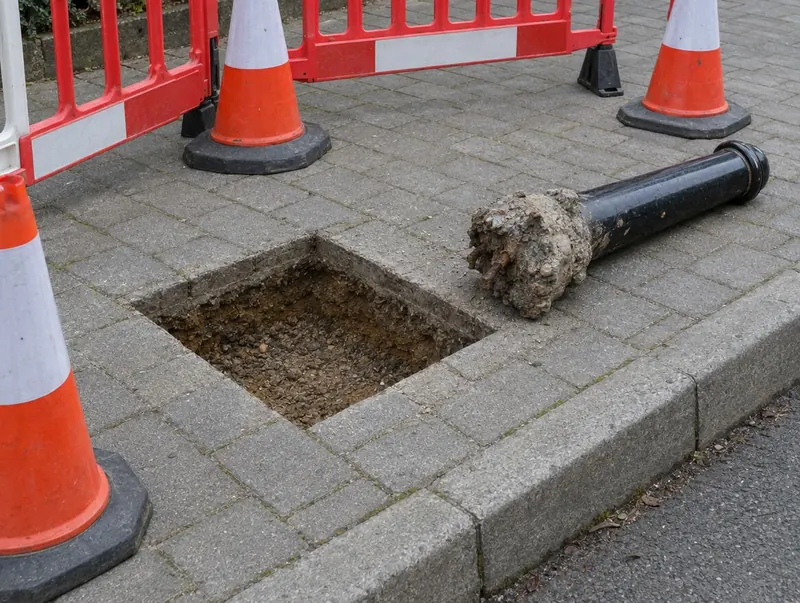 Computer-generated image
About bollard removal jobs in South Benfleet
Bollard removal jobs suit plenty of South Benfleet sites, small industrial units, high street shopfronts and residential driveways among them. Posts can be cut off at or below ground level or fully extracted with their concrete.
Coverage in South Benfleet takes in the SS7 postcode district and nearby places like Thundersley, Daws Heath and Tarpots. We also cover neighbouring Canvey Island (2.3 miles), Pitsea (2.3 miles), Rayleigh (3 miles) and Wickford (4.3 miles) — distances are straight-line. South Benfleet is about 7 miles from Southend-on-Sea.
Local details
- Area
- Essex, England
- Highway authority
- Essex County Council (local roads)
- Planning authority
- the council for Castle Point
- Postcodes
- SS7
- Guide price
- Typically £80–£355 per post + VAT (£95–£425 inc VAT for homes); minimum job £295
- Survey
- Free, with a fixed written quote
- Nearby
- Canvey Island (2.3 mi), Pitsea (2.3 mi), Rayleigh (3 mi), Wickford (4.3 mi)
What bollard removal jobs cost in South Benfleet
| Specification | Guide price | Includes |
|---|---|---|
| Standard | £80–£195 + VAT · £95–£225 inc VAT | Post out, hole backfilled, simple surface |
| Upgraded | £165–£275 + VAT · £195–£325 inc VAT | Footing removed, tarmac or block paving reinstated |
| Premium | £245–£355 + VAT · £285–£425 inc VAT | Large footing, concrete or natural stone reinstated |
Per post removed with footing, surface made good; +3% for East of England. Guide only — the fixed price follows a survey.
Common reasons for bollard removal jobs in South Benfleet
What bollard removal jobs usually sort out in South Benfleet:
- Access routes no longer needing control
- Taking out broken stubs and empty sockets
- Car park and forecourt redesigns
Before we dig in South Benfleet
In South Benfleet, work on adopted pavements and verges needs consent from Essex County Council, the local highway authority. Car parks, forecourts and other private land only need the owner's permission.
Bollards on private land often don't need planning permission, but it depends on the council's view, the height and the location; in a conservation area, next to a listed building or under an Article 4 direction, ask the local planning authority (the council for Castle Point) first — we flag this at survey.
Cables and pipes are often laid close to existing posts after they were installed, so breaking out is done carefully and services are traced first. Where the area is being resurfaced anyway, removal is timed to happen first so the patching disappears under the new surface.
- Check whether the bollards were required by a planning condition, lease, security plan or the highway authority before removing them.
- In conservation areas, check before removing historic bollards, as consent may be needed or retention expected.
How the job runs
Survey what is in the ground
The free site survey identifies bollard types, likely foundation sizes, any power or ducts, and what the area will be used for next. You receive a fixed written quote for the agreed level of removal.
Make supplies safe
For automatic and lighting bollards, a qualified electrician isolates and disconnects the supply, and hydraulic units are drained.
Remove posts and foundations
Posts are cut off or extracted, foundations broken out where agreed, and sockets, cassettes and ducts removed or capped.
Specification choices
| Option | Detail |
|---|---|
| Full extraction | Post and foundation broken out, leaving clear ground for resurfacing or new works. |
| Automatic bollard decommissioning | Electrical isolation, hydraulic drain-down, cassette removal and capping of ducts. |
| Cut off below surface | Post removed at or below finished level, foundation left in place and the surface patched. Quick and low-disruption. |
What moves the price in South Benfleet
Two South Benfleet jobs with the same number of posts can price quite differently. The usual reasons:
- Electrical isolation and hydraulic drain-down
- Access, working hours and waste disposal
- Number and type of bollards
Keeping them working
Keep any keys, manuals and records from removed automatic bollards until the controller and cabling have also been dealt with, as they help an electrician confirm what was connected. After removal, keep an eye on reinstated areas for settlement over the following months, particularly where large foundations were broken out.
We can also service, repair or replace existing posts anywhere in South Benfleet.
Questions about bollard removal jobs in South Benfleet
Can you carry out bollard removal jobs anywhere in South Benfleet?
We cover all of South Benfleet (SS7) and the rest of Essex. We also work in Canvey Island, Pitsea and Rayleigh.
Who gives permission for bollards on the pavement in South Benfleet?
In South Benfleet, work on adopted pavements and verges needs consent from Essex County Council, the local highway authority. Car parks, forecourts and other private land only need the owner's permission.
What's a typical price for bollard removal jobs in South Benfleet?
In South Benfleet, typically £80–£355 per post removed with footing, surface made good, plus VAT (£95–£425 including VAT for homeowners), with a minimum job of £295 plus VAT, using our East of England guide prices. The fixed figure comes in writing after we've seen the site.
Can removed bollards be reused elsewhere on site?
Often, if they come out undamaged. Steel posts and removable bollards relocate well. New foundations are formed at the new positions.
Will the surface look patched after removal?
On block paving it can be nearly invisible, as the blocks are relaid. Tarmac, resin and concrete usually show a patch, especially on older weathered surfaces. Timing removal before resurfacing avoids that.
Bollard removal near South Benfleet
- Canvey Island (2.3 mi)
- Pitsea (2.3 mi)
- Rayleigh (3 mi)
- Wickford (4.3 mi)
- Basildon (4.5 mi)
- Stanford-le-Hope (5.8 mi)