Rhondda Cynon Taf · Wales
Bollard removal in Rhondda
Planning bollard removal jobs in Rhondda? We check ownership, consents and buried services first, then quote a fixed price.
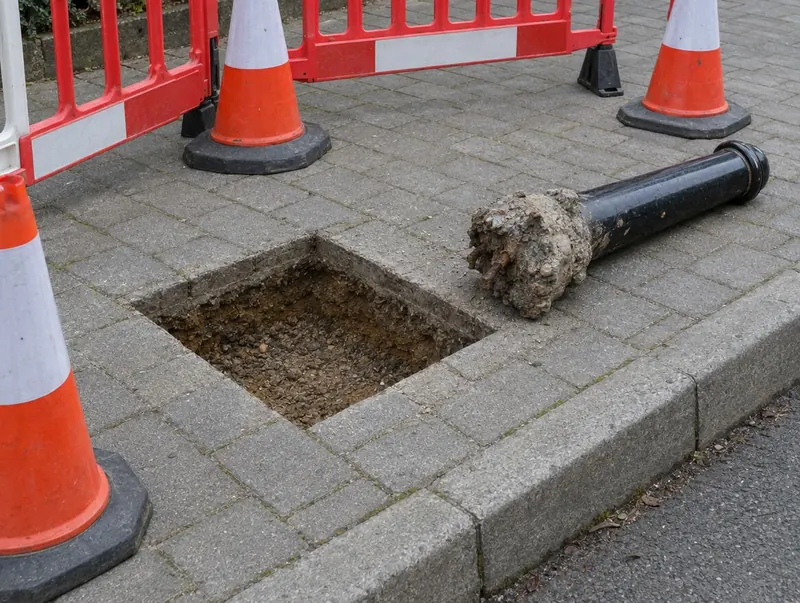 Computer-generated image
Bollard removal in Rhondda
Posts can be cut off at or below ground level or fully extracted with their concrete. In Rhondda, that tends to mean sites such as residential driveways, community car parks and schools.
We cover Rhondda's CF41, CF43, CF40 and CF42 postcode districts, including places such as Ferndale, Maerdy, Tylorstown and Pontygwaith. Jobs in Rhondda can be combined with work in Mountain Ash (3.4 miles), Aberdare (3.8 miles), Pontypridd (6 miles) and Treharris (6.1 miles) (straight-line distances). Rhondda is about 17 miles from Cardiff.
Key facts for this area
- Area
- Rhondda Cynon Taf, Wales
- Highway authority
- Rhondda Cynon Taf County Borough Council (local roads)
- Planning authority
- Rhondda Cynon Taf County Borough Council
- Postcodes
- CF41, CF43, CF40 and CF42
- Guide price
- Typically £80–£335 per post + VAT (£95–£395 inc VAT for homes); minimum job £285
- Survey
- Free, with a fixed written quote
- Nearby
- Mountain Ash (3.4 mi), Aberdare (3.8 mi), Pontypridd (6 mi), Treharris (6.1 mi)
Bollard removal prices in Rhondda
| Specification | Guide price | Includes |
|---|---|---|
| Standard | £80–£185 + VAT · £95–£215 inc VAT | Post out, hole backfilled, simple surface |
| Upgraded | £155–£265 + VAT · £185–£315 inc VAT | Footing removed, tarmac or block paving reinstated |
| Premium | £225–£335 + VAT · £265–£395 inc VAT | Large footing, concrete or natural stone reinstated |
Per post removed with footing, surface made good; -3% for Wales. Guide only — the fixed price follows a survey.
Common reasons for bollard removal jobs in Rhondda
Typical reasons for bollard removal jobs in Rhondda:
- Clearing old bollards before resurfacing
- Decommissioning automatic bollards that are no longer used
- Moving bollards to new positions on the same site
Permissions and groundwork in Rhondda
Before digging near the kerb in Rhondda we establish who owns the ground: adopted footways are Rhondda Cynon Taf County Borough Council's responsibility, trunk roads the Welsh Government's, and everything else belongs to the site owner.
Many private-land installations in Rhondda need no planning application, but the rules don't clearly cover bollards, so listed buildings, conservation areas and prominent frontages are worth raising with the planning team at Rhondda Cynon Taf County Borough Council before posts go in.
Backfilling in compacted layers stops later settlement, which otherwise shows as a dip in the new surface. Older bollards may sit in large blocks of concrete, and rated bollards in very large reinforced bases, so full extraction can mean substantial breaking out and spoil removal.
- In conservation areas, check before removing historic bollards, as consent may be needed or retention expected.
- Consider whether removal leaves an asset or route unprotected and record the decision in your risk assessment.
How the job runs
Survey what is in the ground
The free site survey identifies bollard types, likely foundation sizes, any power or ducts, and what the area will be used for next. You receive a fixed written quote for the agreed level of removal.
Make supplies safe
For automatic and lighting bollards, a qualified electrician isolates and disconnects the supply, and hydraulic units are drained.
Remove posts and foundations
Posts are cut off or extracted, foundations broken out where agreed, and sockets, cassettes and ducts removed or capped.
Finishes and options
| Option | Detail |
|---|---|
| Full extraction | Post and foundation broken out, leaving clear ground for resurfacing or new works. |
| Socket and cassette removal | Removable sockets and telescopic or semi-automatic cassettes extracted whole and the hole filled. |
| Automatic bollard decommissioning | Electrical isolation, hydraulic drain-down, cassette removal and capping of ducts. |
Pricing bollard removal jobs in Rhondda
Our Wales guide prices are a starting point; the survey in Rhondda firms them up. What tends to move them:
- Electrical isolation and hydraulic drain-down
- Size of foundations and amount of spoil
- Number and type of bollards
Looking after them
If foundations were left in place, record their positions on site drawings so future contractors are not surprised by buried concrete. After removal, keep an eye on reinstated areas for settlement over the following months, particularly where large foundations were broken out.
For damaged or loose posts in Rhondda, repairs and replacements are priced in writing first.
Bollard removal in Rhondda: FAQs
Which parts of Rhondda do you cover for bollard removal jobs?
We cover all of Rhondda (CF41, CF43, CF40 and CF42) and the rest of Rhondda Cynon Taf. We also work in Mountain Ash, Aberdare and Pontypridd.
Who gives permission for bollards on the pavement in Rhondda?
Before digging near the kerb in Rhondda we establish who owns the ground: adopted footways are Rhondda Cynon Taf County Borough Council's responsibility, trunk roads the Welsh Government's, and everything else belongs to the site owner.
How much do bollard removal jobs cost in Rhondda?
In Rhondda, typically £80–£335 per post removed with footing, surface made good, plus VAT (£95–£395 including VAT for homeowners), with a minimum job of £285 plus VAT, using our Wales guide prices. The fixed figure comes in writing after we've seen the site.
Can removed bollards be reused elsewhere on site?
Often, if they come out undamaged. Steel posts and removable bollards relocate well. New foundations are formed at the new positions.
What happens to the waste?
Steel and iron are recycled where possible, concrete and spoil are taken away, and hydraulic fluid is disposed of properly. You are left with a clean, reinstated area.
Bollard removal in nearby towns
- Mountain Ash (3.4 mi)
- Aberdare (3.8 mi)
- Pontypridd (6 mi)
- Treharris (6.1 mi)
- Merthyr Tydfil (6.9 mi)
- Llantrisant (8.8 mi)