Cambridgeshire · England
Bollard replacement in March
Local installation of replacement bollards in March — free survey, fixed written price, and posts set to the right spacing for people and vehicles.
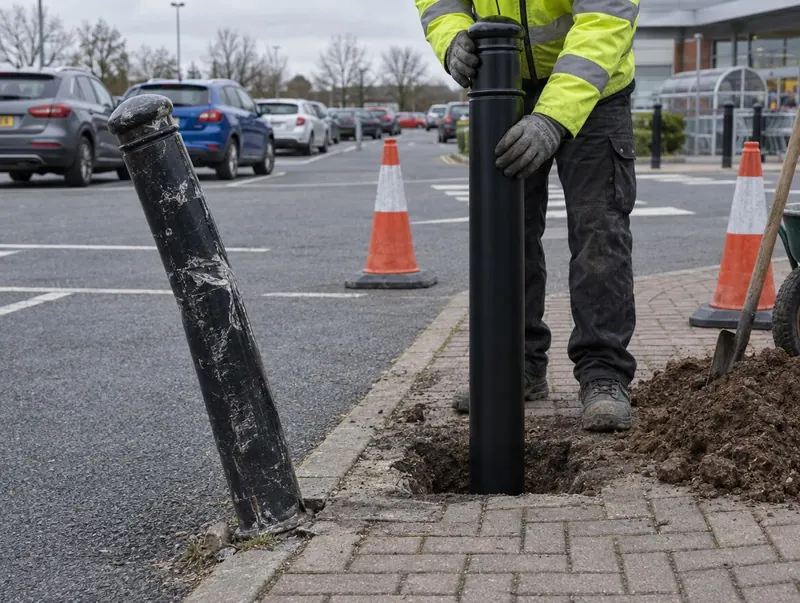 Computer-generated image
March replacement bollards
We supply and fit replacement bollards throughout March, typically for sites such as high street shopfronts, filling-station forecourts and community car parks. Replacement is the right answer when a post is too damaged to repair or no longer suits how the site is used.
We work across PE15 — March itself and places including Doddington, Manea, Wimblington and Benwick. Nearby, we also work in Wisbech (8.5 miles), Ely (12.8 miles), Peterborough (14.2 miles) and King's Lynn (18.9 miles), measured as the crow flies.
Local details
- Area
- Cambridgeshire, England
- Highway authority
- Cambridgeshire County Council (local roads)
- Planning authority
- the council for Fenland
- Postcodes
- PE15
- Guide price
- Typically £225–£1,245 per post + VAT (£265–£1,495 inc VAT for homes); minimum job £455
- Survey
- Free, with a fixed written quote
- Nearby
- Wisbech (8.5 mi), Ely (12.8 mi), Peterborough (14.2 mi), King's Lynn (18.9 mi)
Guide prices for March
| Specification | Guide price | Includes |
|---|---|---|
| Standard | £225–£645 + VAT · £265–£765 inc VAT | Standard post, foundation, reinstatement |
| Upgraded | £525–£945 + VAT · £625–£1,145 inc VAT | Upgraded finish or fittings, reflective band, matched keys |
| Premium | £825–£1,245 + VAT · £985–£1,495 inc VAT | Heavy-duty or architectural spec, premium finish |
Per post replaced, old post and footing removed; +3% for East of England. Guide only — the fixed price follows a survey.
Why March sites book replacement bollards
Why sites in March book replacement bollards:
- Posts bent, sheared or broken by vehicle impacts
- Cracked cast iron or chipped concrete bollards
- Corroded steel posts at the end of their life
Permissions and groundwork in March
In March, work on adopted pavements and verges needs consent from Cambridgeshire County Council, the local highway authority. Car parks, forecourts and other private land only need the owner's permission.
If your site in March is listed or inside a conservation area, check with the local planning authority (the council for Fenland) before choosing a finish — heritage settings often favour cast iron or painted steel over stainless.
Upgrades to rated products usually need a completely new, larger foundation. Removing an old bollard often reveals more concrete than expected, because foundations from different eras vary widely in size.
- Where bollards were required by a planning condition, a security plan or a lease, check that any change of type still meets that requirement.
- Keep gaps and visibility bands in line with Inclusive Mobility guidance when replacing posts on pedestrian routes.
Installation, step by step
Make safe
If a broken post or stub is a hazard, it can be removed or capped first. That is priced separately in writing so you can approve it on its own.
Survey and match
At the free site survey we measure the existing bollards, photograph the line and check the foundations. A fixed written quote sets out like-for-like and any upgrade options.
Install the new post
The new bollard is set in a fresh foundation, aligned with its neighbours and the surface is reinstated to match.
Choosing the right spec
| Option | Detail |
|---|---|
| Crash-rated upgrade | Replacing unrated posts with tested products, installed to the manufacturer's foundation design and specified with your security adviser. |
| Matched finishes | RAL powder coat, stainless grade and finish, or heritage paint schemes matched to the existing line. |
| Heavier section | Larger diameter, thicker wall or concrete-filled steel where posts keep getting bent. |
Pricing replacement bollards in March
When we price replacement bollards in March, these make the biggest difference:
- Number of posts and the product chosen
- Size and condition of the old foundation
- Matching special finishes, castings or discontinued products
Keeping them working
After replacement, look at why the post failed. Treat new posts as part of your routine inspections: check for lean, chips and faded bands.
If posts in March are later hit or damaged, we can repair or replace them — see bollard repairs.
Common questions
Which parts of March do you cover for replacement bollards?
We cover all of March (PE15) and the rest of Cambridgeshire. We also work in Wisbech, Ely and Peterborough.
Who gives permission for bollards on the pavement in March?
In March, work on adopted pavements and verges needs consent from Cambridgeshire County Council, the local highway authority. Car parks, forecourts and other private land only need the owner's permission.
How much do replacement bollards cost in March?
In March, typically £225–£1,245 per post replaced, old post and footing removed, plus VAT (£265–£1,495 including VAT for homeowners), with a minimum job of £455 plus VAT, using our East of England guide prices. The fixed figure comes in writing after we've seen the site.
Can a new bollard reuse the old foundation?
Sometimes, if the old foundation is sound and suits the new post. Foundations cracked by an impact are broken out. Rated bollards always need the manufacturer's tested foundation.
Can you replace just one bollard in a line?
Yes. We measure and match the existing posts so the new one sits in line at the same height and finish. If the original product is no longer made, we show you a close equivalent first.
Bollard replacement in nearby towns
- Wisbech (8.5 mi)
- Ely (12.8 mi)
- Peterborough (14.2 mi)
- King's Lynn (18.9 mi)
- Spalding (19.1 mi)
- Huntingdon (19.2 mi)