Derbyshire · England
Bollard replacement in Derby
Replacement bollards for sites across Derby and the rest of Derbyshire, from the first measurement to the last relaid paving block.
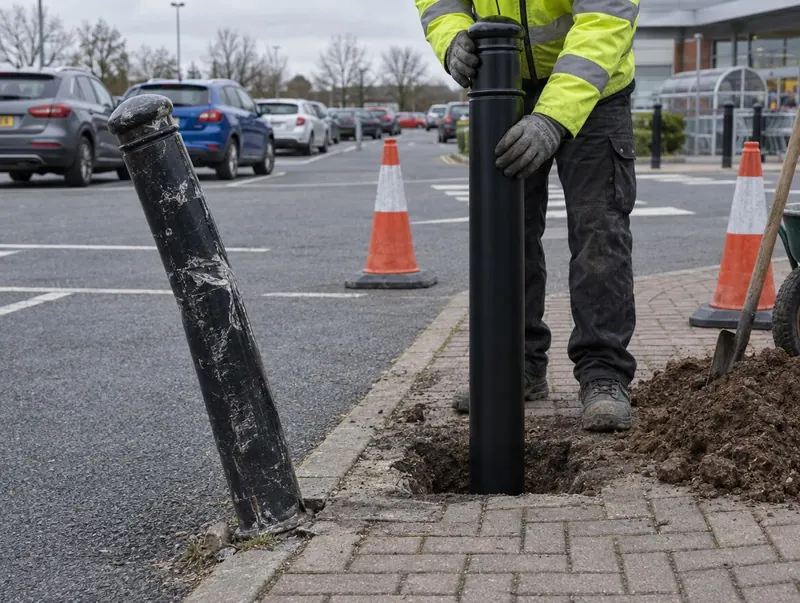 Computer-generated image
About replacement bollards in Derby
In the city of Derby, replacement bollards tend to go in at university campuses, multi-storey car parks and distribution parks. Replacement is the right answer when a post is too damaged to repair or no longer suits how the site is used.
Coverage in Derby takes in the DE1, DE22, DE23, DE21, DE24 and DE3 postcode districts and nearby places like Quarndon and Breadsall. Jobs in Derby can be combined with work in Belper (6.9 miles), Ilkeston (7.7 miles), Heanor (8.1 miles) and Ripley (8.3 miles) (straight-line distances). Nottingham is around 14 miles away.
Derby at a glance
- Area
- Derbyshire, England
- Highway authority
- Derby City Council (local roads)
- Planning authority
- Derby City Council
- Postcodes
- DE1, DE22, DE23, DE21, DE24, DE3 and DE73
- Guide price
- Typically £215–£1,195 per post + VAT (£255–£1,445 inc VAT for homes); minimum job £435
- Survey
- Free, with a fixed written quote
What replacement bollards cost in Derby
| Specification | Guide price | Includes |
|---|---|---|
| Standard | £215–£615 + VAT · £255–£735 inc VAT | Standard post, foundation, reinstatement |
| Upgraded | £495–£905 + VAT · £585–£1,095 inc VAT | Upgraded finish or fittings, reflective band, matched keys |
| Premium | £785–£1,195 + VAT · £935–£1,445 inc VAT | Heavy-duty or architectural spec, premium finish |
Per post replaced, old post and footing removed; -2% for East Midlands. Guide only — the fixed price follows a survey.
Common reasons for replacement bollards in Derby
What replacement bollards usually sort out in Derby:
- Upgrading posts that keep being hit
- Corroded steel posts at the end of their life
- Single missing posts in an otherwise sound line
Permissions and groundwork in Derby
In Derby, work on adopted pavements and verges needs consent from Derby City Council, the local highway authority. Car parks, forecourts and other private land only need the owner's permission.
If your site in Derby is listed or inside a conservation area, check with the local planning authority (Derby City Council) before choosing a finish — heritage settings often favour cast iron or painted steel over stainless.
If the old foundation is cracked from the impact, it is removed entirely; if it is sound and suits the new post, reuse can reduce disruption. Removing an old bollard often reveals more concrete than expected, because foundations from different eras vary widely in size.
- Where bollards were required by a planning condition, a security plan or a lease, check that any change of type still meets that requirement.
- Upgrades to rated products must use the manufacturer's tested foundation, specified with your security adviser.
From survey to handover
Order the replacement
Matching posts, sockets or castings are ordered, and you see details of any close equivalent before it is confirmed.
Remove the old bollard
The damaged post is cut or extracted and the old foundation broken out, checking for services as the hole is opened.
Install the new post
The new bollard is set in a fresh foundation, aligned with its neighbours and the surface is reinstated to match.
Finishes and options
| Option | Detail |
|---|---|
| Heavier section | Larger diameter, thicker wall or concrete-filled steel where posts keep getting bent. |
| Making safe | Removing or capping a dangerous broken stub before the replacement is fitted. |
| Crash-rated upgrade | Replacing unrated posts with tested products, installed to the manufacturer's foundation design and specified with your security adviser. |
What moves the price in Derby
Two Derby jobs with the same number of posts can price quite differently. The usual reasons:
- Number of posts and the product chosen
- Surface type and reinstatement
- Size and condition of the old foundation
Keeping them working
Keep a record of the new product, finish and supplier so future replacements match. After replacement, look at why the post failed.
For damaged or loose posts in Derby, repairs and replacements are priced in writing first.
Bollard replacement in Derby: FAQs
Can you carry out replacement bollards anywhere in Derby?
We cover all of Derby (DE1, DE22, DE23, DE21, DE24 and DE3) and the rest of Derbyshire. We also work in Belper, Ilkeston and Heanor.
Who gives permission for bollards on the pavement in Derby?
The highway authority for local roads in Derby is Derby City Council; motorways and trunk roads sit with National Highways. Bollards on the adopted footway are a matter for the highway authority, so we only install there with its written agreement.
What's a typical price for replacement bollards in Derby?
In Derby, typically £215–£1,195 per post replaced, old post and footing removed, plus VAT (£255–£1,445 including VAT for homeowners), with a minimum job of £435 plus VAT, using our East Midlands guide prices. The fixed figure comes in writing after we've seen the site.
Can a new bollard reuse the old foundation?
Sometimes, if the old foundation is sound and suits the new post. Foundations cracked by an impact are broken out. Rated bollards always need the manufacturer's tested foundation.
Can you provide paperwork for an insurance claim?
Yes. The written quote, photographs and itemised invoice are usually what an insurer asks for when recovering the cost from the driver responsible. We can provide them in the format your insurer needs.
Bollard replacement in nearby towns
- Belper (6.9 mi)
- Ilkeston (7.7 mi)
- Heanor (8.1 mi)
- Ripley (8.3 mi)
- Long Eaton (8.7 mi)
- Burton upon Trent (10.6 mi)