Lisburn and Castlereagh · Northern Ireland
Bollard replacement in Lisburn
Replacement bollards for sites across Lisburn and the rest of Lisburn and Castlereagh, from the first measurement to the last relaid paving block.
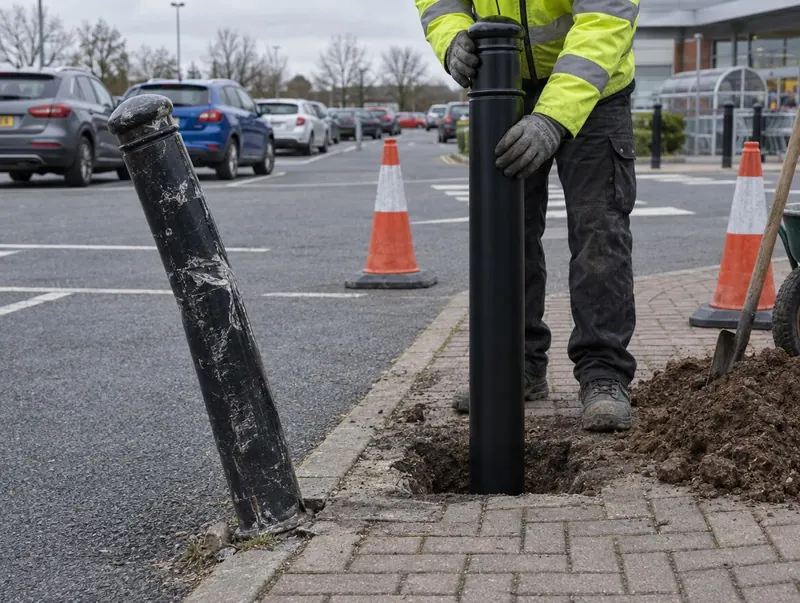 Computer-generated image
Bollard replacement in Lisburn
In the city of Lisburn, replacement bollards tend to go in at housing association car parks, industrial estates and retail parks. Like-for-like or upgraded replacement of bollards damaged by vehicles, corrosion or wear, matched to the existing line.
We cover every part of Lisburn in the BT27, BT28, BT26 and BT8 postcode districts. Nearby, we also work in Belfast (6.7 miles), Dundonald (10.6 miles), Newtownabbey (10.7 miles) and Holywood (11.6 miles), measured as the crow flies. Lisburn is about 7 miles from Belfast.
Key facts for this area
- Area
- Lisburn and Castlereagh, Northern Ireland
- Roads authority
- the Department for Infrastructure (DfI Roads)
- Planning authority
- Lisburn and Castlereagh City Council
- Postcodes
- BT27, BT28, BT26 and BT8
- Guide price
- Typically £215–£1,195 per post + VAT (£255–£1,445 inc VAT for homes); minimum job £435
- Survey
- Free, with a fixed written quote
- Nearby
- Belfast (6.7 mi), Dundonald (10.6 mi), Newtownabbey (10.7 mi), Holywood (11.6 mi)
What replacement bollards cost in Lisburn
| Specification | Guide price | Includes |
|---|---|---|
| Standard | £215–£615 + VAT · £255–£735 inc VAT | Standard post, foundation, reinstatement |
| Upgraded | £495–£905 + VAT · £585–£1,095 inc VAT | Upgraded finish or fittings, reflective band, matched keys |
| Premium | £785–£1,195 + VAT · £935–£1,445 inc VAT | Heavy-duty or architectural spec, premium finish |
Per post replaced, old post and footing removed; -2% for Northern Ireland. Guide only — the fixed price follows a survey.
Typical replacement bollards requests in Lisburn
Why sites in Lisburn book replacement bollards:
- Crushed sockets and failed telescopic cassettes
- Corroded steel posts at the end of their life
- Replacing mixed, mismatched posts with a consistent line
Consents, ground and services in Lisburn
In Lisburn, as everywhere in Northern Ireland, public roads and footways are looked after by DfI Roads rather than the council. If a post would sit on adopted footway, that consent comes first; private forecourts and car parks are a matter for the owner.
Many private-land installations in Lisburn need no planning application, but the rules don't clearly cover bollards, so listed buildings, conservation areas and prominent frontages are worth raising with the planning team at Lisburn and Castlereagh City Council before posts go in.
Where a replacement is being made after an impact, the surrounding paving and kerbs are checked as well, because a vehicle that bent a post has often lifted or cracked the surface beside it, and that damage is included in the quote rather than left for later. Removing an old bollard often reveals more concrete than expected, because foundations from different eras vary widely in size.
- On public highway, DfI Roads may need to approve the replacement or carry out the work itself.
- Keep gaps and visibility bands in line with Inclusive Mobility guidance when replacing posts on pedestrian routes.
How the job runs
Make safe
If a broken post or stub is a hazard, it can be removed or capped first. That is priced separately in writing so you can approve it on its own.
Order the replacement
Matching posts, sockets or castings are ordered, and you see details of any close equivalent before it is confirmed.
Install the new post
The new bollard is set in a fresh foundation, aligned with its neighbours and the surface is reinstated to match.
Specification choices
| Option | Detail |
|---|---|
| Like-for-like | Same diameter, height, finish and fixing, so the line looks unchanged. |
| Matched finishes | RAL powder coat, stainless grade and finish, or heritage paint schemes matched to the existing line. |
| Change of type | Swapping fixed posts for removable, telescopic, flexible or polymer bollards to suit how the site is used. |
What moves the price in Lisburn
Our Northern Ireland guide prices are a starting point; the survey in Lisburn firms them up. What tends to move them:
- Upgrades that need larger foundations
- Size and condition of the old foundation
- Matching special finishes, castings or discontinued products
Looking after them
Treat new posts as part of your routine inspections: check for lean, chips and faded bands. Keep a record of the new product, finish and supplier so future replacements match.
If posts in Lisburn are later hit or damaged, we can repair or replace them — see bollard repairs.
Common questions
Can you carry out replacement bollards anywhere in Lisburn?
We cover all of Lisburn (BT27, BT28, BT26 and BT8) and the rest of Lisburn and Castlereagh. We also work in Belfast, Dundonald and Newtownabbey.
Do I need consent for bollards on a public footway in Lisburn?
In Lisburn, as everywhere in Northern Ireland, public roads and footways are looked after by DfI Roads rather than the council. If a post would sit on adopted footway, that consent comes first; private forecourts and car parks are a matter for the owner.
How much do replacement bollards cost in Lisburn?
In Lisburn, typically £215–£1,195 per post replaced, old post and footing removed, plus VAT (£255–£1,445 including VAT for homeowners), with a minimum job of £435 plus VAT, using our Northern Ireland guide prices. The fixed figure comes in writing after we've seen the site.
Can you provide paperwork for an insurance claim?
Yes. The written quote, photographs and itemised invoice are usually what an insurer asks for when recovering the cost from the driver responsible. We can provide them in the format your insurer needs.
What happens to the old bollard?
It is taken away with the broken-out concrete. Steel and iron are recycled where possible. Original heritage bollards can be returned to you if you want to keep them.
Bollard replacement near Lisburn
- Belfast (6.7 mi)
- Dundonald (10.6 mi)
- Newtownabbey (10.7 mi)
- Holywood (11.6 mi)
- Newtownards (14.6 mi)
- Antrim (15.1 mi)